

Key takeaways
- Compare the best motorcycle helmet lights for night riding, from wireless brake-sensing rear lights to a bright off-road beam, with fit and battery tips.
A motorcycle’s own brake light sits low, often below a following driver’s natural line of sight, and it only tells part of the story when you slow down by downshifting or rolling off the throttle. A helmet light puts the signal at eye level, exactly where drivers are already looking, and the smarter models react to deceleration itself rather than waiting for the brake lever. This guide covers the main types: wireless brake-sensing lights that flare when you slow down, simple rechargeable rear markers that keep you visible all ride long, and one forward-facing beam built for night trail work. Every pick below mounts without drilling or permanent modification, and each one suits a different kind of rider.
As an Amazon Associate, we earn from qualifying purchases.
Quick answer
For most riders, the Brake Free is the helmet light to buy: its sensors flare 100 LEDs whenever you brake, downshift, or engine-brake, with no wiring at all. The Autolizer H2 adds flowing light patterns and the longest runtime here, the VERSATTA is the featherweight pick for simple rear visibility, and the Oxbow Voyager is a forward beam for night trail riding.
Brake Free Helmet Brake Light

The Brake Free is the reference point for this category: a self-contained rear helmet light that works out braking on its own. Internal sensors detect deceleration from the brake lever, from downshifting, and from engine braking, then drive all 100 LEDs to full brightness for the length of the event. There is no transmitter to wire into the bike, no app to pair, and no Bluetooth connection to manage, which makes it easy to move between motorcycles.
A single button on top cycles three modes: Standard, Pulsing, and Stealth, the last keeping only the center LEDs lit as a running light until a braking event fires the full array. The maker rates runtime at 8 to 12 hours per charge, with Stealth stretching further, and the USB-C port refills the battery in about an hour and a half. The housing is weather sealed to an IP65 rating, and the light clips into a 3M adhesive mount, with Universal and XL mounts included in the box so it fits a wide range of shell shapes. Riders who want brake signaling that also covers engine braking, on any bike they own, should start here.
Autolizer H2 Motorcycle Helmet Light

The Autolizer H2 (model AT-H2) takes a similar sensor-based approach and adds showmanship. Its G-sensor brake mode brightens the light when it detects the motorcycle coming to a stop, so following traffic gets a clear signal even when you are easing to a halt in traffic rather than braking hard. Around that core function, the H2 offers ten flowing light types, animated patterns that sweep across the housing and make the helmet hard to ignore at night.
Autolizer rates the rechargeable battery at up to 18 hours of runtime, the longest figure in this roundup, and a USB-C charging cable is included. The lens and housing are polycarbonate, and the unit is a 2024 design that mounts to the back of the helmet without any connection to the motorcycle. Because the patterns are the point, this is the pick for riders who want maximum visual presence on urban night rides and group rides, and who are happy to trade a little subtlety for attention. If your riding is mostly daylight highway work, the simpler lights below will cover your needs for less fuss.
VERSATTA LED Motorcycle Helmet Light

The VERSATTA (model SUVELAM) is the minimalist option: a small red rear light that does one job, keeping you visible from behind, and does it with almost no weight on the shell. A single button cycles the modes in order, from constant light to blinking to an alternating left-and-right flash, so it is easy to change settings with gloves on before you set off.
The ABS housing carries an IPX6 waterproof rating, which shrugs off rain from any direction, and the light attaches with adhesive hook-and-loop fasteners, two sets of which are included, so you can move it between helmets or reposition it until the angle looks right. The built-in lithium polymer battery recharges over USB in roughly two hours. There is no brake sensing and no app, and that is precisely the appeal: riders who want a set-and-forget visibility aid for commuting and evening rides, without paying for smart features they will not use, are well served here. It is also a sensible second light to pair with a brake-sensing model on a second helmet.
Trailstrike TS-101-A Helmet Light

The Trailstrike TS-101-A is the straightforward pick for riders who like their specifications published and their controls simple. It is a red rear helmet light with one-button operation and three modes, and the maker states the runtime for each: about four hours in constant mode, eight hours in blinking mode, and nine hours in warning mode, from a rechargeable lithium battery that refills in roughly two hours over USB.
Mounting is by hook-and-loop fasteners: two Velcro pads and a USB cable are in the box, and the light is light enough that it does not noticeably change the fit or feel of the helmet. The listing describes the unit as waterproof and fine to expose to rain, and Trailstrike positions it for motorcycle, bicycle, scooter, and snowmobile helmets, which suits riders who split their year between road and snow. There is no brake sensor and no app, so what you get is predictable rear visibility that you set before the ride and then forget. Choose it if you want a simple light with honest per-mode battery figures you can plan a week of commuting around.
Oxbow Voyager Helmet Light Kit
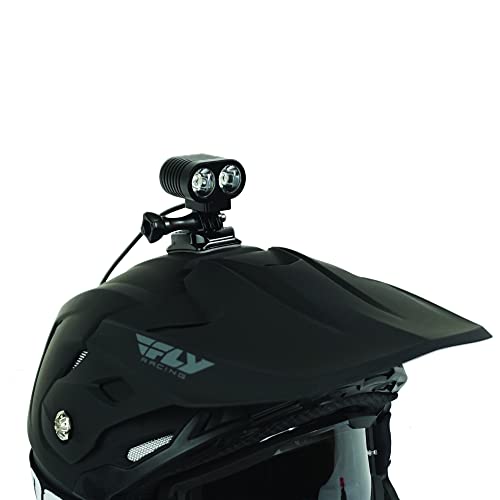
The Oxbow Voyager (model HL1005) solves the opposite problem: instead of being seen, it helps you see. This is a forward-facing trail beam for dirt and dual-sport riders who ride singletrack, fire roads, or unlit rural routes after dark. Its CREE LED produces 2100 lumens in a 6500K beam, with low, medium, and high settings, and it runs for over three hours on high and more than twelve hours on low.
The light head itself weighs just 2.1 ounces and uses GoPro-compatible mounts, while the separate rechargeable battery, at 9.7 ounces, rides in a pocket or pack and connects by cable. The kit is unusually complete: curved and flat adhesive helmet mounts, a vented helmet strap, a handlebar mount, a charger, and a storage case are all in the box, and a four-LED gauge on the battery shows remaining charge. Be clear about the role, though: the Voyager is an illumination light for off-road pace, not a brake light, and on public roads it supplements rather than replaces your motorcycle’s own headlight.
How to choose
Start with the job. If you want drivers behind you to react sooner, choose a brake-sensing rear light such as the Brake Free or the Autolizer H2; if you simply want to be more conspicuous, a steady or flashing marker like the VERSATTA is enough; and if your problem is seeing the trail, you need a forward beam like the Oxbow Voyager. Some riders combine a rear marker with a forward beam on the same helmet.
Mounting matters more than brightness for most people. Adhesive mounts and hook-and-loop fasteners are the norm, and they are the right approach: never drill a helmet shell, and follow the helmet maker’s guidance on adhesives and accessories. Check that the mount suits your shell shape, since sharply curved or heavily vented helmets give flat mounts less purchase. Then look at runtime against your longest typical ride, charging connector convenience, and weather sealing if you ride in rain. Finally, remember that a helmet light supplements your motorcycle’s lights rather than replacing them, and local rules on auxiliary and flashing lights vary, so check what applies where you ride.
Who should skip
Skip helmet lights entirely if you almost never ride after dark or in poor visibility; the added weight, charging routine, and cost buy you little on daytime rides. Riders whose helmets cannot take an adhesive mount, including some matte or textured finishes where pads will not bond, should also pass, as should racers and track-day riders whose organizers restrict helmet attachments. If you want turn-signal synchronization with the motorcycle, none of the sensor-based picks here do that; look instead at systems with a bike-mounted control unit, and accept the wiring that comes with them. And if your real problem is a dim headlight on the road, fix that first with a proper headlight upgrade rather than a helmet beam.
FAQ
Are motorcycle helmet lights legal?
In most places a helmet light is treated as an auxiliary visibility aid, and the key point is that it supplements rather than replaces the motorcycle’s required lights. Rules on flashing red lights and added equipment vary by state and country, so check your local regulations, and keep the bike’s own brake light and indicators fully functional regardless of what is on your helmet.
Do helmet brake lights need to be wired to the motorcycle?
The sensor-based models in this guide do not. They detect deceleration with internal motion sensors, so installation is just the adhesive mount and the light clips on and off for charging. A different class of product syncs with the bike’s brake and turn signals through a control unit wired into the motorcycle, which gives true signal synchronization at the cost of a permanent installation.
Will an adhesive mount damage my helmet?
Adhesive pads and hook-and-loop fasteners are designed to bond to the shell’s clear coat without drilling or solvents, and they can usually be removed with gentle heat and patience. Avoid mounts that require screws or shell modification, follow the helmet manufacturer’s guidance on accessories, and place the mount on a smooth, clean section of shell for the strongest bond.
How long do helmet lights run on a charge?
Runtime varies widely by type. Simple rear markers and brake-sensing lights in this guide are rated from around 8 hours up to 18 hours depending on mode, with flashing and stealth settings stretching further. A high-output forward beam is thirstier, managing a few hours on high but much longer on low. Match the rating to your longest night ride and recharge as part of your post-ride routine.
Final verdict
For most riders, the Brake Free is the easiest recommendation: genuine brake detection that also catches downshifts and engine braking, eye-level placement, and zero wiring. The Autolizer H2 is the alternative for riders who want animated patterns and the longest runtime, while the VERSATTA covers basic rear visibility at minimal weight and the Trailstrike adds published per-mode runtimes for planners. Off-road riders who ride trails at night should look at the Oxbow Voyager as a seeing tool rather than a signal. Whichever type fits your riding, a helmet light is one of the simplest visibility upgrades you can make.
Product and ASIN Reference
| Product | ASIN |
|---|---|
| Brake Free Helmet Brake Light | B0F94KSVZS |
| Autolizer H2 Motorcycle Helmet Light | B0F2M4GGCX |
| VERSATTA LED Motorcycle Helmet Light | B092RJV1NG |
| Trailstrike TS-101-A Helmet Light | B091V54NN4 |
| Oxbow Voyager Helmet Light Kit | B07G4FQY6V |
More from Amazon
Programs that pair well with the guide above. Offers and eligibility are set by Amazon and may change.
Free shipping on eligible items, Prime Video and more. Eligible new members can start with a free trial.
Start a Prime free trialA Prime membership for ages 18-24 with a trial period. Eligibility is set by Amazon.
See Prime for Young AdultsAudiobooks and podcasts to listen to on the go. Eligible new members can start with a free trial.
Try Audible freeAd-free music streaming. Eligible new subscribers can start with a free trial.
Try Music Unlimited freeAs an Amazon Associate we earn from qualifying purchases.


Write Your Review
No reviews yet. Be the first to share your experience!