

Key takeaways
- Pro: bolt-on kit, with brackets that fit common bar diameters.
- Pro: Bluetooth built in, so there is no head unit to buy.
- Pro: entry price tier.
- Con: the 80 Hz low end means almost no bass.
- Con: IPX5 resists spray, but the amplifier should not sit in direct road spray.
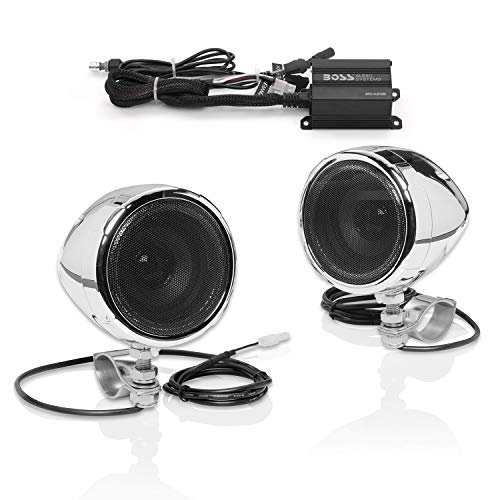
If your bike has no fairing and no speaker pockets, the easiest working audio setup is a handlebar kit with a built-in Bluetooth amplifier, and the Boss MCBK420B is the baseline most riders start from. The MCBK425BA adds a newer Bluetooth chip and RCA input, the MCBK470B adds a second pair of speakers, and a weather-sealed portable Bluetooth speaker on a bar mount is the cheapest no-wiring alternative. None of them will sound like a fairing system at highway speed, and this guide explains where the real limits are, using published specs and retailer data rather than personal use.
Our top picks


As an Amazon Associate we earn from qualifying purchases at no extra cost to you.
Quick answer by situation
| Your bike and use | Best choice | Why | Price tier |
|---|---|---|---|
| Naked or cruiser, mostly city and back roads | Boss MCBK420B | Simple two-speaker kit with Bluetooth amp | Entry |
| Wants newer Bluetooth and a wired input option | Boss MCBK425BA | Built-in amp, Bluetooth 5.0, RCA inputs | Entry to mid |
| Wants front and rear coverage | Boss MCBK470B | Four speakers, remote volume | Entry to mid |
| Does not want any wiring | IP67 portable Bluetooth speaker with bar mount | No battery connection, removable | Entry |
| Wants louder, cleaner sound | Powersports amp plus 6.5 in speakers in pods | Real RMS power instead of peak claims | Mid to premium |
| Rides highways above 70 mph | Helmet communicator (Cardo or Sena) | Speakers sit next to your ears | Mid to premium |
Boss MCBK420B: best basic handlebar speaker kit
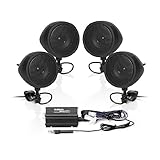
Spec line: two 3-inch full-range weatherproof speakers, compact Class D 2-channel amplifier with Bluetooth, 600 W max rating, 80 Hz to 15 kHz response, IPX5 rating, brackets for 0.75 to 1.25 in handlebars, 3.5 mm aux input, inline power and volume control, 7.5 A fuse in the power lead.
Best for: riders who want music at city and country-road speeds with a simple install.
Skip if: you ride long highway stretches or want bass.
- Pro: bolt-on kit, with brackets that fit common bar diameters.
- Pro: Bluetooth built in, so there is no head unit to buy.
- Pro: entry price tier.
- Con: the 80 Hz low end means almost no bass.
- Con: IPX5 resists spray, but the amplifier should not sit in direct road spray.
Boss MCBK425BA: best for a newer Bluetooth chip and wired option
Spec line: one pair of 3-inch speakers with a built-in Class D amplifier, Bluetooth 5.0 with about 33 ft (10 m) range per retailer listings, RCA inputs, IPX5-rated speakers.
Best for: riders who want a stable phone connection and the option to plug in a wired source.
Skip if: you want a four-speaker system or are on a tight budget.
- Pro: Bluetooth 5.0 improves connection stability and range over older chips.
- Pro: RCA inputs let you connect a small head unit or media player.
- Pro: same bar-mount approach as the other Boss kits.
- Con: priced above the MCBK420B at some retailers.
- Con: same 3-inch driver limits on bass and volume.
Boss MCBK470B: best four-speaker handlebar and fender setup
Spec line: four 3-inch matte black speakers, Class D amplifier with Bluetooth, 1,000 W max rating, 80 Hz to 15 kHz, signal-to-noise above 85 dB, THD below 0.01 percent, 150 mV to 1 V input sensitivity, wired volume remote, RCA inputs.
Best for: bikes where you want speakers at both handlebars and a second position such as the fender or tank area.
Skip if: your electrical system is already stretched by heated gear.
- Pro: four speakers spread the sound for a passenger.
- Pro: wired volume remote is easy to use with gloves.
- Pro: low distortion figure for an entry system.
- Con: more wire to route and hide.
- Con: the 1,000 W figure is a peak claim that the fuse cannot supply, as explained below.
Portable IP67 Bluetooth speaker with a bar mount: best no-wiring option
Spec class: compact rechargeable speaker with an IP67 rating (dust-tight and protected against immersion up to 1 m), 10 to 15 hours of playback, and a handlebar or strap mount.
Best for: riders who borrow a bike, rent, or do not want to touch the wiring.
Skip if: you hate vibration rattles or want automatic on and off with the ignition.
- Pro: zero wiring and removable for charging at home.
- Pro: IP67 rating handles rain and wash-downs.
- Pro: entry price tier and easy to move between bikes.
- Con: it needs its own charging, and a dead battery means no music.
- Con: mounting on a vibrating bar can loosen the clamp and damage the speaker over time.
Kicker PSC65 pair with a Kicker PXA400.4 amplifier: best for loud, clean sound from a pod build
Spec line: 6.5 in powersports coaxials rated 60 W RMS each (4-ohm version) with a 4-channel Class D amplifier rated 100 W RMS x 4 at 4 ohms, IP66 or IP67 per retailer listings.
Best for: custom bagger and cruiser builds with fairing pods or lids.
Skip if: you want a handlebar-only install.
- Pro: real RMS power, not peak claims.
- Pro: waterproof amplifier built for open vehicles.
- Pro: scalable to four speakers later.
- Con: requires fabrication, wiring and a proper fused power run.
- Con: mid to premium tier once parts and wiring are added up.
Cardo Packtalk Edge: best alternative for highway riders
Spec line: 40 mm JBL speakers in the helmet, IP67, about 13 hours of talk time, DMC mesh for up to 31 riders.
Best for: highway riders who find handlebar speakers drowned out above 60 mph.
Skip if: you want to share music with a passenger without an intercom.
- Pro: speakers sit next to your ears, so wind noise matters less.
- Pro: no wiring to the bike.
- Pro: doubles as an intercom for group rides.
- Con: premium tier.
- Con: only the rider hears the music unless a passenger has a second unit.
The wattage myth: what the fuse tells you
Handlebar kits advertise 600 W or 1,000 W. The 420B manual lists a 7.5 A fuse in the power lead, and the arithmetic shows why the claim is not realistic. At 12 V, a 7.5 A fuse limits input to about 90 W. With a Class D efficiency near 85 percent, the maximum output is around 75 W for the whole system, shared between two speakers, so each 3-inch driver gets perhaps 35 W at best. That is plenty for a pair of small drivers at city speeds, and it is not a reason to buy a kit because of a “1,000 W” label.
| Claim or part | Number | What it means in practice |
|---|---|---|
| Boss 420B max rating | 600 W | Peak marketing figure |
| Boss 470B max rating | 1,000 W | Peak marketing figure |
| Fuse in 420B power lead | 7.5 A | About 90 W input at 12 V |
| Realistic output ceiling | About 75 W | Divided across all speakers |
| Kicker PXA400.4 rating | 100 W RMS x 4 | True continuous power, needs 60 A fusing |
How to choose handlebar and Bluetooth speakers
1. Check the bar diameter
The Boss brackets fit 0.75 to 1.25 in. A 1 in Harley bar, a 7/8 in (22 mm) standard bar and a 1-1/8 in (28.6 mm) fat bar all fall inside that range, but add a thin rubber shim for the smaller bars so the clamp does not slip.
2. Decide where the speakers aim
Handlebar speakers point at your chest and face, and they drop in volume quickly at speed. Tilt them upward toward your ears, and keep them as close to the grips as the controls allow without blocking the levers.
3. Wire to a switched source
Connect the amplifier to an ignition-switched circuit so it shuts off with the bike. A permanent connection can drain a battery over several weeks, since even a small amplifier draws a few milliamps in standby.
4. Pick a position for the amplifier
Mount it under the seat, behind a side cover or inside a fairing pocket, where it is out of direct spray and away from the exhaust. Heat shortens the life of the amplifier, and a position within 20 cm of an exhaust header is a risk.
5. Plan for the noise floor
At 60 mph on a naked bike, ambient noise at the rider’s ears can run around 85 to 95 dB. A small speaker playing at 85 dB at one meter will not rise above that, so expect handlebar audio to be most useful below about 55 mph, and for highway use choose a helmet communicator instead.
Best handlebar speakers for Harley-Davidson
Harley riders with a Sportster, Softail or Dyna can use the same 3-inch kits, since a 1 in handlebar sits within the bracket range. Check that the speaker pods do not interfere with the clutch lever, the master cylinder or the mirror mount, and route the wire along the existing harness so full-lock turns do not stretch it. Touring models with a fairing and factory infotainment are usually better served by fairing speakers, which are covered in the Harley-specific guides.
Best portable speakers for a motorcycle
When using a portable unit, choose one that has an IP67 rating, a rubberized body and a strap-style mount, not a rigid clamp. Mount it on the handlebar crossbar, away from the grips, to reduce vibration. Keep the volume modest and put a thin foam pad behind the speaker to prevent rattles. Because the battery is internal, charge it before every ride, and carry the cable in a tank bag for stops on long trips.
Step-by-step: installing a handlebar kit cleanly
- Lay everything out on the bike before cutting a zip tie. Hold the speakers on the bar and the amplifier under the seat, and check that the wire reaches without tension at full steering lock.
- Disconnect the negative terminal. This protects the amplifier and the bike’s electronics while you connect the power lead.
- Run the power lead to a fused, switched source. Use an accessory fuse block or the bike’s switched accessory wire, and keep the supplied inline fuse close to the source.
- Find a clean ground. Sand the paint off a frame bolt location and use a ring terminal, because a poor ground is the main cause of whining and cutting out.
- Mount the speakers and set the angle. Tighten the clamp enough to stop movement but not enough to crush the bar finish, and aim the grilles at your ears.
- Pair the phone and set the volume. Pair at idle in the garage, set the phone to about 80 percent volume, and use the amplifier’s volume knob for the final level.
- Take a short test ride at 30 and 50 mph. Check for rattles, rubbing wires and any loss of connection, then adjust before a longer trip.
What to expect at different speeds
| Speed | Typical rider-ear noise (approx.) | Handlebar 3 in speakers | Helmet speakers |
|---|---|---|---|
| Idle to 25 mph | 65 to 75 dB | Clear and comfortable | Clear at low volume |
| 35 to 45 mph | 75 to 85 dB | Usable, vocals dominate | Clear |
| 55 to 65 mph | 85 to 95 dB | Struggles, bass disappears | Usable with some volume |
| 70 mph and above | 90 to 100 dB | Mostly masked | Usable with earplugs and a good seal |
The noise values are broad estimates, because helmet shape, windscreen, bike design and ear protection all change them. The pattern is consistent, though: small speakers a meter from your ears lose to wind noise around 55 to 60 mph.
Mistakes that make cheap kits sound worse
- Mounting on the wrong side of the bar. Speakers facing forward or down waste output, so aim them back at the rider.
- Sharing a ground with ignition or lights. That causes engine-speed whine in the audio, and a dedicated ground solves it.
- Cranking the phone to maximum. A phone at 100 percent can overdrive the amplifier input, which creates distortion even at low amp volume.
- Ignoring wire gauge. A thin lead drops voltage, which costs volume, so use at least the gauge the kit recommends.
- Leaving the amp where heat collects. A pocket next to the exhaust or under a black seat in summer shortens its life.
Ownership realities
- Vibration. Check bracket screws and the wire connectors every 1,000 miles, since vibration loosens them.
- Cable rubbing. Wrap the wire where it crosses the triple clamp.
- Water ingress. Seal the amplifier plugs with dielectric grease and keep the drain side down.
- Theft. Handlebar speakers are easy to remove, so detach portable units when you park.
Frequently Asked Questions
What are the best handlebar speakers for a motorcycle?
The Boss MCBK420B is the baseline choice, the MCBK425BA adds Bluetooth 5.0 and RCA input, and the MCBK470B adds a second pair of speakers. All three use 3-inch drivers, so expect a modest sound at city speeds.
Are handlebar speakers loud enough on the highway?
Usually not above about 55 to 60 mph, because wind noise exceeds what a small speaker can produce. For highway riding, a helmet communicator or a fairing-mounted system is a better solution.
Do Boss handlebar speakers drain the battery?
If wired to a switched circuit they draw current only when the ignition is on. At normal volume the draw is a few amps, which most bikes can supply, but an always-on connection can drain the battery over weeks.
Are handlebar speakers waterproof?
They are rated IPX5, which means protected against water jets, but not submersion. Rain is generally fine, while pressure washing at close range is not.
Can I use a portable Bluetooth speaker on my motorcycle?
Yes, if it has a strong IP rating and a secure mount. The risks are vibration damage and a dead internal battery, so treat it as a removable accessory.
Which is better for a Harley: handlebar or fairing speakers?
Fairing speakers sound better because they are larger and sit closer to your ears. Handlebar kits are better when the bike has no fairing or when you want a no-cut, removable setup.
More from Amazon
Programs that pair well with the guide above. Offers and eligibility are set by Amazon and may change.
Free shipping on eligible items, Prime Video and more. Eligible new members can start with a free trial.
Start a Prime free trialA Prime membership for ages 18-24 with a trial period. Eligibility is set by Amazon.
See Prime for Young AdultsAudiobooks and podcasts to listen to on the go. Eligible new members can start with a free trial.
Try Audible freeAd-free music streaming. Eligible new subscribers can start with a free trial.
Try Music Unlimited freeAs an Amazon Associate we earn from qualifying purchases.


Write Your Review
No reviews yet. Be the first to share your experience!