

The best motorcycle gloves for most riders in 2026 are the Alpinestars SP-8 v3 Air for warm-weather street and sport riding, the Klim Badlands Pro for all-weather adventure and touring, and the Alpinestars SMX-1 Air V2 for riders who want certified protection on a tight budget. Gloves are the one piece of gear you will use in nearly every slide, because instinct sends your hands to the ground first. Choose them by season and riding style, then check the protection label and fit before anything else.
Our top picks


As an Amazon Associate we earn from qualifying purchases at no extra cost to you.
Quick Comparison of the Best Motorcycle Gloves
| Pick | Best for | Main material | Key protection | Price tier |
|---|---|---|---|---|
| Alpinestars SP-8 v3 Air | Best overall for warm-weather sport and street | Perforated leather | CE Level 2 knuckle armor, TPU palm slider | Mid-range |
| Alpinestars SMX-1 Air V2 | Best budget | Leather and mesh | Knuckle protection, palm reinforcement | Budget |
| Dainese Mig 3 | Best for summer commuting | Leather with ventilated panels | CE Level 2 protection | Mid-range |
| REV’IT! Sand 4 | Best hot-weather touring | Leather and mesh | Knuckle and palm reinforcement | Mid-range |
| Klim Badlands Pro | Best for adventure and touring | Goatskin palm, textile back | Gore-Tex waterproofing, CE Level 2 knuckles | Premium |
| Held Satu Gore-Tex | Best for cold weather | Leather with Gore-Tex insert | Waterproof membrane, insulated | Premium |
| Dainese Carbon 4 Long | Best for track days | Leather with carbon fiber | Carbon knuckle protection, palm sliders | Premium |
Specifications come from manufacturer descriptions and independent roundups; materials and protection levels can change between model years, so verify on the product label.
Best Overall: Alpinestars SP-8 v3 Air
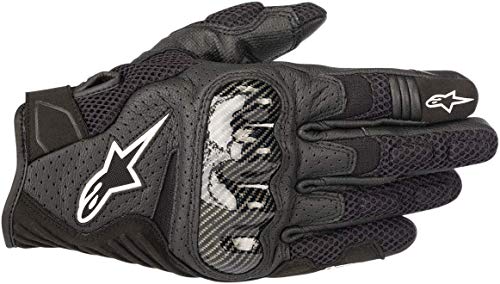
The SP-8 v3 Air uses perforated leather to move air across the hand while carrying CE Level 2 knuckle armor and a TPU palm slider that lets the hand skid rather than grab. It suits sport, naked and commuter riders who spend the majority of their time in warm and mild conditions. The wrist closure is secure and the pre-curved finger shapes reduce fatigue.
The trade-off is that perforated leather is not waterproof or warm. If you ride year-round, you will need a second pair for rain and cold.
Best Budget: Alpinestars SMX-1 Air V2
The SMX-1 Air V2 combines leather and mesh with knuckle protection and a palm reinforcement. Reviewers regularly rank it as a safe, affordable entry. It suits students, new riders and anyone who needs a spare pair for the pillion.
The trade-off is thinner leather and simpler armor than the SP-8, so it offers less abrasion resistance than the premium picks and wears faster with heavy use.
Best for Summer Commuting: Dainese Mig 3
The Mig 3 is an urban-oriented glove with ventilation panels and CE Level 2 protection. It balances airflow with coverage and works well with a fitted jacket cuff. The short cuff makes it comfortable at stoplights and easy to take on and off.
The trade-off is the short cuff itself: on a fall, a longer gauntlet and a second wrist strap hold the glove on better.
Best for Hot-Weather Touring: REV’IT! Sand 4
REV’IT! designed the Sand 4 for riders who face hot weather over long distances. It offers a mix of leather and mesh to keep hands cool and a design intended to avoid hot spots over many hours. Reviewers have called it a strong all-round hot-weather touring glove.
The trade-off is limited weather protection. A sudden rain shower will soak the mesh, so pack a pair of waterproof overgloves or a lightweight liner.
Best for Adventure and Touring: Klim Badlands Pro
The Badlands Pro uses a goatskin palm for abrasion resistance and feel, a Gore-Tex waterproof layer and CE Level 2 knuckle protection. It handles dirt roads, rain and long highway days, which is why it appears on so many adventure lists. The long gauntlet cuff goes over or under jacket sleeves.
The trade-off is cost and warmth. It can feel hot in summer, and you will pay premium prices.
Best for Cold Weather: Held Satu Gore-Tex
The Satu uses a Gore-Tex membrane and insulation to keep hands warm and dry in cold conditions. A good winter glove prevents numb fingers, which is a safety issue because poor dexterity makes braking and clutch control harder.
The trade-off is bulk. Heavily insulated gloves reduce feel at the levers, so check that you can still operate the controls with confidence.
Best for Track Days: Dainese Carbon 4 Long
The Carbon 4 Long is a race-oriented glove with a carbon-fiber knuckle protector, a long gauntlet and reinforced palm sliders. Track organizers often require long gauntlet gloves with certified protection, so this style covers that requirement.
The trade-off is that a stiff race glove is overkill for commuting and can feel cumbersome in traffic.
How to Choose Motorcycle Gloves
1. Match the glove to the season
Ventilated gloves suit temperatures above about 20 degrees C (68 F). Between roughly 10 and 20 degrees C, a standard leather glove is comfortable. Below 10 degrees C (50 F), look for insulation or a waterproof liner, because wind chill at highway speed can make your hands feel colder by many degrees.
2. Look at the certification
In Europe, motorcycle gloves are tested to EN 13594, which has Level 1 and Level 2 ratings, with Level 2 requiring higher abrasion and impact performance. The “KP” marking indicates knuckle protection. In the United States, many brands still follow the CE framework as a quality benchmark.
3. Choose leather type by priorities
- Cowhide: durable and affordable, a bit stiff at first.
- Goatskin: lighter and more flexible with strong abrasion resistance for its thickness.
- Kangaroo: very strong and thin, usually found on premium racing gloves.
4. Get the fit right
Measure the circumference of your hand around the knuckles, excluding the thumb. A glove should feel snug, with no bunching in the palm and a fingertip gap of no more than about 3 mm. Leather stretches slightly, so a glove that feels slightly tight at first will mold after a few rides.
5. Check the closure
A wrist strap and a second strap over the cuff keep the glove on in a slide. Gloves held on by one small velcro tab can peel off.
Worked Example: Cost Per Ride
If a mid-range glove costs 120 in your currency and you ride 150 days a year for three years before the leather wears out, that is 450 rides, or roughly 0.27 per ride. A budget glove at 50 that lasts two seasons of the same riding costs about 0.17 per ride but may offer less protection. Spending more makes sense for rider-critical features such as stronger palm material and secure closures.
Durability and Ownership Realities
- Seams and stitching wear first, especially near the finger joints and thumb.
- Do not machine-wash leather gloves. Wipe with a damp cloth and let them dry away from heat.
- Conditioning with a leather balm prevents cracking, but avoid heavy oiling on perforated sections.
- Replace after a crash, since hidden stitching damage and armor cracks are not always visible.
- Waterproof liners can lose effectiveness over time, so dry gloves thoroughly after rain.
Frequently Asked Questions
Are leather or textile motorcycle gloves better?
Leather generally resists abrasion better, which matters in a slide. Textile gloves are lighter, easier to waterproof and often cheaper. Many modern gloves combine both, with leather on the palm and textile on the back of the hand.
How tight should motorcycle gloves be?
Snug without cutting circulation. The fingertips should touch the end with a tiny gap, and the palm should lie flat without wrinkles. Leather stretches, so a slightly firm fit is normal at first.
Do I need armored gloves?
Yes, for any road riding. Knuckle armor and palm sliders are the features that reduce injury in a fall. Look for CE-rated protection rather than decorative plastic.
Can I use mesh gloves in the rain?
Mesh gloves will soak through quickly and feel cold when wet. Carry waterproof overgloves or switch to a membrane glove if rain is likely.
How often should I replace motorcycle gloves?
Replace them when the leather is thin, the stitching is loosening or the armor is cracked, which is typically after two to four seasons of frequent use. Replace immediately after any crash.




Write Your Review
No reviews yet. Be the first to share your experience!