

Key takeaways
- Wind noise is the real enemy. At 100 km/h a typical full-face helmet exposes the rider to roughly 95-100 dB around the ears, so volume headroom matters more than fidelity. Look for automatic volume control that raises output with speed.
- Placement beats driver size. A 40 mm speaker an inch from your ear sounds worse than a 32 mm speaker pressed against it. Check that the helmet’s ear pocket is deep enough.
- Earplugs help. Many riders pair helmet speakers with filtered earplugs that cut wind noise by 15-25 dB while preserving speech and music clarity, which lets them listen at a lower and safer volume.
- Voice clarity matters as much as music. Look for noise-cancelling microphones, which both Sena and Cardo emphasize on their premium units, because a rider you cannot understand makes the intercom pointless.
The best Bluetooth helmet speakers for most riders in 2026 are the Cardo Packtalk Edge for premium mesh groups and the Cardo Packtalk Neo for the same mesh core at a lower tier, while the Fodsports M1-S Plus is the sensible budget entry. Riders who want Bose-tuned sound and cellular-backed range should look at the Sena 60S Evo. Solo commuters who only need music, maps and calls can skip mesh entirely and buy a simple two-rider unit such as the Cardo Spirit HD.
Helmet speakers are not the same as the earbuds you wear on the street. They are thin drivers, usually 40 mm across, that sit in the ear pockets of a helmet and connect through a small communicator mounted on the shell. The communicator carries the Bluetooth radio, the microphone, the battery and, on higher models, the intercom. That means a purchase decision is really about three things: how the speakers sound at highway speed, how long the battery lasts, and how many riders you need to talk to. This guide ranks seven current options on those criteria, then explains fitting, power and maintenance so the system keeps working once it is attached to your helmet.
Our top picks


As an Amazon Associate we earn from qualifying purchases at no extra cost to you.
Quick comparison of the seven picks
Figures below come from the manufacturers’ published specification sheets and retailer listings. Battery and range numbers are claimed maximums, and several sources disagree on exact values, so treat them as a guide to ranking rather than a promise.
| Pick | Best for | Speakers | Intercom | Claimed battery | Water rating | Market tier |
|---|---|---|---|---|---|---|
| Cardo Packtalk Edge | Best overall | 40 mm JBL | Mesh, up to 15 riders | About 13 h Bluetooth, about 8 h mesh | IP67 | Premium |
| Sena 60S Evo | Best sound and range options | 40 mm, Sound by Bose tuning | Mesh 3.0, up to 24 riders, plus cellular Wave | Roughly 16-19 h mesh, up to 27 h Bluetooth | IPX7 | Premium |
| Sena 60S | Best for large groups | 40 mm Harman Kardon | Mesh, up to 24 riders, plus Wave | About 17 h mesh, 24 h Bluetooth | IPX7 | Premium |
| Cardo Packtalk Neo | Best value mesh | 40 mm JBL | Mesh, up to 15 riders | Up to 13 h talk | IP67 | Upper mid |
| Sena 50S | Best for dual-chip pairing | 40 mm Harman Kardon | Mesh, 24-rider group | Up to 13 h mesh (Mesh 3.0 version) | Not clearly published | Upper mid |
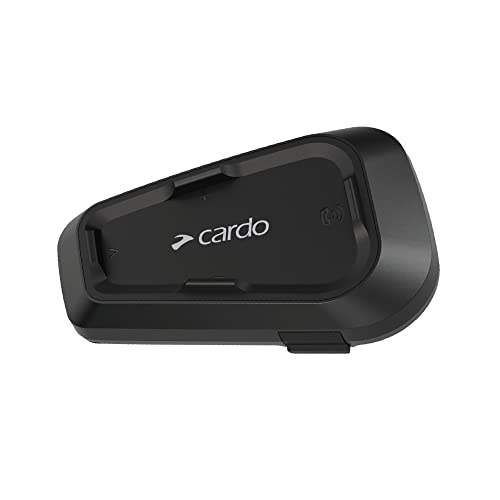
| Cardo Spirit HD | Best for solo and pair riders | 40 mm HD | 2 riders, about 600 m | About 13 h | IP65 | Budget to mid |
| Fodsports M1-S Plus | Best low-cost group intercom | Customized speakers | Bluetooth intercom, 8-10 riders | About 20 h talk | IP65 (newer version) | Budget |
Best overall: Cardo Packtalk Edge
The Packtalk Edge is the system most 2026 roundups put first, and the reasons are specific. It pairs 40 mm JBL-branded speakers with Cardo’s Dynamic Mesh Communication, which supports groups of up to 15 riders and reconnects automatically when someone drops out of range and returns. The unit is rated IP67, so a downpour or a pressure wash will not damage it, and the magnetic Air Mount lets you pull the communicator off the helmet with one hand when you park.
Who it suits: riders who regularly travel in groups of four or more, touring couples who want a dependable pairing, and anyone who rides in a wet climate. Cardo states a rider-to-rider range of about 1.6 km (one mile) in open terrain and a group range of up to 8 km across a chain of riders, though real-world distance in traffic or hills is closer to 900-1,200 m.
Main trade-off: mesh drains the battery faster than plain Bluetooth, and independent comparisons put realistic mesh runtime nearer 9-11 hours than the headline figure. It also sits in the premium tier, so riders who never talk to another person are paying for hardware they will not use.
Best for sound and range options: Sena 60S Evo
The 60S Evo is Sena’s newer flagship for 2026 and brings Sound by Bose tuning to 40 mm speakers. According to Sena’s published feature list it adds Mesh 3.0 with group support of up to 24 participants, an AI-based noise-cancelling microphone, an integrated flashlight and over-the-air updates. Its headline extra is Wave Intercom, which uses a cellular connection to talk to riders beyond mesh range wherever there is signal.
Who it suits: riders who treat music and podcasts as seriously as the intercom, and groups that spread out over long distances. The main unit is small, listed at about 94 x 52 x 27 mm and 68 g, which keeps it from dominating the side of a helmet.
Main trade-off: retailers disagree on battery numbers, with mesh talk time quoted anywhere from 16 to 19 hours, so confirm against Sena’s own specification tab. Wave only helps in areas with mobile coverage, which a remote forest road may not have.
Best for large groups: Sena 60S
The earlier 60S remains a strong option when the Evo is out of reach. It carries Harman Kardon 40 mm speakers, group mesh of up to 24 riders and a published IPX7 waterproof rating. Claimed battery life is about 17 hours on mesh and 24 hours on Bluetooth, among the longest of any unit in this list. One independent reviewer expects 10-12 hours of real use with mesh active, which still covers a full day’s riding.
Who it suits: club riders, rally organisers and anyone leading a convoy where the number of connected riders matters more than the branding on the speakers.
Main trade-off: it is a more complex unit than basic communicators, and its menu has more features than most casual riders will ever touch.
Best value mesh: Cardo Packtalk Neo
The Neo takes the core of the Edge and trims the extras. It keeps second-generation Dynamic Mesh Communication, groups of up to 15 riders, 40 mm JBL speakers, Bluetooth 5.2 with two channels for phone and GPS, FM radio, voice control and the IP67 rating. Cardo claims up to 13 hours of talk time, a two-hour full charge and a 20-minute top-up that delivers roughly two hours of use. Cardo introduced the Neo as the successor to its earlier Bold model.
Who it suits: riders who want mesh reliability without paying for the Edge’s magnetic mount and premium finish.
Main trade-off: the mount is a simpler clip-style design, and the speaker tuning is a step behind the Edge in comparisons. Cardo’s “Tune by JBL” wording refers to audio processing, so do not assume the hardware is identical to a standalone JBL speaker.
Best for dual-chip pairing: Sena 50S
The 50S is the mesh unit many riders still recommend because its dual-chip architecture lets the intercom and the phone connection run at the same time without dropping either. Sena’s specification sheet lists 40 mm Harman Kardon speakers, group mesh for 24 riders and an open-terrain intercom range of about 2 km. The current product page lists Mesh 3.0 with up to 13 hours of mesh talk time and 16 hours of Bluetooth talk time, whereas the original Mesh 2.0 version was rated for roughly 9 hours on mesh and 14 hours on Bluetooth.
Who it suits: riders who want a proven mesh system at a lower tier than the 60S line. Some retailers describe the 50S as being replaced by the 60S Evo, so check stock and software support before ordering.
Main trade-off: published water protection is less clear than on the IP67 and IPX7 units, so protect it in heavy weather and keep the charging cover closed.
Best for solo and pair riders: Cardo Spirit HD
If you ride alone or with one partner, the Spirit HD makes more sense than any mesh system. It supports two-rider Bluetooth intercom up to about 600 m according to Cardo’s product page, with 40 mm HD speakers, three sound profiles, FM radio, Bluetooth 5.2, USB-C fast charging and about 13 hours of talk time. Cardo lists an IP65 rating, enough for rain but not for immersion.
Who it suits: commuters who want turn-by-turn directions and music, and couples who ride together without a larger group.
Main trade-off: there is no mesh, so a third rider cannot join the conversation. The base Spirit, with 32 mm speakers and roughly 10 hours of battery, costs less but is noticeably weaker on sound.
Best low-cost group intercom: Fodsports M1-S Plus
The Fodsports M1-S Plus is the budget pick for riders who want to talk to a small group without a premium outlay. Older listings describe an 8-rider group with a 900 mAh battery. Newer versions on the maker’s site support 10 riders, a 1,000 mAh battery, Bluetooth 5.0 and an IP65 rating. All versions advertise about 20 hours of talk time, 300 hours of standby, USB-C charging, FM radio and music sharing between two units.
Who it suits: new riders trying a communicator for the first time, and groups of friends who each want their own set.
Main trade-off: Fodsports quotes up to 2,000 m in open terrain but a maximum of 500 m between adjacent riders, so the headline range is optimistic. Sound is clear for speech and acceptable for music, but it will not match the JBL or Bose-tuned units at highway speed.
How to choose: a decision matrix
| Your situation | Choose | Reason |
|---|---|---|
| Ride alone, want music and navigation | Cardo Spirit HD | Two-rider capability is enough and 13 hours covers a long day |
| Ride with one regular partner | Cardo Spirit HD or Fodsports M1-S Plus | No need to pay for mesh |
| Weekend group of 4-8 riders | Cardo Packtalk Neo or Sena 50S | Mesh reconnects automatically as riders pass each other |
| Club rides of 10+ riders | Sena 60S or 60S Evo | Group mesh up to 24 participants |
| Heavy rain or off-road use | Cardo Packtalk Edge or Neo | IP67 rating |
| Strict budget | Fodsports M1-S Plus | Lowest tier with real group features |
Speaker quality: what to listen for
Almost every unit on this list uses a 40 mm driver, but sound differs because of tuning and how the speaker sits against your ear. A few practical points decide whether the audio is usable at speed.
- Wind noise is the real enemy. At 100 km/h a typical full-face helmet exposes the rider to roughly 95-100 dB around the ears, so volume headroom matters more than fidelity. Look for automatic volume control that raises output with speed.
- Placement beats driver size. A 40 mm speaker an inch from your ear sounds worse than a 32 mm speaker pressed against it. Check that the helmet’s ear pocket is deep enough.
- Earplugs help. Many riders pair helmet speakers with filtered earplugs that cut wind noise by 15-25 dB while preserving speech and music clarity, which lets them listen at a lower and safer volume.
- Voice clarity matters as much as music. Look for noise-cancelling microphones, which both Sena and Cardo emphasize on their premium units, because a rider you cannot understand makes the intercom pointless.
Fit and compatibility checks before you buy
- Measure the ear pocket. Most helmets have a recess roughly 40-45 mm across. If the pocket is shallow, thin speakers fit better than thicker sets.
- Check the mounting surface. Communicators attach with an adhesive plate or a clamp that slides between the shell and the liner. Adhesive needs a flat, clean area and about a day to cure.
- Confirm microphone type. Boom microphones suit open-face and half helmets, while wired microphones tuck into the chin curtain of a full-face helmet. Cardo and Sena both sell each type.
- Plan the cable route. Route speaker wires under the liner, not across the neck roll, so they do not pinch when you turn your head.
- Check warranty and updates. Both Sena and Cardo push firmware over the air, which improves mesh stability over the product’s life.
Installation step by step
- Remove the cheek pads and ear-pocket covers. This exposes the recess where the speaker will sit, and it lets you see where the wire can run without crossing the pad edge.
- Dry-fit the speakers. Hold each speaker against the ear pocket and put the helmet on. The driver should rest about level with the middle of your ear. Move it with hook-and-loop tabs until it does.
- Route the wires. Run the cable along the lower edge of the liner toward the back of the helmet, where the communicator will sit. Leave a small slack loop so the cable does not tension when the cheek pads flex.
- Mount the communicator. Clean the shell with an alcohol wipe, apply the adhesive plate or fit the clamp, and let adhesive cure before riding.
- Position the microphone. A boom mic should sit about a thumb’s width from the corner of your mouth. A wired mic sits behind the chin curtain.
- Pair and test. Connect your phone, play a track, and listen at a standstill, then at low speed before using it on the highway. Adjust the volume in small steps.
Worked example: runtime on a long ride day
Suppose you ride 9 hours in a day with a mix of music, navigation prompts and group chat. If a unit like the Edge delivers about 8-9 hours of mesh time, a 9-hour day uses close to 100 percent of the battery and leaves nothing for a delayed return. A Sena 60S rated at 17 hours of mesh would use roughly 53 percent of its claim for the same day, and even if real use is 30 percent lower than advertised the unit would still finish with a small reserve. Fast charging narrows the gap, since a 20-minute stop can restore about two hours on a Cardo, which is usually enough to close the difference if you plan a lunch break.
Cost per ride-hour: a quick way to compare value
A simple calculation helps when two units sit in different tiers. Divide the purchase price by the number of hours you expect to ride with it over its useful life. A rider who commutes one hour a day for 220 days a year and keeps a unit three years logs about 660 hours. A communicator that costs twice as much as a budget unit therefore adds a modest amount per hour, while a premium unit used for 20 hours a year over the same period spreads the cost over only 60 hours. The takeaway is that frequent riders get more from stepping up to better speakers and a longer warranty, while occasional riders are better served by a lower-priced set.
Durability and ownership realities
- Foam speaker covers wear first. Sweat and sun degrade the foam over a season or two, and replacement pads are inexpensive.
- Charging ports are the common failure point. Keep the rubber cover shut, and wipe the port dry after a wet ride.
- Adhesive mounts lose grip in heat. Clamp-style mounts are more forgiving if you leave your helmet in a hot car.
- Batteries age. Expect noticeably shorter runtime after two to three years of daily charging, a normal trait of lithium-ion cells.
- Helmet safety comes first. Never drill into or glue onto a shell without checking the helmet maker’s guidance, since modifications can compromise protection.
- Cold cuts runtime. Lithium cells lose capacity near freezing, so expect a drop of 10-20 percent on winter mornings and keep the unit warm before the ride.
Common mistakes to avoid
- Buying mesh when you only ride with one partner, which adds cost without any benefit.
- Setting the volume too high instead of fixing wind noise with better placement or earplugs.
- Placing the communicator where it blocks the helmet’s vent or visor mechanism.
- Skipping firmware updates, which often fix pairing bugs and improve range.
- Mixing brands in the same intercom group. Cardo and Sena mesh systems use different protocols, so riders in one group generally need the same brand, apart from limited Bluetooth intercom pairing.
Legal and safety notes
Rules about wearing audio devices while riding differ by region. Some jurisdictions restrict in-ear devices but allow helmet-mounted speakers, and others restrict any audio that blocks ambient sound. Check local law, keep the volume low enough that you can still hear sirens and horns, and use voice commands rather than touching the unit while moving.
Frequently Asked Questions
Do helmet speakers fit every helmet?
Most 40 mm speakers fit helmets with ear pockets or removable cheek pads. Helmets without pockets can still work if you place thin speakers under the liner, but fit varies. Check the maker’s compatibility list or try the speakers against your helmet before committing.
What is the difference between Bluetooth and mesh intercom?
Bluetooth intercom links riders in a chain or pair, and the connection drops if one rider falls out of range. Mesh creates a network where each rider’s unit relays the signal, so the group stays connected as people move around and rejoin automatically. Mesh is better for groups, and Bluetooth is fine for two riders.
How long do helmet communicators last on a charge?
Claimed talk times range from about 10 to 27 hours depending on the model and whether mesh is active. Real use is often 10-30 percent lower than the claim, especially in cold weather. Plan for a mid-day top-up on long tours.
Can I use helmet speakers with any phone?
Yes. All the units here pair over standard Bluetooth, so they work with iPhone and Android devices for calls, music and navigation. Some features, such as voice assistant triggers, depend on the phone’s operating system.
Are cheap helmet speakers worth it?
For casual use, yes. Budget units cover calls and basic music, and the Fodsports M1-S Plus adds a small-group intercom. They give up sound tuning, build quality and software support, so frequent long-distance riders usually benefit from stepping up.
Will speakers make my helmet louder?
Speakers themselves do not change wind noise, but bulky units or poorly routed cables can disturb airflow around the ears. Mounting the communicator flush and using earplugs generally keeps noise at the same level or lower.





Write Your Review
No reviews yet. Be the first to share your experience!