

Our Top Picks
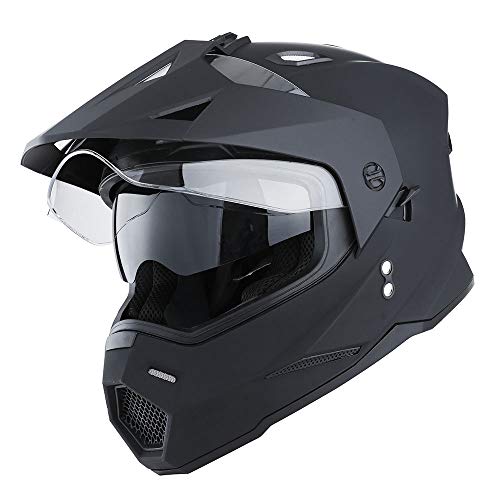 1Storm Dual Sport Motorcycle Motocross Off Road FullMedium16 x 10.3 x 11.8 inches4.6 poundsCheck on Amazon
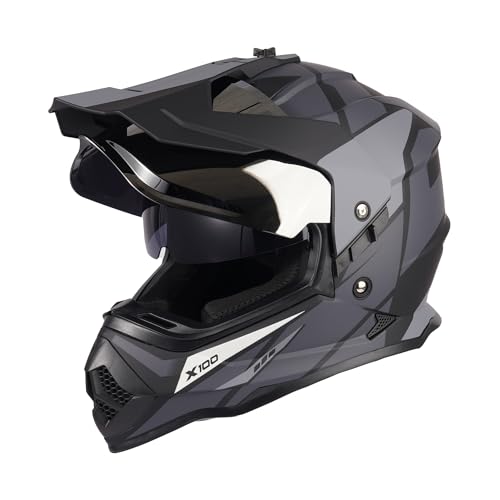

The ILM WS902 is the best all-round pick for most riders who split their time between pavement and dirt. A dual sport helmet blends a street-style full-face shell with an off-road peak and a large eyeport, so it works with a visor on the highway and with goggles on the trail. The WS902 pairs a wide-view outer visor with an internal drop-down sun shield and accepts a Pinlock-style anti-fog insert. The Orthrus models suit riders who want an intercom-ready liner, the O’Neal Sierra suits adventure riders who prefer a known name, and the 1Storm suits a tight budget with a moto look.
Quick List
- Orthrus Dual Sport Adventure (first listing) – best for riders who want intercom slots and an adjustable peak
- O’Neal Sierra – best for adventure riders who want a recognized off-road brand
- ILM WS902 (first listing) – best overall for mixed street and trail riding
- 1Storm Dual Sport HF802 – best for riders who want a motocross-style look with two visors
- Orthrus Dual Sport Adventure (second listing) – best for riders who want the same helmet in a different size or graphic
- ILM WS902 (second listing) – best for riders who need the WS902 in another size or color
Which One Is Right for You?
| If you… | Choose |
|---|---|
| ride pavement and trails equally and want a fog-resistant setup | ILM WS902 (either listing) |
| plan to add a Bluetooth intercom and want room for speakers | Orthrus Dual Sport Adventure (either listing) |
| want a brand known for off-road gear and an adventure shape | O’Neal Sierra |
| want a motocross-style shell with an inner smoked visor | 1Storm Dual Sport HF802 |
| need a different size or color than the first Orthrus listing | Second Orthrus listing |
| need a different size or color than the first ILM listing | Second ILM WS902 listing |
Start with fit, because a dual sport helmet that squeezes your temples will end a ride early no matter how many features it has. If you plan long highway stretches, favor the models with an internal sun visor and a Pinlock-compatible shield. If most of your riding is slow trail work, ventilation and weight matter more than anything else.
All 6 Picks in Detail
1. Orthrus Dual Sport Adventure Helmet (first listing) – Best for intercom-ready adventure riding
As an Amazon Associate we earn from qualifying purchases at no extra cost to you.

This Orthrus helmet targets riders who want a DOT-labeled dual sport shell with the extras that usually cost more, mainly a liner designed to accept helmet speakers. The listing describes a UV-protected outer shield, a hidden inner sun visor and an adjustable peak meant to stay stable at highway speed. It suits commuters who take a gravel shortcut, ATV and UTV riders, and snowmobilers who want something that blocks wind.
- Dual visor setup: outer UV-protected shield plus an inner drop-down sun visor
- Intercom slots built into the liner for Bluetooth speakers
- Adjustable top peak for sun and roost control
- Three-point ventilation (top, front and back vents) per the product description
- Removable, washable liner and a quick-release buckle
- DOT FMVSS-218 certification claimed by the seller
Pros
- Speaker pockets mean no cutting into the padding
- Inner sun visor reduces the need for sunglasses
Cons
- Reported to be on the heavier side (one listing gives about 2.2 kg), which can tire the neck on long days
- A Pinlock insert is not mentioned as included, so confirm before relying on it for cold weather
Who might skip it: riders who spend most of their time in cold, damp weather and want a fully documented anti-fog system, or anyone sensitive to neck fatigue from a heavier shell. Because the listing does not state a Pinlock-style insert, plan on an anti-fog coating or a separate insert from the maker if fogging matters to you.
Compared with the ILM WS902, this helmet is easier to add comms to, while the ILM is the better choice if anti-fog performance is the priority.
2. O’Neal Sierra – Best for adventure riders who want a known off-road brand

The listing name for this one is short, giving only the brand, model, the black and gray color scheme and a medium size, so most details below come from the manufacturer’s category rather than the title. O’Neal sells the Sierra line as an adventure-style helmet for street, enduro and side-by-side riding, with a face shield and a sun visor. It suits riders who like O’Neal’s off-road styling and want something between a dirt helmet and a touring lid.
- Adventure-style shell with a peak and a full-face shield
- Size shown in the listing: medium, in black and gray
- Older Sierra versions are described by retailers as ABS-shell helmets around 1,590 g; confirm the weight for this version
- Certification wording differs by generation (DOT, and ECE 22.05 on older versions); confirm on the product page
- Removable, washable liner described for the line
Pros
- Off-road brand with a purpose-built adventure shape
- Peak and sun visor suit mixed-surface riding
Cons
- The listing title shares very few specifications, so you must check the page for details
- Certification and weight vary between model generations
Who might skip it: shoppers who want every spec confirmed in the listing title. Because the title is so brief, you will need to read the product page for the certification label, shell weight and what is included in the box, and to make sure the generation you are buying matches the details you expect.
Next to the Orthrus, the Sierra offers brand familiarity, while the Orthrus is more explicit about intercom provisions and its dual visor system.
3. ILM Dual Sport Adventure Helmet WS902 (first listing) – Best overall for mixed street and trail riding

The WS902 earns the top spot because its listing covers the features dual sport riders ask about most: a dual visor system, a Pinlock-compatible shield, a wide-view eyeport and a ventilation layout meant for slow, hot trail riding. It suits riders on ADVs, dual sport bikes, ATVs and snowmobiles who want one helmet for everything.
- Oversize removable outer visor over an extra-wide eyeport
- Internal drop-down sun shield
- Pinlock 30 compatible (insert sold separately)
- Seven-position vent system and a breath box to limit fogging
- Removable chin curtain for cold, wind and dust
- ABS shell with EPS foam; DOT FMVSS-218 claimed, and some listings also claim ECE, so confirm
Pros
- Strongest anti-fog and visibility setup in this group
- Chin curtain extends the riding season
Cons
- Listed around 1,650 g in one source, which is not light
- Pinlock insert must be bought separately
Who might skip it: riders who only need a basic shell for short, warm-weather trips. Features such as the chin curtain and Pinlock compatibility add real value in cool or wet conditions but are wasted on a summer-only helmet, and the extra visor hardware adds a little weight.
It is a step above the 1Storm for visor flexibility, though the 1Storm has a simpler, motocross-style layout.
4. 1Storm Dual Sport HF802 – Best for a motocross-style look with two visors
The 1Storm HF802 is a full-face helmet with a motocross profile and an inner smoked visor, listed in matte black and a medium size. It suits riders who want a simple dual sport helmet for short rides, farm work and light trail use, and who are happy with a simpler, no-frills design.
- Dual visor system: clear outer shield and inner smoked visor per the maker
- Thermoplastic alloy shell
- DOT FMVSS-218 compliance claimed
- Sized from small to XXL; the maker lists head circumferences from about 20.9 to 24.1 inches
- Removable, washable padding
- Listing name states motocross and off-road use
Pros
- Straightforward two-visor design
- Wide size range
Cons
- Item weight is listed near 2.1 kg, heavier than some rivals
- No intercom provisions or Pinlock mention in the title
Who might skip it: long-distance riders, cold-weather riders and anyone who plans to add a communication headset. The listing name does not mention speaker pockets or an anti-fog insert, and a motocross-style shell can feel noisy at highway speed.
Compared with the ILM WS902, the 1Storm gives up fog-control features in exchange for a plainer design.
5. Orthrus Dual Sport Adventure Helmet (second listing) – Best for the same design in another size or graphic

This is a second listing of the same Orthrus helmet, which appears in several sizes and graphics; a camouflage-style Halo graphic is among the versions sold. The title matches the first listing, so the features are the same: dual visor, intercom slots, adjustable peak and DOT FMVSS-218 claims. Choose it if your size or color is not available on the first listing.
- Same dual visor and intercom-ready liner as the first Orthrus listing
- Size and graphic differ; confirm which version the page shows
- Three-point ventilation described for the model
- Quick-release buckle and washable liner
- Seller claims DOT FMVSS-218 certification
Pros
- Gives a second chance at stock in your size
- Same speaker-friendly padding
Cons
- Graphics can look busier than plain black
- Weight is on the heavier side, as with the first listing
Who might skip it: riders who prefer a subdued, solid-color look, since graphics versions stand out, and anyone who has not yet confirmed that the size shown suits their head. Check the size selector carefully because the listing covers several variants.
Treat it as the same product as the first Orthrus and pick whichever matches your size; against the ILM, the usual trade between comms and anti-fog applies.
6. ILM Dual Sport Adventure Helmet WS902 (second listing) – Best for the WS902 in another size or color
This second WS902 listing carries the same title as the top pick, so it offers the same dual visor, Pinlock-compatible shield and ventilation, only in a different size or color. It is the right click for riders whose head size or finish preference is not covered by the first listing.
- Same oversize outer visor and internal sun shield as the first WS902
- Pinlock 30 compatible; insert sold separately
- Seven-position vents and breath box
- Removable chin curtain, quick-release buckle
- Variant details (size, color) vary; confirm on the listing
Pros
- Same strong feature list as the leader
- Useful backup if the first listing lacks your size
Cons
- Little to separate it from the first listing
- Pinlock and some accessories cost extra
Who might skip it: riders who have already found their size and color on the first WS902 listing, since there is no feature advantage here. Read the size and color shown on the page, because the title alone does not tell the two listings apart.
It sits level with the first WS902 and ahead of the 1Storm for fog control.
Specs Compared
| Helmet | Style | Visor system | Certification claimed | Notable feature | Weight note |
|---|---|---|---|---|---|
| Orthrus Dual Sport (first) | Adventure full face | UV outer shield plus inner sun visor | DOT FMVSS-218 (seller claim) | Intercom slots, adjustable peak | About 2.2 kg in one listing |
| O’Neal Sierra | Adventure full face | Shield and sun visor per line description | Confirm on listing | Off-road brand shape | Confirm on listing |
| ILM WS902 (first) | Dual sport full face | Outer visor plus drop-down sun shield, Pinlock 30 compatible | DOT FMVSS-218, ECE on some listings | Chin curtain, seven vent positions | About 1,650 g in one listing |
| 1Storm HF802 | Motocross-style full face | Clear outer plus smoked inner | DOT FMVSS-218 (maker claim) | Size range S to XXL | About 2.1 kg item weight |
| Orthrus Dual Sport (second) | Adventure full face | Same as first Orthrus | DOT FMVSS-218 (seller claim) | Variant size or graphic | Confirm on listing |
| ILM WS902 (second) | Dual sport full face | Same as first WS902 | DOT FMVSS-218, ECE on some listings | Variant size or color | Confirm on listing |
How We Chose These
This guide is research-based. We started from the six products listed for this topic and read their listing titles and the manufacturers’ published descriptions. We then compared them on the criteria that matter for mixed riding: the visor and sun-shield setup, fog control, ventilation, certification claims, weight, fit range and comfort features such as washable liners. Where a listing title did not state a value, we say to confirm it on the product page rather than guess. We did not run any laboratory or on-road evaluation of these helmets, and two pairs of listings share a title, so we treat each pair as a size or color variant of one model.
What to Look For
Certification: DOT, ECE and independent ratings
In the United States, a street-legal helmet must carry the DOT sticker under FMVSS 218, but DOT is a self-certification program, so the label alone does not show how a particular helmet performed. ECE 22.06 is the current European standard and involves independent laboratory verification of production batches, so a helmet that carries it adds another layer of confidence. Independent programs such as SHARP and Snell publish their own results. Treat a “DOT approved” line in a listing as the seller’s claim and look for the sticker and labeling inside the shell when the helmet arrives.
Visors, peaks and fog control
A dual sport helmet usually offers an outer visor plus either an internal sun visor or a space for goggles. An internal drop-down sun visor saves you from swapping shields when you ride from shade into sun. Fog is the biggest annoyance on slow trails, so a Pinlock-compatible shield, a breath box and a chin curtain that you can remove are worth more than a long feature list. The peak shades your eyes and sheds roost, but a large peak can lift at highway speed, so look for one that is adjustable or removable.
Weight, shell and ventilation
Dual sport helmets in this price class often weigh between about 1.4 and 2.2 kg. Each extra 200 g is noticeable after a few hours, especially with a big peak catching wind. Look for more than one intake and exhaust vent, and check whether the vents can be closed for cold mornings. Dual sport riders usually pick shell materials such as ABS or thermoplastic alloy at this level; heavier shells are not necessarily safer, so use weight as a comfort guide rather than a safety score.
Fit and sizing
Measure your head with a soft tape about one finger-width above your eyebrows and ears, around the widest part. Many size charts in this category run in roughly half-inch steps, for example the 1Storm range of about 20.9 to 24.1 inches across small to XXL. A helmet should feel snug all over with no pressure points and should not shift when you shake your head. Worked example: if your head measures 23.0 inches and the chart shows a medium at 22.4 to 22.8 and a large at 23.2 to 23.6, choose the large only if the medium leaves a pressure point at the forehead; padding compresses by a small amount in the first weeks, so a firm but not painful fit is the target.
Dual sport, adventure and motocross shells compared
The three labels overlap, which makes shopping confusing. A motocross shell has a long peak, no shield and a very open eyeport built for goggles; it is light and cool but offers no weather protection. An adventure or touring-style shell adds a shield, better aerodynamics and usually more sound insulation, but it is heavier. A dual sport helmet sits between them, with a smaller peak, a removable shield and an eyeport that accepts goggles. When a listing mixes terms, as the 1Storm title does with dual sport, motocross and off road, rely on the photos and the visor description to see which style you are actually buying.
Comms and cold-weather extras
If you plan to add a headset, look for speaker pockets in the liner, as the Orthrus listing describes, because they let the speakers sit near your ears without crushing the pad. A removable chin curtain, as on the ILM WS902, extends the season for cold or dusty rides. Make sure any added headset does not block the buckle or press into the cheek pads. If you ride in snow, a breath box and chin curtain also keep warm breath from fogging the shield, and a pair of thin liner gloves will keep your fingers working on the visor latch.
Questions
What makes a helmet dual sport rather than a standard full-face?
A dual sport helmet combines the face shield of a street helmet with the peak and wide eyeport of an off-road helmet. This lets you wear a visor on the highway and goggles on the trail.
Are cheap DOT dual sport helmets safe enough?
A DOT label shows the maker claims to meet the federal standard, but it does not rank helmets against one another. If safety ratings matter most, compare ECE 22.06 labeling and independent results from programs such as SHARP and Snell.
Do I need a Pinlock insert?
If you ride in cold or damp conditions, a Pinlock insert greatly reduces fog by creating a sealed air gap in front of the visor. It is optional in warm, dry weather. The ILM WS902 is Pinlock-compatible, but the insert is sold separately.
Can I use goggles with these helmets?
Yes, but only after removing or lifting the visor; a peak and a wide eyeport are what make goggle use comfortable. Check that the goggle strap sits clear of the chin bar before heading out.
How tight should a dual sport helmet be?
It should be snug enough that your cheeks move when the helmet moves, with no hot spots after ten minutes. If the helmet rotates freely or you feel a headache coming on, try another size.
How should I treat the two listings of the same helmet?
They are variants of the same model that differ in size or color. Pick the one that matches your head measurement and confirm the details on the product page before ordering.
Update History
- October 14, 2026 – Initial publication; product set drawn from current catalog listings.
- Check the product page for current specifications and availability before buying.
Sources
- Manufacturer product and specification pages for ILM, 1Storm and O’Neal
- Retailer listing titles and specification fields for Orthrus and the other listed helmets
- Published descriptions of DOT FMVSS 218 and ECE 22.06 helmet standards



Write Your Review
No reviews yet. Be the first to share your experience!