

Key takeaways
- Five motorcycle chain rollers and guide sliders compared by roller size, bearing seals, material and fitment, with wear limits and install checks.
A dirt bike chain does not run in free air. It rolls across an upper and lower chain roller, slides along the plastic strip on top of the swingarm, and feeds into the rear sprocket through a chain guide block. All three are sacrificial wear parts, and all three are easy to ignore until the damage is done. A grooved or seized roller adds drag and noise, a slider worn through lets the chain saw into the swingarm itself, and a worn guide block lets the chain wander off line just before the sprocket. Unlike the bolt-on chain guard covers in our chain guard coverage, these parts do real mechanical work on every ride. This roundup covers five replacement rollers, guides and sliders with verified listings: a sealed roller for full-size bikes, a CNC guide for Honda dual sports, two pit bike rollers split by bolt size, and a Kawasaki slider set.
As an Amazon Associate, we earn from qualifying purchases.
Quick answer
Start with the All Balls 79-5008 sealed roller for most Japanese and European dirt bikes, since its polyurethane body and sealed bearings outlast stock plastic rollers. Add the JFG CNC guide on a CRF250L or CRF300L, pick the Windance or HARIFOGER rollers for pit bikes, and use the Kawasaki slider set to protect a KX swingarm.
All Balls Racing 79-5008 Sealed Chain Roller

The All Balls 79-5008 is the default replacement roller for a long list of full-size dirt bikes, and it improves on the stock part in the two places that matter: material and bearings. The roller body is polyurethane at a 98A durometer hardness, which resists the deep grooving that soft stock plastic develops, and it spins on precision contact-sealed bearings instead of a plain bushing. It also adds an outer mechanical seal that keeps water and grit away from the bearings, and mounting hardware is included.
The roller measures 34mm in diameter and 24mm wide with an 8mm mounting bolt, and it replaces Yamaha OEM part BR9-22178-00-00. The fitment list is unusually broad: Honda CR125R, CR250R and XR400R models, KTM LC4 and 950 and 990 Adventure machines, Suzuki RM, RM-Z and DR models, Yamaha YZ and WR machines in the lower position, and a wide run of GasGas EC two-strokes and four-strokes. All Balls sells narrower and wider rollers under other part numbers, so confirm the 79-5008 against your bike and against the upper or lower position before ordering. For a rider whose stock roller has gone oval, stopped spinning, or worn a deep channel, this is the safest single pick in the group.
JFG RACING CNC Rear Chain Guide for CRF300L and CRF250L

Most rear chain guides are molded plastic, but the JFG RACING guide for Honda’s small dual sports is machined from aluminum and finished in polished red anodizing. That construction suits the CRF250L and CRF300L, which spend their lives bouncing between pavement and trail: a metal guide shrugs off the rock strikes and boot scuffs that crack thin plastic guides, and it holds the chain in line as it feeds onto the rear sprocket over rutted ground.
Fitment covers the CRF300L and CRF300L Rally from 2021 to 2024, the CRF250L and CRF250L Rally from 2013 to 2021, plus the older XR250 Baja and CRM125. It is a bolt-on part that uses the stock mounting points, and the manufacturer part number is Y14160214. Two honest cautions apply. First, aluminum does not flex the way nylon does, so a truly hard hit transfers more force to the mounting tabs; check the bolts after rocky rides. Second, this is a model-specific part with no universal claims, which is exactly what you want in a guide, but it means CRF owners outside the listed years should look elsewhere in this roundup.
Windance 8mm Chain Tensioner Guide Wheels, 2-Pack
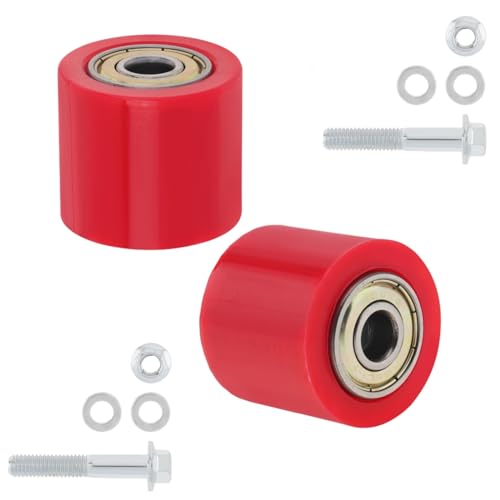
Pit bikes and small play bikes chew through chain rollers faster than full-size machines, partly because the rollers are smaller and partly because the bikes live in mud and pressure washers. The Windance guide wheels address that reality by selling two rollers in one pack, so a spare is on the shelf. Each wheel is a rubber roller on bearing steel, 32mm in outside diameter and 28mm wide, built around 608Z bearings with an 8mm bore.
The 8mm bore is the detail to check, because pit bike roller bolts split between 8mm and 10mm. If your tensioner arm or frame mount takes the 8mm size, these wheels suit the guide and tensioner positions found on most Chinese pit bikes, small dirt bikes and youth ATVs, and the listing offers red or blue finishes. Rubber is quieter than hard plastic against the chain, though it also wears faster under a gritty, dry chain, so keep the chain clean and lubed to get the most from them. As a consumable bought in pairs for bikes that eat rollers, the Windance set is the practical choice.
HARIFOGER 10mm Chain Roller Pulley for Pit Bikes

The HARIFOGER roller covers the other half of the pit bike world: bikes whose roller bolt measures 10mm. The pulley has a 10mm inner diameter, an outside diameter of about 36mm, and a length of about 34mm, and it comes in black or red. The listing names the usual 125cc to 160cc pit bike crowd, including SSR models, the XR125, CRF50, KLX110 and Pitster machines.
That larger 36mm diameter also makes this roller a useful option where a worn 32mm wheel has started letting the chain slap, since the bigger wheel takes up a little slack and presents a fresh rolling surface. There is nothing exotic here, and that is the point: pit bike rollers are simple parts, and the buying decision is measurement, not brand. Measure the bolt, measure the old wheel, and keep the stock spacer stack in the same order when you fit the new one. Riders with an 8mm bolt should choose the Windance pair above instead, because a loose bore on the bolt will wobble and wear both parts quickly.
Nylon Chain Slider and Guide Protector Set for KX250F and KX450F

Kawasaki’s KX250F and KX450F from 2009 to 2018 use a front swingarm slider and a rear guide protector that wear together, and this unbranded nylon set replaces both pieces in one purchase. The slider screws to the top of the swingarm where the chain enters, and the guide protector keeps the chain tracking into the rear sprocket. The listing notes the slider can be trimmed or drilled to suit, which is common for these pattern parts, and describes the material as wear-resistant plastic with good heat resistance.
Two things deserve plain statement. This is an unbranded pattern set, not a Kawasaki or race-shop part, and no fitting instructions are included, so compare the bolt pattern and shape against your stock slider before you start and expect a few minutes of test fitting. You get the two highest-wear chain contact parts for these KX models refreshed at once, which is the right way to do the job: fitting a new guide against a worn slider, or the reverse, leaves the chain running on a mismatched path. For KX owners doing a chain and sprocket swap, this set belongs on the same work order.
How to choose
Start by identifying which of the three parts is worn. Spin each roller by hand: it should turn freely and quietly, with no flat spots, deep grooves or side play. Check the swingarm slider near the pivot, where wear is fastest, and look at the guide block for a widened channel. Some factory manuals give limits; Honda, for example, specifies replacement diameters for the CRF450X rollers, at 39mm for the upper roller and 35mm for the lower. When a manual limit exists, measure with calipers and follow it.
Next, match the hardware. Roller diameter and width must suit the space between the frame mounts, and the bolt bore, 8mm or 10mm on most small bikes, must match exactly. Then consider construction: sealed bearings outlast plain bushings in wet conditions, polyurethane rollers resist grooving better than soft plastic, and aluminum guides trade flex for strength. Finally, separate model-specific parts from universal ones. Guides and sliders are shaped for one swingarm and should be bought by exact model and year, while simple rollers can cross between brands when the dimensions agree.
One recall note belongs in every roller purchase for a specific older BMW: NHTSA recall 10V-273 covered the factory top chain take-up roller bracket on BMW G 650 X models, which could break and jam the chain. That recall concerns the original bracket, not any aftermarket roller in this roundup, but owners of those bikes should confirm the dealer remedy was done before fitting new parts.
Who should skip
Skip this category if your street bike uses only a rubber swingarm buffer strip and has no rollers or guide block to replace, which is common on road machines. Skip it, too, if your rollers still spin freely and measure within the manual’s service limits, and your slider shows an even wear surface with material to spare; these are cheap parts, but replacing healthy ones buys nothing. Riders whose bikes are covered by an open factory remedy for a chain roller bracket should take the free dealer repair first rather than working around it with aftermarket parts.
FAQ
How often should chain rollers and sliders be replaced?
There is no fixed interval, because wear depends on chain tension, mud, washing and mileage. Inspect them at every chain service: replace a roller when it is grooved, cracked, flat-spotted or no longer spins freely, and replace a slider before the chain reaches the swingarm surface beneath it.
What size chain roller does my dirt bike need?
Measure the old roller. You need its outside diameter, its width and the diameter of the bolt that passes through it, which is 8mm or 10mm on most small bikes and 8mm on many full-size models. If your service manual lists a minimum diameter, treat anything below it as worn out.
Can a worn chain guide or slider damage the bike?
Yes. A slider worn through lets the chain machine grooves into the swingarm, which is far costlier than the plastic part. A worn or broken guide can let the chain derail under power, and a derailed chain can damage the engine cases, the sprocket and the rider’s leg.
Are universal pit bike rollers a safe swap for stock rollers?
They are, provided the bore, diameter and width match the original and the wheel spins freely on its bolt. Pit bike rollers are simple wear parts with no structural role beyond guiding the chain, so a correctly sized universal wheel is a sound replacement. Keep the original spacers and bolt, and recheck chain tension after fitting.
Final verdict
For most full-size dirt bikes, the All Balls 79-5008 is the roller to buy: sealed bearings, tough polyurethane and a fitment list that covers much of the Japanese and European off-road fleet. CRF250L and CRF300L owners get the most tailored upgrade from the JFG CNC guide, while pit bike riders should measure their bolt and choose the Windance pair for 8mm or the HARIFOGER pulley for 10mm. Kawasaki KX owners refreshing a whole chain drive should add the nylon slider and guide set so every contact surface starts fresh together.
Product and ASIN Reference
| Product | ASIN |
|---|---|
| All Balls Racing 79-5008 Sealed Chain Roller | B0052ERMZA |
| JFG RACING CNC Rear Chain Guide for CRF300L and CRF250L | B07P5RK52X |
| Windance 8mm Chain Tensioner Guide Wheel, 2-Pack | B0CDZW95SQ |
| HARIFOGER 10mm Chain Roller Pulley for Pit Bikes | B0B246LWYS |
| Nylon Chain Slider and Guide Protector Set for KX250F and KX450F | B0GDDTFN2T |
More from Amazon
Programs that pair well with the guide above. Offers and eligibility are set by Amazon and may change.
Free shipping on eligible items, Prime Video and more. Eligible new members can start with a free trial.
Start a Prime free trialA Prime membership for ages 18-24 with a trial period. Eligibility is set by Amazon.
See Prime for Young AdultsAudiobooks and podcasts to listen to on the go. Eligible new members can start with a free trial.
Try Audible freeAd-free music streaming. Eligible new subscribers can start with a free trial.
Try Music Unlimited freeAs an Amazon Associate we earn from qualifying purchases.

Write Your Review
No reviews yet. Be the first to share your experience!