

Key takeaways
- Compare the best 360 cameras for motorcycle filming, with stabilization picks, mounting advice and battery tips for long touring days ahead.
As an Amazon Associate we earn from qualifying purchases.
A regular action camera only sees where it points. A 360 camera records everything around the bike at once: the switchback opening up ahead, the truck drifting toward your lane, the friend who finally kept up through the pass. You mount it, press record, and choose the angle later at home, so the shot is never missed because the camera faced the wrong way.

The trade is real, though. Every 360 clip needs reframing before it looks like a normal video, the lenses bulge out where road grit can reach them, and the files are heavy. This guide covers the five 360 cameras that make sense on a motorcycle today, and the details — mounts, batteries, card space, rain — that decide whether you use the footage.
Disclosure: This article contains affiliate links. If you make a purchase through these links, we may earn a commission at no extra cost to you.
How to Choose
Reframing is the real workload
Understand this first: a 360 camera does not hand you a finished video. It hands you a sphere of footage, and you pick the framing afterwards in the maker’s app or desktop software — reframing. Modern apps help with subject tracking and one-tap templates, but a full day of touring still produces hours of raw sphere video to sort through. Riders who enjoy editing get creative freedom no fixed camera can match. Riders who want a clip online before dinner should favor the cameras with the fastest, smartest apps.
Mounts and the invisible stick
The signature 360 shot looks like a drone flying beside the bike, and it comes from a selfie stick that the stitching software erases automatically. On a motorcycle that stick clamps to the handlebar, a mirror stalk, or the tail, and motorcycle mount kits bundle the heavy-duty clamps and short extensions you need. Vibration is the enemy: a clamp that creeps on a gravel road ruins the shot and can drop the camera. Use metal clamps, keep extensions short, and add a safety tether. Also know your local rules, since some regions restrict anything protruding from a helmet; bar and tail mounts avoid that question entirely.
The lenses are exposed — plan for scratches
Both lenses on a 360 camera dome outward so they can see past the body, which means they cannot hide behind flat glass. One stone chip or one careless drop onto gravel can mark a lens, and a mark shows up in every frame from that side. Removable lens guards are the single most valuable accessory: they take the hit instead and swap out in seconds. Sticky guards and slip-on caps help too. Carry the camera in a hard case in your tank bag, never loose with keys and tools, and wipe lenses with a clean microfiber cloth only.
Battery life, heat, and memory cards
Lab battery figures assume mild weather and a still camera. On a bike in summer sun, a camera recording 8K or 5.7K works hard, gets hot, and may pause to cool down at a viewpoint. Spreading recording across the day, shading the camera at stops, and carrying one spare battery covers most touring days. File sizes are the other limit: high-resolution 360 video consumes tens of gigabytes per hour, so a fast, large card is not optional. Look for UHS-I V30 or faster cards, and offload each evening.
Stabilization and horizon lock
Engine buzz and rough pavement would make unstabilized footage unwatchable, so every camera here applies strong electronic stabilization, and the best systems add horizon lock, keeping the world level as the bike leans through corners. Lean is a judgment call: a locked horizon looks calm and polished, while allowing some lean feels faster and more honest. Most apps let you choose during reframing. Stabilization also depends on the mount — a rigid bar clamp beats a wobbling mirror stalk every time.
Wind noise and external microphones
At highway speed the soundtrack of any bike-mounted camera is mostly wind roar, however good the built-in microphones are. Foam windscreens and placement behind a fairing help at town speeds. For narration and clean engine sound, an external microphone is the real fix: a small wireless mic clipped inside your jacket or helmet, or a wired mic tucked out of the wind. Some cameras pair directly with wireless mic transmitters; others need a USB-C adapter. Decide how much audio matters before choosing, because it narrows the field quickly.
Rain and water sealing
Every camera in this guide has a water-resistant housing that shrugs off rain on the move, and most are sealed well enough for a dunking. One caution matters more than the depth figure: water droplets bead on domed lenses and smear the image, so expect rain footage to look soft until you wipe the lens at a stop. For motorcycle use, treat the sealing as storm insurance and keep riding.
Insta360 X4
The X4 is the easiest 360 camera to recommend for motorcycle touring. Its 8K 360 recording leaves so much detail in the sphere that a reframed 1080p or 4K clip still looks crisp, and its 5.7K mode at 60 frames per second smooths fast riding while stretching battery life. In single-lens mode it behaves like a conventional 4K action camera, handy for a quick forward shot at a stop. Battery endurance is the strongest in this group at moderate settings, and the big touchscreen is genuinely usable with the bike parked and gloves off.
Two details matter specifically on a bike. The lens guards twist off and on by hand, so a chipped guard after a gravel spray is a ten-second fix rather than a repair bill, and the motorcycle mount kits from Insta360 clamp solidly to bars and mirrors. The app is also the most mature reframe editor here, with tracking that follows the bike through a corner while you do nothing. Check the current Insta360 X4 listing on Amazon for bundle options, since kits with spare batteries and mounts rotate often.
Specs
- 360 video up to 8K at 30 fps, 5.7K at 60 fps, and 4K at 100 fps; single-lens mode up to 4K at 60 fps
- Dual 1/2-inch 48MP sensors; 72MP 360 photos
- 2290mAh battery: up to 135 minutes at 5.7K30, about 75 minutes at 8K30
- Waterproof to 10 m (33 ft) without a housing; removable lens guards included
- 203 g with a 2.5-inch touchscreen
- microSD storage up to 1 TB (UHS-I V30 recommended); maximum bitrate 200 Mbps
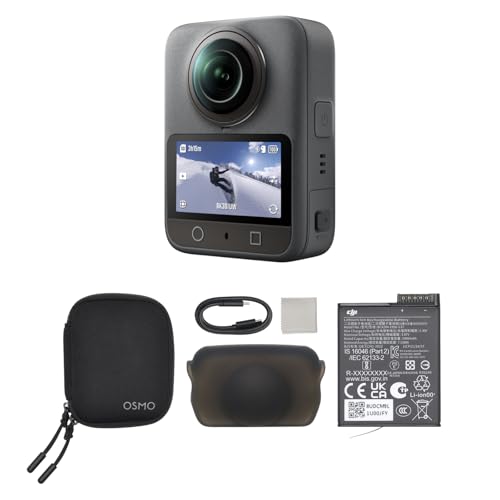
DJI Osmo 360
DJI’s first 360 camera is the image-quality pick. Its pair of 1-inch square sensors gather far more light than the smaller sensors in rival cameras, which shows up exactly where riders struggle: dawn starts, tree-covered mountain roads, and tunnels. It records native 8K 360 video and holds that mode for about 100 minutes continuously, the longest 8K endurance here, and can push to higher frame rates at 8K for slow-motion work. The 10-bit D-Log M profile gives editors real room to grade footage shot in harsh midday sun.
Motorcycle riders get two practical gifts. The camera carries 105 GB of usable built-in storage, so a forgotten or full card does not end the day’s filming, and it pairs directly with DJI’s wireless microphone transmitters, so a Mic Mini inside your helmet records clean voice and engine notes without cables. Its quick-release magnetic mounts make swapping between a bar clamp and a chest mount fast. Lens protection is the weak point: the domes sit proud, and the camera deserves its case whenever it leaves the mount. See the DJI Osmo 360 Standard Combo on Amazon for what is in the box.
Specs
- 360 video in native 8K up to 50 fps; single-lens Boost video up to 4K at 120 fps
- Dual 1-inch square HDR sensors with f/1.9 lenses; 120MP 360 photos
- 1950mAh battery: up to 100 minutes of continuous 8K30 recording; 50 percent charge in about 12 minutes
- 105 GB of usable built-in storage plus a microSD slot for cards up to 1 TB
- IP68 sealing; waterproof to 10 m (33 ft)
- 183 g; pairs directly with DJI Mic transmitters for wireless helmet audio
Insta360 X3
The X3 remains the sensible way into 360 filming if the flagship models feel like more camera than you need. It records 5.7K 360 video with dual 1/2-inch sensors, produces sharp 72MP stills, and shares the same app, mounts, and invisible-stick tricks as the X4. For social clips and trip highlights, a reframed X3 video is hard to tell apart from more expensive footage, especially in good light.
The compromises are predictable. There is no 8K headroom for aggressive cropping, the battery gives roughly 81 minutes at its top 360 setting, and its lens protection relies on optional stick-on guards rather than the twist-off guards of the X4 — buy them with the camera, because the domes are just as exposed. On the plus side, the huge accessory ecosystem around this model means clamps, cases, and spare batteries are easy to find. The Insta360 X3 on Amazon is the standard camera package; bundles with cards and sticks appear alongside it.
Specs
- 360 video up to 5.7K at 30 fps with Active HDR; single-lens mode up to 4K at 30 fps
- Dual 1/2-inch 48MP sensors; 72MP 360 photos
- 1800mAh battery: up to 81 minutes at 5.7K30
- Waterproof to 10 m (33 ft) without a housing
- 180 g with a 2.29-inch touchscreen
- microSD storage up to 1 TB (UHS-I V30 recommended)
GoPro MAX

The MAX is the pick for riders already living in GoPro’s world of mounts and the Quik app. Its 5.6K 360 video sits a step below the newest rivals on paper, but the footage is clean, the colors need little work, and Max HyperSmooth stabilization with horizon leveling handles bar-mounted vibration well. Six microphones capture convincing spatial audio at moderate speeds, and built-in GPS lets the app overlay speed and route data on your clips, a trick touring riders love for pass climbs.
Age shows in a few places. Resolution and low-light ability trail the X4 and Osmo 360, the sealing depth is shallower at 5 m, and the battery is small, so carry a spare for a full day. GoPro includes protective lens covers in the box, and the folding mounting fingers work with the enormous GoPro clamp ecosystem you may already own. It is also the lightest camera here, which your mirror stalk will appreciate. Check the GoPro MAX on Amazon for the current package.
Specs
- 360 video up to 5.6K at 30 fps; HERO mode at 1440p and 1080p up to 60 fps
- 16.6MP 360 photos; 6.2MP PowerPano shots
- Removable 1600mAh Enduro battery
- Waterproof to 5 m (16 ft); protective lens covers included
- 154 g; built-in GPS and a touch screen
- Six microphones for 360 and stereo audio; Max HyperSmooth with horizon leveling
Insta360 ONE RS Twin Edition

The ONE RS Twin Edition takes a different approach: a modular core that accepts interchangeable lens blocks, and the Twin Edition ships with two of them. Fit the 360 lens and it records 5.7K spherical video like the others here. Swap to the 4K Boost lens and it becomes a wide-angle action camera with strong stabilization, which some riders prefer for a fixed forward view. One battery base, one set of mounts, two shooting styles.
Modularity has honest downsides for bike use. The assembled camera is only sealed against water once locked into its mounting bracket, the 5 m depth limit is the joint shallowest here, and the 1445mAh battery is the smallest in this guide, giving about 82 minutes with the 360 lens fitted. Swapping lenses at a fuel stop with dusty hands also asks for care around the exposed contacts. In return you get the lightest 360 setup here and a system you can extend with other lens modules later. The Insta360 ONE RS Twin Edition on Amazon includes both lenses, the core, and the battery base.
Specs
- Two lens modules included: 5.7K30 360 lens and 4K60 Boost lens with 48MP photos
- 1445mAh battery base: up to 82 minutes with the 360 lens, 75 minutes with the 4K Boost lens
- Waterproof to 5 m (16 ft) when assembled in the mounting bracket
- 135.3 g with the 360 lens fitted; 125.3 g with the 4K Boost lens
- Core module with a reversible touch display; FlowState stabilization and 360 horizon lock
- microSD storage (UHS-I V30 recommended)
FAQ
Can a 360 camera replace a regular action camera for touring?
For most riders, yes. Every camera here has a single-lens mode that behaves like a normal action camera, and reframed 360 footage covers fixed-angle shots too. The real differences are workload and risk: you will spend time reframing, and the exposed lenses need more care than a flat action-cam lens. If you only ever mount a camera facing forward, a standard action camera is simpler. If you like choosing the shot afterwards, 360 wins.
Where should I mount a 360 camera on a motorcycle?
The handlebar or a bar-end clamp gives the classic flying-alongside view with an invisible stick angled up and back. A tail mount looks forward over the rider and works well for group rides. Helmet mounting gives a true rider’s-eye view but adds weight up high and is restricted in some places, so check local rules. Whichever you choose, use a metal clamp, keep the stick short, and add a tether.
How much memory card space does a day of 360 filming use?
Plan generously. At their higher settings these cameras record at bitrates that can consume roughly 40 to 90 GB per hour, so a day of selective recording — passes, towns, viewpoints — easily reaches 100 GB. A 256 GB or larger fast card is the comfortable choice, and offloading each night keeps the next day stress-free.
Will rain hurt a 360 camera, and how do I keep the lenses safe?
Rain itself is fine: every camera here is sealed for wet weather, and the top picks shrug off full submersion. The bigger enemies are droplets beading on the domes, which soften the image until wiped, and grit scratching the glass. Fit lens guards, wipe with microfiber at stops, and carry the camera in a hard case, treating the guards as consumables to replace when they mark up.
Conclusion
Pick by how you actually ride and edit. The Insta360 X4 is the best all-round motorcycle 360 camera: sharp, flexible footage, the longest moderate-setting battery life, and twist-off lens guards that suit life on the road. Choose the DJI Osmo 360 if your rides start at dawn or run through dark forests, and if clean helmet audio matters, since its big sensors and direct mic pairing lead the field. The Insta360 X3 is the smart entry point for testing whether reframing fits your habits. Existing GoPro users will feel at home with the GoPro MAX and its GPS overlays, while the Insta360 ONE RS Twin Edition suits riders who want one kit that shoots both 360 and classic wide-angle video. Whichever you mount, buy the lens guards and a spare battery at the same time — you will want both by the second day.
More from Amazon
Programs that pair well with the guide above. Offers and eligibility are set by Amazon and may change.
Free shipping on eligible items, Prime Video and more. Eligible new members can start with a free trial.
Start a Prime free trialA Prime membership for ages 18-24 with a trial period. Eligibility is set by Amazon.
See Prime for Young AdultsAudiobooks and podcasts to listen to on the go. Eligible new members can start with a free trial.
Try Audible freeAd-free music streaming. Eligible new subscribers can start with a free trial.
Try Music Unlimited freeAs an Amazon Associate we earn from qualifying purchases.

Write Your Review
No reviews yet. Be the first to share your experience!