

Key takeaways
- Compare the best hybrid integrated amplifiers for a dedicated listening room, from the flagship Advance Paris A10 to Dayton and Fosi tube hybrids.
A dedicated listening room is built around one job: two speakers, one seat, and nothing in the signal path that does not earn its place. That is exactly the brief a hybrid integrated amplifier is designed for. A vacuum tube preamplifier shapes the signal first, adding the harmonic richness and midrange ease that tube listeners chase, and then a solid-state power stage does the heavy lifting, delivering the current and control that a full tube output stage struggles to match at sane cost.

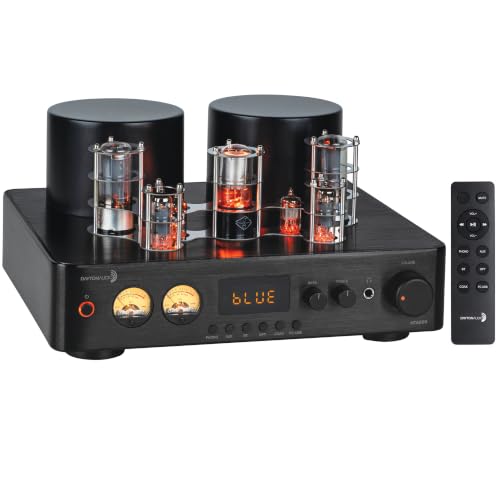
The four amplifiers in this guide all follow that formula, but they aim at very different rooms. One is a full-width flagship with balanced inputs, a moving coil phono stage and enough power for demanding floorstanders. Two are mid-sized Dayton Audio units with phono preamps, USB DACs and subwoofer outputs built in. The fourth is a compact Fosi Audio amp that brings the same tube-preamp idea to a smaller room or a desk-side system. All four are stereo integrated amplifiers sold new on Amazon US, and every specification below comes from the Amazon listing data for the exact model named.
As an Amazon Associate, we earn from qualifying purchases.
Quick Picks
| Product | Best for | Key point |
|---|---|---|
| Advance Paris A10 Classic | A serious room with demanding speakers and several sources | 130 watts per channel, tube preamp, MM/MC phono and balanced inputs |
| Dayton Audio HTA200 | Listeners who want hybrid warmth with real drive | 100 watts RMS per channel with phono, USB DAC and a subwoofer output |
| Dayton Audio HTA100 | A mid-sized room that needs phono and digital in one box | 65 watts RMS per channel, high-resolution USB input and tube preamp |
| Fosi Audio MC331 | Smaller rooms and nearfield setups | Compact tube hybrid with a built-in DAC and rollable preamp tubes |
How to Choose
Match power to speaker sensitivity, not to room size alone. In a dedicated room you sit closer and listen at controlled levels, so sensitivity matters more than raw wattage. Speakers rated at 90 dB or above will sing on 25 to 65 watts per channel. Hungrier designs in the mid-80 dB range, and most 4 ohm loads, reward the headroom of the 100 to 130 watt models here. Check the rating into the impedance you actually own, because hybrid amps quote their biggest number into 4 ohms.
Confirm the preamp stage really uses tubes. The hybrid label gets stretched. A genuine hybrid runs the signal through vacuum tubes in the preamplifier and hands it to transistors for power. Every amp in this guide does that, with named tube types in the listing: ECC81/12AT7 in the Advance Paris, 6F1 and 6P14A in the Dayton HTA100, and replaceable 5725W or 6J1 tubes in the Fosi. If a listing hides the tube type or treats the tubes as decoration, treat the claim with suspicion.
Decide how your sources connect before you buy. A listening room usually runs a turntable, a streamer or a computer, and a disc player. The Advance Paris covers the widest spread, with MM and MC phono, balanced XLR, HDMI ARC and a high-resolution USB DAC. The two Dayton amps combine a moving magnet phono stage with USB, optical and coaxial digital inputs plus Bluetooth. The Fosi has a DAC and five inputs but no phono stage, so vinyl needs a turntable with one built in or a separate phono preamp.
Plan for a subwoofer, or rule it out honestly. Even in a treated room, a well-integrated sub fills in the lowest octave that bookshelf speakers cannot reach. The Advance Paris offers dual subwoofer outputs with selectable crossover points, and both Dayton amps carry a mono subwoofer output. The Fosi instead offers a preamp output, which can feed a powered sub with its own crossover or a future power amp.
Think about heat and tube care. Tube preamps run warm and like open air above the chassis, so keep clearance in the rack and never stack components on top. Preamp tubes last for years, far longer than power tubes in a full tube amp, and because these are preamp tubes only, replacement sets are small and affordable. Rollable tubes, as on the Fosi and the Daytons, also let you fine-tune the sound later without changing amplifiers.
Keep the chain simple. The point of an integrated amp in a dedicated room is one volume control, one remote and no receiver menus between you and the music. If you need room correction, multiroom audio or surround decoding, none of these is the right tool; that is a different product category entirely.
Best Options
Advance Paris A10 Classic
The A10 Classic is the flagship pattern for this category: a French-designed, full-width integrated amplifier that pairs an ECC81/12AT7 tube preamplifier with a push-pull Class AB solid-state power stage. Output is rated at 130 watts RMS per channel into 8 ohms and 190 watts into 4 ohms, with a switchable high-bias mode that runs the first watts in Class A. In a dedicated room, that combination means delicate low-level detail when the music is quiet and genuine grip when a recording opens up.
Connectivity is the broadest here by a wide margin. There is a phono stage that handles both moving magnet and moving coil cartridges, balanced XLR inputs, HDMI ARC for the room’s screen, and an ESS Sabre ES9018 DAC with USB input supporting up to 32-bit/384 kHz playback. Dual subwoofer outputs with selectable crossover frequencies make two-sub setups practical, the preamp and power sections can be separated, and the front panel carries the twin blue meters and tube window that define the design.
Specs
- Hybrid design with two ECC81/12AT7 tubes in the preamp stage; Class AB push-pull solid-state power stage with switchable high-bias mode; 130 watts RMS per channel into 8 ohms and 190 watts RMS per channel into 4 ohms; ESS Sabre ES9018 DAC with USB up to 32-bit/384 kHz; MM/MC phono stage; HDMI ARC; balanced XLR input; dual subwoofer outputs; preamp output; A and B speaker terminals; 430 x 175 x 385 mm; 14.5 kg
Best for: A dedicated room with full-range or low-sensitivity speakers, a turntable with either cartridge type, and both digital and balanced sources
Watch out for: It is a full-size, heavy component that needs proper rack space and ventilation for the tubes, and Bluetooth streaming requires an optional plug-in receiver rather than a built-in radio
Dayton Audio HTA200
The HTA200 is the high-power option in Dayton Audio’s hybrid line, built around a tube preamplifier feeding a Class A/B solid-state output stage rated at 100 watts RMS per channel into 4 ohms. That is enough drive for the great majority of bookshelf and tower speakers a listening room is likely to hold, and the dual VU meters and amber tube glow give the rack a classic look while it works.
Dayton Audio loads this amp with the inputs a modern two-channel room actually uses. A phono preamp is built in for a turntable, a USB DAC covers a computer, optical and coaxial inputs take a streamer or disc player, and Bluetooth 5.0 handles casual listening from a phone. A subwoofer output and a headphone jack round out the panel, and a remote control is included, which matters more in a seated listening room than almost any other feature.
Specs
- Hybrid design with a vacuum tube preamplifier and a Class A/B solid-state power stage; 100 watts RMS per channel at 4 ohms; Bluetooth 5.0; USB DAC input; optical and coaxial digital inputs; RCA line input; built-in phono preamp; subwoofer output; headphone output; remote control included; dual VU meters; approximately 13.1 x 6.5 x 12.5 inches
Best for: Listeners who want the hybrid sound with enough power for full-size speakers, plus phono, digital and subwoofer connections in a single unit
Watch out for: The headline power figure is quoted into 4 ohms, so expect less into 8 ohm speakers, and the chassis is deeper than typical budget components, so measure the shelf before ordering
Dayton Audio HTA100

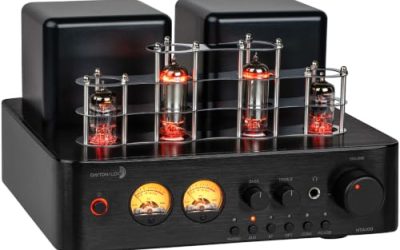
The HTA100 sits one step down in the same Dayton Audio family and suits the smaller end of dedicated rooms. Its tube preamplifier uses two 6F1 and two 6P14A tubes ahead of a Class A/B solid-state output stage rated at 65 watts RMS per channel into 4 ohms, with a peak rating of 100 watts per channel. For speakers of average sensitivity in a room where you sit eight to ten feet away, that is comfortable territory.
The digital side is stronger than the size suggests. The PC-USB input accepts signals up to 192 kHz at 32-bit, the optical and coaxial inputs handle standard SPDIF sources, and Bluetooth 5.0 is built in. A phono preamp covers a turntable, a subwoofer output covers the low end, and the front panel adds a headphone output and the same twin VU meters as its bigger sibling. Channel separation is listed at 58 dB, which supports the wide, stable imaging a listening room is set up to reveal.
Specs
- Hybrid design with a vacuum tube preamplifier using 6F1 x 2 and 6P14A x 2 tubes; Class A/B solid-state power stage; 65 watts RMS per channel into 4 ohms, 100 watts peak per channel; PC-USB input up to 192 kHz/32-bit; optical and coaxial digital inputs; Bluetooth 5.0; built-in phono preamp; subwoofer output; headphone output; channel separation 58 dB; 10.6 x 6.6 x 11.5 inches
Best for: Mid-sized listening rooms and efficient speakers, especially where a turntable and a computer both need to plug into the same amplifier
Watch out for: The digital inputs top out at standard SPDIF rates on optical and coaxial, so the USB input is the route for high-resolution files, and very low-sensitivity speakers will want the HTA200 instead
Fosi Audio MC331
The MC331 takes the hybrid idea down to desktop scale. A tube preamplifier with replaceable tubes feeds a solid-state power stage rated at up to 105 watts per channel into 4 ohms, and a built-in DAC, a headphone amplifier and a preamp output all share the compact chassis. For a small listening room, a study or a nearfield setup with bookshelf speakers on stands, it covers the whole system in one small box.
Five inputs (Bluetooth, USB, optical, coaxial and RCA) mean a computer, a streamer and a disc player can all stay connected, and the preamp output lets a powered subwoofer or a larger power amplifier join later. The front panel VU meter and the glowing tubes keep the vintage character that draws people to hybrids in the first place, and because the preamp tubes are socketed, swapping them is the cheapest upgrade path in this entire guide.
Specs
- Hybrid design with a vacuum tube preamplifier and a solid-state power stage; up to 105 watts per channel into 4 ohms; replaceable preamp tubes, supplied as 5725W or 6J1 type; built-in DAC; Bluetooth, USB, optical, coaxial and RCA inputs; preamp output; 3.5 mm headphone output; VU meter; remote control
Best for: Smaller rooms, desks and nearfield systems where a full-width amplifier will not fit but the tube hybrid sound still appeals
Watch out for: There is no phono input, so a turntable needs its own phono stage, and the preamp tube type supplied varies between 5725W and 6J1 and cannot be chosen when ordering
Which One Fits
Choose the Advance Paris A10 Classic if the room is the main system: demanding speakers, a turntable that might run a moving coil cartridge, balanced sources, and any plan for one or two subwoofers. It is the only amp here that covers every one of those bases without an add-on box.
Choose the Dayton Audio HTA200 if you want one amplifier that does nearly everything (phono, USB DAC, Bluetooth, subwoofer output, remote) with power to spare for full-size speakers, and the A10’s connectivity goes beyond what your sources need.
Choose the Dayton Audio HTA100 if the room and speakers are a size down from that, or if high-resolution USB playback from a computer is the main digital source. It keeps the phono stage and subwoofer output of the bigger model in a smaller, lighter chassis.
Choose the Fosi Audio MC331 if space is the hard limit, the speakers sit close, or the system doubles as a desk setup. It is also the natural pick for a first hybrid, because the rollable tubes make experimentation cheap.
Common Mistakes
Buying on the biggest wattage number. Hybrid listings headline the 4 ohm or peak figure. Compare RMS ratings into your speakers’ impedance instead; the HTA100’s honest 65 watts RMS will outplay a rival quoting a larger peak number, and the A10’s 130 watts into 8 ohms is the most conservative rating in this guide.
Pairing a low-power hybrid with insensitive speakers. Tube warmth cannot fix a simple power shortage. If your speakers sit below about 86 dB sensitivity and you listen at full volume in a larger room, step up to the HTA200 or the A10 rather than running a small amp at its limit.
Forgetting the phono stage question. Two of these amps include one, one includes a switchable MM/MC stage, and the Fosi includes none. A turntable without a built-in phono preamp connected to a line input will sound thin and quiet, and no tone control fixes that.
Blocking the tubes. Hybrid preamps need air. Sliding one into a closed cabinet or stacking a streamer on top shortens tube life and can add noise. Leave open space above the chassis.
Expecting receiver features. None of these amplifiers decodes surround sound, corrects room acoustics or streams over Wi-Fi by itself. They are single-purpose stereo components, which is precisely why they suit a dedicated room.
FAQ
Do hybrid amplifiers sound like tube amplifiers?
They sound closer to a tube system than a plain solid-state amp, because the tubes sit in the preamp stage where much of the tonal character is set. The solid-state output stage keeps bass control and power delivery tighter than most full tube designs, so the result is tube flavour with transistor discipline rather than an exact copy of either.
How long do the preamp tubes last, and can they be replaced?
Preamp tubes in these amplifiers typically run for years of regular listening because they handle small signals, not speaker power. All four models use socketed, replaceable tubes, and the Fosi and Dayton models use common tube types that are widely available, so a replacement set is a minor expense rather than a repair bill.
Can a hybrid integrated amplifier drive 4 ohm speakers?
Yes, provided the rating is quoted into 4 ohms and the load is not unusually reactive. Every amplifier here publishes a 4 ohm figure: 190 watts per channel for the Advance Paris, 100 watts RMS for the HTA200, 65 watts RMS for the HTA100 and up to 105 watts for the Fosi. Check that minimum impedance line in the listing before pairing with known difficult speakers.
Is a separate DAC still needed with these amplifiers?
Usually not. The Advance Paris carries an ESS Sabre DAC with high-resolution USB support, both Dayton amps include a USB DAC, and the Fosi has a DAC built in as well. A separate DAC only becomes necessary if you need a specific input type or decoding feature none of them offers.
Final Verdict
For a dedicated listening room, the Advance Paris A10 Classic is the most complete hybrid integrated amplifier here: real power, a proper MM/MC phono stage, balanced inputs and a high-resolution DAC behind a tube preamp. The Dayton Audio HTA200 is the value centre of the guide, with 100 watts RMS per channel and every connection a two-channel room normally needs, while the HTA100 trims the same formula for smaller rooms. The Fosi Audio MC331 proves the hybrid idea works at desktop scale. Pick by speaker demand and source list, and any of the four will anchor a serious stereo room.
More from Amazon
Programs that pair well with the guide above. Offers and eligibility are set by Amazon and may change.
Free shipping on eligible items, Prime Video and more. Eligible new members can start with a free trial.
Start a Prime free trialA Prime membership for ages 18-24 with a trial period. Eligibility is set by Amazon.
See Prime for Young AdultsAudiobooks and podcasts to listen to on the go. Eligible new members can start with a free trial.
Try Audible freeAd-free music streaming. Eligible new subscribers can start with a free trial.
Try Music Unlimited freeAs an Amazon Associate we earn from qualifying purchases.






Write Your Review
No reviews yet. Be the first to share your experience!