

Key takeaways
- Pro: the 93 dB sensitivity is high for a 6.5-inch, which means it plays loud on modest factory amplifier power.
- Pro: IP66 sealing and a polymer cone and surround handle rain, wash-downs and sun better than paper cones.
- Pro: a built-in crossover with a mylar capacitor means no separate crossover to wire in.
- Con: it needs about 2.3 in of mounting depth, so tight fairing or lid cavities can foul the magnet.
- Con: a coaxial cannot match the staging of a component set with a separate tweeter.
The best motorcycle speakers for most riders are a weather-sealed pair of 6.5-inch coaxials sized for the bike’s factory speaker location, such as the Memphis Audio MXA62HD or the Kicker PSC65, because fit and sealing matter more than headline wattage. Handlebar-mounted 3-inch systems like the Boss MCBK420B suit bikes with no fairing, and the Rockford Fosgate TMS24-65 is the one to look at if you ride a 2024 or newer Harley touring model. Everything below is based on published specs, manufacturer fitment charts and owner reports, not personal experience on any single bike.
Our top picks



As an Amazon Associate we earn from qualifying purchases at no extra cost to you.
Quick comparison of the speakers worth shortlisting
| Pick | Best for | Size | Key published specs | Price tier |
|---|---|---|---|---|
| Memphis Audio MXA62HD | Harley 2014+ Street Glide, 2015+ Road Glide | 6.5 in coaxial | 75 W RMS / 150 W peak, 93 dB, IP66, 2.3 in depth | Mid |
| Kicker PSC65 | Powersports and cruiser lowers, bagger lids | 6.5 in coaxial | 60 W RMS (4-ohm version), 92.5 dB, 3/4 in titanium tweeter | Entry to mid |
| Rockford Fosgate TMS65 family | Harley 2014 to 2023 touring fairings | 6.5 in 2-way | Direct fit on factory harness, weather resistant | Mid |
| Rockford Fosgate TMS24-65 | Harley 2024+ Road Glide and Street Glide | 6.5 in full range | Gen-2 design for Skyline OS bikes, supplied with fairing grilles | Premium |
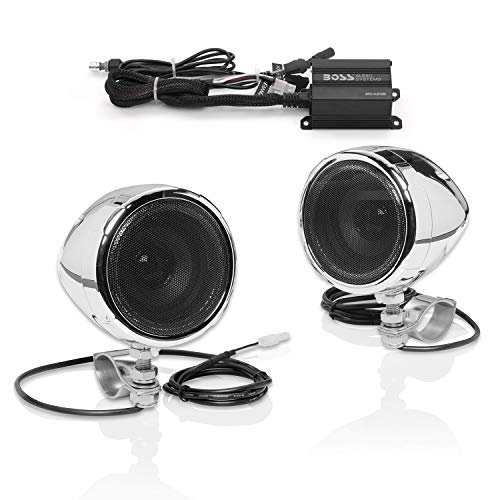
| Boss MCBK420B | Handlebar audio on cruisers and nakeds | 3 in full range, amp included | 600 W max Class D amp, 80 Hz to 15 kHz, IPX5 | Entry |
| Boss MCBK470B | Four-speaker handlebar and fender setups | 3 in x 4 | 1,000 W max amp, Bluetooth, remote volume | Entry to mid |
| J&M ROKKER XXR | Honda Gold Wing 2018 to 2026 | 5.17 in | Exact-size replacement for the stock speaker opening | Mid |
Peak (“max”) wattage on the Boss systems is a marketing figure. RMS is the continuous number that matters, and that is why the table leads with RMS wherever a manufacturer or retailer publishes it.
Memphis Audio MXA62HD: best overall 6.5-inch for Harley baggers
Spec line: 6.5-inch coaxial, 75 W RMS, 150 W peak, 93 dB sensitivity, 35 mm voice coil, neodymium magnet, carbon-fiber reinforced polypropylene cone, Santoprene surround, IP66 rating, 2.3 in mounting depth.
Best for: riders with a 2014 or newer Street Glide or 2015 or newer Road Glide who want a factory-location swap with more clarity and a bit more volume.
Skip if: your bike is a 2024 or newer model on Skyline OS. Memphis lists this speaker against the earlier fairings, so check its current fitment chart for your model year first.
- Pro: the 93 dB sensitivity is high for a 6.5-inch, which means it plays loud on modest factory amplifier power.
- Pro: IP66 sealing and a polymer cone and surround handle rain, wash-downs and sun better than paper cones.
- Pro: a built-in crossover with a mylar capacitor means no separate crossover to wire in.
- Con: it needs about 2.3 in of mounting depth, so tight fairing or lid cavities can foul the magnet.
- Con: a coaxial cannot match the staging of a component set with a separate tweeter.
Kicker PSC65: best value powersports speaker
Spec line: 6.5-inch PS Series coaxial, 60 W RMS and 120 W peak per speaker in the 4-ohm version, 92.5 dB sensitivity, 3/4-inch titanium dome tweeters; a 2-ohm version also exists with 40 Hz to 20 kHz response and 2 in mounting depth, according to retailer listings.
Best for: bikes, ATVs and side-by-sides where cost matters and the speaker will live on a lid, lower fairing or custom pod.
Skip if: you want a Harley-specific bolt-in with a molded bracket. Kicker says the PSC65 works best around 60 W per channel, so budget an amplifier of similar output.
- Pro: 92.5 dB sensitivity keeps the amp requirement reasonable.
- Pro: titanium tweeters stay crisp when the road and wind noise rise.
- Pro: priced in the entry to mid tier, which makes a four-speaker build practical.
- Con: the 2-ohm and 4-ohm versions look alike, and buying the wrong impedance for your amp is a common mistake.
- Con: it is a universal fit, so adapters or custom baffles are often part of the job.
Rockford Fosgate TMS65 family: the safe choice for 2014 to 2023 Harley fairings
Spec line: 6.5-inch two-way designed to plug into the factory harness of 2014 to 2023 Road Glide and Street Glide fairings; the older TMS6SG and TMS6RG sibling parts are rated 75 W RMS and 150 W peak with a 25 mm dome tweeter, according to the maker’s listings.
Best for: riders who want a documented direct-fit part from a brand that also builds the factory-style amplifier kits.
Skip if: you ride a 2024 or newer bike. Rockford’s own fitment guidance moves those bikes to the TMS24-65, so a TMS65 is the wrong part there.
- Pro: plug-and-play connectors reduce cutting and soldering.
- Pro: the same brand sells matching saddlebag speakers and amplifier kits, so you can expand later.
- Pro: the dome tweeter gives vocals more presence than the stock cone.
- Con: it costs more than a generic 6.5-inch for similar power ratings.
- Con: older TMS6 numbers are for 1998 to 2013 bikes, so part-number confusion is easy.
Rockford Fosgate TMS24-65: best for 2024 and newer Harley touring bikes
Spec line: 6.5-inch full-range Gen-2 speaker with fairing grilles for 2024+ Road Glide and Street Glide; the maker pairs it with its HD24-STG2 and HD24-STG3 kits and the TMA-1000X4i amplifier.
Best for: Skyline OS owners who want to leave the original behind and keep a clean, dealer-style look.
Skip if: you ride a Street Glide Special, Street Glide ST or Road Glide ST. Rockford’s chart showed no Stage 2 fitment for those trims, so confirm your exact model before ordering.
- Pro: engineered around the newer fairing and its digital audio path.
- Pro: ships with the fairing grilles that fit this generation.
- Pro: scales from a two-speaker upgrade to a full four-speaker system.
- Con: premium tier, and the speakers alone do not unlock the full potential without an amp.
- Con: fitment is trim-specific, which makes the research step longer.
Boss MCBK420B and MCBK470B: best budget handlebar speakers
Spec line (MCBK420B): two 3-inch full-range weatherproof speakers, compact Class D amplifier with Bluetooth, 600 W max, 80 Hz to 15 kHz response, IPX5 rating, brackets for 0.75 to 1.25 in handlebars, 3.5 mm aux input and an inline volume control. The MCBK470B adds a second speaker pair for four speakers and a 1,000 W max amp rating.
Best for: cruisers, nakeds and ATVs with no fairing or bag lids to cut into.
Skip if: you want deep bass or plan to ride mostly above 70 mph. A 3-inch driver cannot move enough air at low frequencies.
- Pro: bolt-on installation, with no cutting, in under an hour.
- Pro: Bluetooth built into the amplifier removes the need for a separate head unit.
- Pro: entry price tier, so a four-speaker setup stays affordable.
- Con: IPX5 means resistance to water jets, not submersion, and the amp should be kept out of direct spray.
- Con: peak ratings are far above real continuous output, and sound thins out at highway speed.
J&M ROKKER XXR: best replacement for 2018 and newer Gold Wings
Spec line: 5.17-inch coaxial built as an exact-size replacement for the stock Gold Wing speaker opening on 2018 to 2026 models; weather resistant, with a power rating that retailers list in the 200 W range (treat that as a peak figure).
Best for: Gold Wing owners who want a bolt-in upgrade without cutting the fairing.
Skip if: you own a 2001 to 2017 GL1800. Those fronts use different sizes, and J&M sells separate kits for them.
- Pro: no adapter rings needed, which keeps the install reversible.
- Pro: larger cone area than the stock driver gives more mid-bass.
- Pro: the same maker offers amp kits if you want to scale up later.
- Con: the speaker is only as good as the amplifier feeding it, and the factory head unit output is limited.
- Con: listed power ratings vary between retailers, so rely on sensitivity and fitment, not the wattage claim.
How to choose: the numbers that actually matter
1. Size and mounting depth first
Measure the opening and the depth behind it. A 6.5-inch speaker that needs 2.3 in of depth will not fit a lid that has 2.0 in. Harley touring fairings, Indian Challenger fairings, Gold Wing fronts and handlebar pods all use different sizes, so the right speaker is usually decided before you think about sound.
2. Sensitivity decides how loud it gets
Every 3 dB of extra sensitivity is equivalent to doubling the amplifier power. A 93 dB speaker on 50 W per channel plays roughly as loudly as a 90 dB speaker on 100 W. On a bike with a modest factory amp, a high-sensitivity speaker is often the cheapest way to get more volume.
3. RMS power should match the amplifier, not exceed it
Aim for an amp that delivers 75 to 150 percent of the speaker’s RMS rating. A 75 W RMS speaker is comfortable with an amp from roughly 60 W to 110 W per channel. Underpowering a speaker and running it into distortion is more likely to damage it than a clean, slightly bigger amp.
4. Worked example: what the battery has to supply
Take a four-speaker setup with a 4 x 100 W amplifier. At full power that is 400 W of output; at about 85 percent efficiency the amp draws roughly 470 W, or about 33 A at 14 V. Music at listening level averages closer to one eighth of full power, so around 4 to 5 A is a more realistic draw. Most touring bikes have spare alternator capacity for that, but a lighter cruiser with heated grips and auxiliary lights may not, so add up your accessories first.
5. Weather ratings in plain terms
| Rating | What it means | Typical use |
|---|---|---|
| IPX5 | Protected against water jets from any direction, not submersion | Handlebar speakers and small amps |
| IP66 | Dust-tight and protected against powerful water jets | Fairing and lid speakers |
| IP67 | Dust-tight and protected against short immersion up to 1 m | Amplifiers and communicators |
The first digit in an IP code is dust protection and the second is water. An X means the item was not rated for dust, which is common in the cheaper handlebar kits.
Best motorcycle speakers for bass
Bass comes from cone area, enclosure volume and amplifier headroom, not from the wattage printed on the box. A 6.5-inch speaker in a sealed lid cavity will always out-bass a 3-inch handlebar speaker. If you want more low end, move to 6.5-inch or 6×9 drivers, add an amplifier with a low-pass crossover set near 80 Hz, and consider a small powered sub in the Tour-Pak. At 70 mph the wind noise at your ears is loud enough that most of the deep bass below 60 Hz is masked anyway, so extending the 80 to 200 Hz range is where listeners tend to notice improvement.
Best waterproof motorcycle speakers
Look for a polymer cone, rubber surround, stainless or coated hardware and an IP66 or better rating. The Memphis MXA62HD has the rating and construction for this, and the Kicker PSC65 is built for powersports use. For the amplifier, an IP66 to IP67 unit like the Kicker PXA400.4 stays safer on open bikes than a standard car amplifier. Wrap exposed connectors with dielectric grease and heat-shrink, because corroded connectors cause more outages than failed speakers do.
Best motorcycle speakers under 200
With a budget of 200, the realistic shopping options are a pair of 6.5-inch powersports coaxials such as the Kicker PSC65 or a complete Boss handlebar system. At that level, the sensible approach is:
- Choose either the pair of speakers or the complete handlebar kit, not both.
- If you choose speakers, keep the stock amplifier and accept a modest volume increase.
- If you choose a handlebar kit, treat the claimed wattage as marketing and focus on IPX5 and bracket fit.
- Keep money aside for wiring, fuse and connectors, which can add a meaningful fraction of the cost.
Prices change often, so compare current offers against your own limit instead of trusting any figure printed here.
Best Bluetooth motorcycle speakers
Bluetooth on a bike is either built into the amplifier (Boss MCBK series), built into the head unit (factory Harley infotainment), or delivered through a helmet communicator. Bluetooth range of roughly 10 meters is enough for a bike-mounted system, because the phone sits in a pocket or tank bag. The weak point is codec quality: standard SBC audio is fine for riding but will not reward high-end speakers. For the best sound on a stock head unit, use the factory Bluetooth stream and spend money on speakers and an amplifier instead.
Ownership realities: what wears first
- Connectors and grounds. Water and vibration attack the ground connection first. Use ring terminals and a clean metal ground point.
- Foam surrounds. Cheap speakers with foam surrounds crack after a few seasons of sun. Rubber or Santoprene lasts longer.
- Fuses. Always fuse the amplifier power wire close to the battery. A 60 A fuse is common for a 4 x 100 W amp.
- Wash-downs. Avoid pressure-washing directly at grilles.
Frequently Asked Questions
What size speakers do most motorcycles use?
Harley touring bikes use 6.5-inch in the fairing and in many aftermarket lid setups, while Gold Wings use smaller drivers and Indian Chieftain and Roadmaster bikes use 5.25-inch fairing speakers. Handlebar kits use 3-inch units. Always check the opening and depth for your exact model year.
Are motorcycle speakers really waterproof?
Most are water resistant rather than submersible. An IP66 rating handles rain and spray, and IPX5 handles jets of water, but neither is meant for immersion. Mount electronics where road spray cannot hit them directly.
Do I need an amplifier for new motorcycle speakers?
Not always, since a good high-sensitivity speaker improves on factory sound even with the stock amplifier. If you want real volume at highway speed, an external amplifier with 50 to 100 W per channel is the next step.
Why do my speakers sound distorted at highway speed?
Usually the factory head unit or amplifier is clipping at high volume, or the speaker is underpowered for the noise level. Lowering the head unit volume and raising amplifier gain can reduce clipping, and a better amplifier removes the cause.
Can I use car speakers on a motorcycle?
You can, but car speakers usually have paper cones and foam surrounds that degrade quickly in rain and sunlight. Marine or powersports speakers are designed for that exposure and are a safer choice.
How long do motorcycle speakers last?
Speakers with polymer cones and rubber surrounds commonly last for many riding seasons if they are kept sealed and well grounded. Cheap foam-surround speakers may last only a few seasons in direct sun.
More from Amazon
Programs that pair well with the guide above. Offers and eligibility are set by Amazon and may change.
Free shipping on eligible items, Prime Video and more. Eligible new members can start with a free trial.
Start a Prime free trialA Prime membership for ages 18-24 with a trial period. Eligibility is set by Amazon.
See Prime for Young AdultsAudiobooks and podcasts to listen to on the go. Eligible new members can start with a free trial.
Try Audible freeAd-free music streaming. Eligible new subscribers can start with a free trial.
Try Music Unlimited freeAs an Amazon Associate we earn from qualifying purchases.


Write Your Review
No reviews yet. Be the first to share your experience!