

Key takeaways
- Pro: direct digital input avoids converting the audio to analog and back.
- Pro: built-in DSP lets you shape the sound for fairing and saddlebag speakers.
- Pro: supports systems up to eight speakers.
- Con: premium tier, with an install kit that costs extra.
- Con: IPX4 means splash resistance, so it needs a protected location.
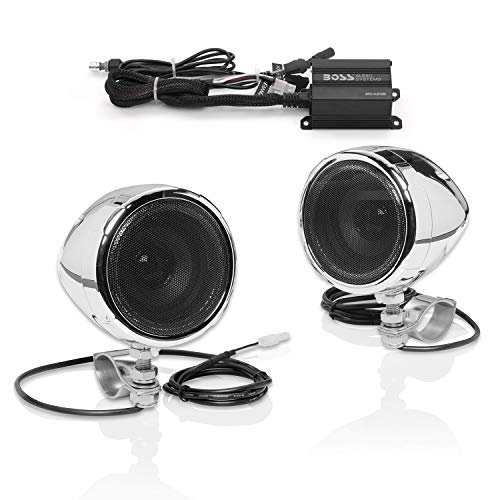
The best motorcycle amplifier for most speaker upgrades is a weather-sealed four-channel Class D unit with roughly 75 to 100 W RMS per channel, and the Kicker PXA400.4 and Rockford Fosgate TM400X4ad fit that description. For 2024 and newer Harley touring bikes on Skyline OS, the Rockford Fosgate TMA-1000X4i is the model built for that digital audio path. For tight spaces and lighter loads, the JL Audio MX280/4 is a compact 50 W x 4 option. This guide uses published manufacturer and retailer specs, not personal installation experience, and it focuses on sizing, fusing and fit, which decide results more than brand.
Our top picks



As an Amazon Associate we earn from qualifying purchases at no extra cost to you.
Amplifier comparison table
| Amplifier | Channels | Rated power (RMS) | Weather protection | Best for | Price tier |
|---|---|---|---|---|---|
| Rockford Fosgate TMA-1000X4i | 4 | 200 W x 4 at 4 ohm or 2 ohm; 400 W x 2 bridged | IPX4 | 2024+ Harley Road Glide and Street Glide (Skyline OS) | Premium |
| Rockford Fosgate TM400X4ad | 4 | 100 W x 4 at 4 ohm and 2 ohm; 200 W x 2 bridged | Conformal-coated board, moto-marine design | Older bikes with speaker-level inputs | Mid to premium |
| Kicker PXA400.4 | 4 | 100 W x 4 at 4 ohm; 200 W x 2 bridged (retailers vary on the 2-ohm figure) | IP66 to IP67 per listings | Open cruisers, baggers, universal builds | Mid |
| JL Audio MX280/4 | 4 | 50 W x 4 at 4 ohm, 70 W x 4 at 2 ohm (14.4 V); 140 W x 2 bridged | IPX6 to IPX7 (sources differ) | Compact installs, lighter speakers | Mid |
| Rockford Fosgate PBR300X4 | 4 | 75 W x 4 | Car amplifier, not rated for open exposure | Only inside a sealed fairing or lid | Entry |
| J&M amp kits (Gold Wing) | 4 | Sold as 400 W and 1,000 W kits (peak ratings) | Kit-specific | 2018+ Gold Wing upgrades | Mid to premium |
Power figures are measured at 14.4 V in the makers’ ratings. A bike running at 12.5 to 13.5 V delivers less, which is why the JL Audio listing shows lower numbers at 12.5 V (about 36 W x 4 at 4 ohm).
Rockford Fosgate TMA-1000X4i: best for 2024+ Harley touring
Spec line: 1,000 W four-channel digital amplifier, 200 W x 4 at 4 ohm or 2 ohm, 400 W x 2 bridged, integrated DSP, Bluetooth tuning through the RF Connect app, A2B digital input, 24 dB per octave low-pass crossover, 4 AWG power connection with a 60 A fuse, 9 to 16 V operating range, IPX4.
Best for: 2024 and newer Road Glide and Street Glide bikes with Skyline OS, where it is sold in the maker’s Stage 2 and Stage 3 kits.
Skip if: your bike is a 2023 or older model, since this amplifier is made for the newer platform only.
- Pro: direct digital input avoids converting the audio to analog and back.
- Pro: built-in DSP lets you shape the sound for fairing and saddlebag speakers.
- Pro: supports systems up to eight speakers.
- Con: premium tier, with an install kit that costs extra.
- Con: IPX4 means splash resistance, so it needs a protected location.
Kicker PXA400.4: best all-round weather-ready four-channel
Spec line: Class D, 100 W RMS x 4 at 4 ohm, 200 W x 2 bridged at 4 ohm, 10 Hz to 20 kHz response, 80 or 120 Hz high-pass and 80 Hz low-pass at 24 dB per octave, preamp and speaker-level inputs (up to 40 V), auto turn-on by DC offset, IP66 to IP67 per retailer listings, stainless hardware, two-year warranty, 8 gauge power and a 60 A fuse recommended.
Best for: bikes where the amplifier must live in the open or near the rear fender.
Skip if: you need a very small package.
- Pro: waterproof rating suits unprotected mounting spots.
- Pro: speaker-level inputs let it work with factory head units that lack preamp outputs.
- Pro: auto turn-on removes the need for a remote wire.
- Con: size varies by source but it is larger than the JL Audio compact unit.
- Con: 2-ohm and bridged ratings differ between retailers, so rely on the 4-ohm figure.
Rockford Fosgate TM400X4ad: best for speaker-level inputs and older Harleys
Spec line: Power Series Class AD four-channel, 100 W RMS x 4 at 4 ohm and 2 ohm, 200 W x 2 bridged at 4 ohm, speaker-level inputs, conformal-coated circuit board, dual cooling fans, hidden top-mount control panel.
Best for: pre-2024 touring bikes where the factory head unit output is speaker-level.
Skip if: you want a fanless unit or the smallest footprint.
- Pro: stable output at 2 ohm, so it can drive two speakers per channel.
- Pro: marine-grade board coating helps in damp conditions.
- Pro: matches the HD14-style kits that use similar 400 W four-channel amplifiers.
- Con: the Class AD design runs warmer than Class D, so ventilation matters.
- Con: fans can pull in dust and water if mounted in the open.
JL Audio MX280/4: best compact four-channel
Spec line: Class D, 50 W RMS x 4 at 4 ohm and 70 W x 4 at 2 ohm at 14.4 V; 140 W x 2 bridged at 4 ohm; variable low- and high-pass filters from 35 to 300 Hz at 12 dB per octave; 8.66 x 1.77 x 3.09 in; 3.18 lb; 35 A fuse; 8 gauge wiring recommended.
Best for: compact bikes and lids where space and weight are limited, matched to speakers around 50 W RMS.
Skip if: you drive high-power 6.5-inch speakers and want strong volume at 75 mph.
- Pro: very small and light for a four-channel amplifier.
- Pro: adjustable crossovers on a wide range let you tune the speakers precisely.
- Pro: IPX6 to IPX7 rating suits exposed spots.
- Con: lower power than the 100 W units, and less at a typical 12.5 to 13.5 V.
- Con: sources differ on the exact water rating, so check the label.
Rockford Fosgate PBR300X4: a car amplifier worth using only in protected spots
Spec line: compact four-channel car amplifier rated at 75 W RMS x 4, per Crutchfield’s listing.
Best for: an amplifier mounted inside a sealed fairing, lid or Tour-Pak where it never meets rain.
Skip if: the amplifier will be exposed to spray, since it is not a marine or powersports unit.
- Pro: entry price tier with decent power.
- Pro: compact size for a four-channel amplifier.
- Pro: easy to find and service.
- Con: no weather protection, so corrosion is a risk.
- Con: wiring and fusing must be designed to car-amp standards on a vibrating bike.
Best 2-channel motorcycle amp: what to look for
A two-channel amplifier is the right size when you power only a front pair, such as fairing speakers, and keep the radio’s existing lines for everything else. Look for a Class D design with 75 to 150 W RMS per channel at 4 ohm, an IP66 or better rating, and speaker-level inputs. A two-channel unit can also be bridged into a single 300 W-class channel for a subwoofer. Specific model availability changes, so use the specs above as a screen when you compare options.
Best amp and speakers for a Harley: bundled options
The simplest way to get a matched amp and speaker set is a kit. For 2024 and newer touring bikes, Rockford’s HD24-STG2 is a two-speaker, 1,000 W kit built on the TMS24-65 speakers and the TMA-1000X4i. The HD24-STG3 adds two 6×9 saddlebag speakers. For 2014 to 2023 bikes, Rockford’s HD14 Stage 3 kit uses a 400 W four-channel amplifier, and for 2018 and newer Gold Wings, J&M sells 400 W and 1,000 W amp kits with the ROKKER speakers.
How to size a motorcycle amplifier
1. Match RMS to the speakers
Add up the RMS rating of the speakers on each channel, and choose an amplifier whose per-channel RMS is within 75 to 150 percent of that number. A pair of 75 W RMS speakers on a 100 W x 4 amp is well matched; the same speakers on a 50 W x 4 amp will run out of headroom at highway speed.
2. Understand impedance
Most motorcycle speakers are 4 ohm. Two 4-ohm speakers wired in parallel on one channel present 2 ohm, and the amplifier must be 2-ohm stable. The TM400X4ad and TMA-1000X4i hold their rating at 2 ohm, while the PXA400.4 figure at 2 ohm differs by retailer.
3. Work out current draw
| Amplifier | Total RMS output | Efficiency assumed | Full-power draw at 14 V | Typical music draw | Fuse |
|---|---|---|---|---|---|
| JL Audio MX280/4 | 200 W | 85 percent | About 17 A | 2 to 3 A | 35 A |
| Kicker PXA400.4 | 400 W | 85 percent | About 34 A | 4 to 6 A | 60 A |
| Rockford TMA-1000X4i | 800 W | 85 percent | About 67 A | 8 to 12 A | 60 A (per maker) |
The typical figure assumes music averages about one eighth of full power. Real use is less than the maximum because the amplifier rarely plays at full output, and the fuse size comes from the maker’s guidance, not from the peak draw alone.
4. Check the charging system
A big-twin touring bike’s alternator output of a few hundred watts leaves a modest margin after lights, heated gear and the infotainment. A 400 W amplifier at normal volume uses about 60 to 80 W, which is fine, but add the loads together before adding a 1,000 W system.
5. Plan the wiring
Use the gauge recommended by the maker: 8 gauge for 35 to 60 A systems and 4 AWG for the TMA-1000X4i. Fuse within about 18 inches of the battery, use a sealed ground connection, and keep the power line away from the ignition and ECU wiring to limit noise.
Which amplifier for which rider
| Rider situation | Amplifier class | Speaker pairing | Reasoning |
|---|---|---|---|
| 2024+ Harley, wants the full factory-style upgrade | TMA-1000X4i in a Stage 2 or 3 kit | TMS24-65 fairing plus 6×9 bag speakers | Digital input, DSP and enough headroom for four to six speakers |
| 2014 to 2023 Harley, daily highway rider | 100 W x 4 class (TM400X4ad or PXA400.4) | Two 6.5 in fairing plus two bag speakers | Speaker-level inputs work with the factory head unit |
| Small cruiser, two lid speakers | JL Audio MX280/4 or similar compact unit | Two 5.25 or 6.5 in speakers around 50 W RMS | Light, small and enough power for a rider on a naked or cruiser |
| Gold Wing 2018+, replacing stock drivers | 400 W J&M amp kit or a 4 x 75 W Class D unit | Replacement 5.17 in front speakers | Matches the exact-size speakers without cutting the fairing |
| Sealed Tour-Pak, wants a budget build | Protected car-style 4 x 75 W unit | 6.5 in coaxials | Lower cost when the amplifier stays dry |
Gain setting: a short method that avoids clipping
- Turn the amplifier gain to minimum and disable any bass boost. Start from a neutral baseline so you can hear distortion clearly.
- Play a track you know well at a steady level. Pick a recording with clean vocals and bass, not a heavily compressed one.
- Raise the head unit to roughly three quarters of its maximum. Most head units distort in the top quarter, so this is your ceiling.
- Increase the amplifier gain slowly until you hear the sound harden. Hardness, fuzz on cymbals or a flat bass note means the amplifier is clipping.
- Back off one notch and mark the position. You now have the loudest clean level for that source.
- Set the high-pass filter near 80 Hz for small speakers. This stops the speaker trying to reproduce bass it cannot, which reduces distortion and protects the cone.
A clipped signal is more dangerous for speakers than extra clean power, because clipping sends a flat-topped waveform that overheats the voice coil. If you find yourself raising the gain to fill up the sound at 70 mph, the correct fix is a more powerful amplifier or more sensitive speakers, not a higher gain setting.
Alternatives to a dedicated amplifier
If the cost, wiring and current draw of an amplifier look like too much, there are lower-effort routes. A pair of high-sensitivity speakers, around 93 dB, lifts volume without any extra power. A helmet communicator with large drivers, such as a 40 mm to 45 mm JBL or Harman Kardon set, bypasses the bike’s audio altogether. A factory upgrade from the dealer, such as Harley’s Stage I or II parts on newer bikes, keeps the warranty simple and uses amplifiers designed for the platform. Each of these gives up some potential output in exchange for lower complexity.
Ownership realities
- Heat. Class AD and Class D amplifiers both need airflow, and a hot tour pack can trip thermal protection on summer rides.
- Vibration. Mount on rubber isolators or a bracket with thread locker so the terminals do not loosen.
- Corrosion. Seal terminals with dielectric grease and check them each season.
- Gain settings. Set gain with the head unit about three quarters up, not by matching volume knobs, and recheck after changing speakers.
Frequently Asked Questions
What is the best amp for motorcycle speakers?
For most open or semi-exposed installs, a Kicker PXA400.4 or Rockford TM400X4ad provides 100 W RMS per channel at four channels. For 2024 and newer Harley touring bikes, the Rockford TMA-1000X4i is built for that platform.
Is a 2-channel or 4-channel amp better?
A 4-channel amplifier is more flexible because it can run fairing and saddlebag speakers separately. A 2-channel amplifier is enough for a front pair, and it can be bridged for a subwoofer.
Do I need an amp for my motorcycle speakers?
Not if you only want better clarity at low volume. For volume above about 65 mph, an amplifier with 50 to 100 W per channel gives the headroom that a factory unit lacks.
Are car amplifiers safe on a motorcycle?
They work electrically, but they are not built for water, vibration and temperature swings. A car amplifier is acceptable inside a sealed enclosure, while a marine or powersports unit is safer in the open.
What fuse and wire do I need?
Follow the maker. A common recommendation is 8 gauge wire and a 60 A fuse for a 4 x 100 W amplifier, and the TMA-1000X4i calls for 4 AWG with a 60 A fuse. Place the fuse close to the battery.
Will an amplifier drain my battery?
Not if it is wired to a switched source. At normal listening levels the draw is several amps, which the charging system covers while the engine runs.
More from Amazon
Programs that pair well with the guide above. Offers and eligibility are set by Amazon and may change.
Free shipping on eligible items, Prime Video and more. Eligible new members can start with a free trial.
Start a Prime free trialA Prime membership for ages 18-24 with a trial period. Eligibility is set by Amazon.
See Prime for Young AdultsAudiobooks and podcasts to listen to on the go. Eligible new members can start with a free trial.
Try Audible freeAd-free music streaming. Eligible new subscribers can start with a free trial.
Try Music Unlimited freeAs an Amazon Associate we earn from qualifying purchases.



Write Your Review
No reviews yet. Be the first to share your experience!