

Key takeaways
- Use the adhesive mount for slim helmets and the clamp mount for helmets with an edge. Clean the shell with isopropyl alcohol before sticking.
- Place speakers directly over your ears with foam or velcro; poor placement is the top cause of weak audio.
- Run charging cycles regularly and update firmware through the manufacturer app.
- Wind noise rises quickly above 100 km/h, so use the windscreen on the microphone and consider ear plugs that allow speakers to sit close.
- Check that the unit is compatible with your helmet’s chin bar and liner thickness, particularly for modular helmets.
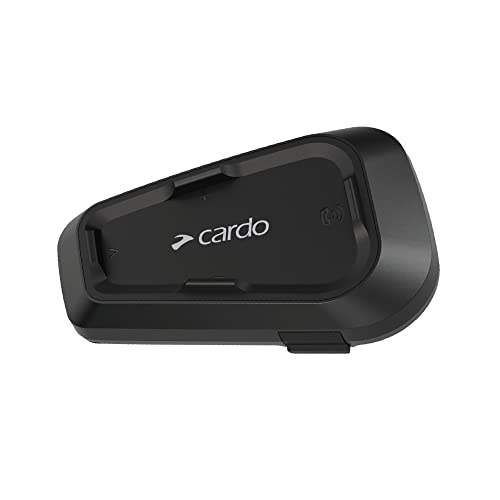
The best motorcycle intercoms in 2026 come from two brands: Cardo and Sena. The Cardo Packtalk Edge is the strongest all-round choice for group riders thanks to its Dynamic Mesh network, while the Sena 50S remains a dependable pick for riders who want reliable pairing, strong audio and a wide accessory ecosystem. For a simple two-up or solo setup, a compact unit such as the Cardo Spirit keeps cost and complexity down.
Our top picks



As an Amazon Associate we earn from qualifying purchases at no extra cost to you.
Quick comparison of top intercoms
| Pick | Best for | Key specs (approximate, per maker) | Price tier |
|---|---|---|---|
| Cardo Packtalk Edge | Large groups | Dynamic Mesh up to 15 riders, JBL speakers, about 13 h talk time | Premium |
| Sena 50S | Feature-rich riders | Mesh 2.0 (up to 24 riders), Bluetooth, about 8-20 h talk time by mode | Premium |
| Cardo Packtalk Bold | Mesh with better value | Dynamic Mesh up to 15 riders, JBL audio, voice control | Upper mid-range |
| Sena 30K | Mesh on a budget | Mesh 2.0 and Bluetooth intercom, about 13 h talk time | Mid-range |
| Cardo Spirit | Pairs and solo riders | Bluetooth intercom, about 13 h talk time, compact | Budget to mid |
Best overall: Cardo Packtalk Edge
The Packtalk Edge uses a mesh system where riders automatically join and leave the network, so the group stays connected even when the lead rider drops out of range. JBL speakers give clear voice and music at highway speeds, and voice commands let you control calls without taking hands off the bars. The trade-off is price, plus the need for every rider to have a compatible Cardo unit for full mesh benefits.
Best feature set: Sena 50S
The 50S supports Sena’s Mesh 2.0 as well as classic Bluetooth intercom, and it offers a clear control layout. Sena publishes support for large groups, and the Sena app and Device Manager make firmware updates and settings easy. Its Bluetooth intercom mode extends range in sparse areas, though battery life drops when mesh runs continuously. It suits riders who like deep customization.
Best value mesh: Sena 30K and Cardo Packtalk Bold
The Sena 30K delivers Mesh 2.0 and Bluetooth intercom in a cheaper, simpler package, which makes it a good starter for friends buying together. The Packtalk Bold sits just below the Edge, with similar mesh behavior and JBL audio but fewer premium extras. Both reduce the cost of building a group system; the compromise is fewer fine-tuning options and slightly less polish.
Best for pairs and solo riders: Cardo Spirit
The Spirit is compact, easy to mount and designed for rider-to-passenger or rider-to-rider communication over Bluetooth. It does not carry mesh, so it is not meant for large groups. If you mostly ride two-up or alone, it covers navigation prompts, music and calls at moderate cost.
Mesh versus Bluetooth: how to decide
| Factor | Bluetooth intercom | Mesh intercom |
|---|---|---|
| Typical group size | 2-8 riders, chained | 10-24 riders, flexible |
| Range | Up to about 1-2 km open air, rider to rider | Extends as riders relay, hop to hop |
| Dropout behavior | Chain breaks if a rider is lost | Group re-forms automatically |
| Battery use | Lower | Higher in active mesh |
If you ride with three or more friends regularly, mesh pays off. For one passenger or one friend, Bluetooth is enough and the unit costs less.
Worked example: a four-person group
Suppose four friends choose between four Packtalk Edge units and four Spirit units. With mesh, any rider can leave the group and rejoin without manual re-pairing. With Bluetooth, the chain requires pairing rider A to B, B to C and C to D, and one dropout affects everyone behind. If a typical group trip happens two weekends a month, the added convenience of mesh can justify the higher price for the group, but occasional riders will do fine with the cheaper units.
Installation and ownership realities
- Use the adhesive mount for slim helmets and the clamp mount for helmets with an edge. Clean the shell with isopropyl alcohol before sticking.
- Place speakers directly over your ears with foam or velcro; poor placement is the top cause of weak audio.
- Run charging cycles regularly and update firmware through the manufacturer app.
- Wind noise rises quickly above 100 km/h, so use the windscreen on the microphone and consider ear plugs that allow speakers to sit close.
- Check that the unit is compatible with your helmet’s chin bar and liner thickness, particularly for modular helmets.
Frequently Asked Questions
Can Cardo and Sena units talk to each other?
Both brands support universal intercom pairing in Bluetooth mode, so riders on different brands can usually connect, though only one at a time. Mesh networks are not cross-compatible between the two brands.
How long does a motorcycle intercom battery last?
Makers quote roughly 8 to 20 hours of talk time depending on the model and mode. Mesh generally uses more power than Bluetooth, and extreme temperatures shorten battery life.
Are intercoms safe to use while riding?
They are designed for hands-free use, but they can distract you. Keep calls short, avoid fiddling with controls in traffic and follow local laws on headset use.
Do intercoms work with any helmet?
Most units fit any full-face, modular or open-face helmet using clamp or adhesive mounts. Very thick liners or unusual shell shapes may need extra care when installing speakers.
Is mesh worth the extra cost?
For groups of three or more riding regularly, yes. It keeps the group connected without manual re-pairing. Solo riders and pairs rarely need it.


Write Your Review
No reviews yet. Be the first to share your experience!