

Key takeaways
- Compare the best textile motorcycle jackets for touring and commuting, with waterproof picks, venting options and armor coverage explained today.
As an Amazon Associate we earn from qualifying purchases.
A textile jacket is the one piece of riding gear most tourers and commuters end up living in. Leather blocks wind and mesh flows air, but a good textile shell with a waterproof membrane, real armor and a liner you can remove covers more of the year than either. The five jackets below show the main ways manufacturers build that versatility: a laminated shell that never soaks through, modular liner systems you reconfigure at a fuel stop, and fixed-membrane designs that ask nothing of you when the sky opens. Each pick is a genuine armored riding jacket, and each section covers its weather protection, its armor, and who it suits.


Disclosure: This article contains affiliate links. If you make a purchase through these links, we may earn a commission at no extra cost to you.
How to Choose
Begin with waterproofing, because it decides how the jacket behaves in hour three of rain. A laminated membrane is bonded directly to the outer shell, so rain beads on the surface and the fabric stays dry and light. A drop liner hangs as a separate waterproof sheet inside the shell. It keeps water off your base layers, but the outer shell soaks through first: it gains weight, holds cold water against the wind, and can take a day to dry in a hotel room. A third approach is a separate rain layer worn over or under the shell: effective, but one more thing to stop and manage. Know which system you are buying.
Be honest with yourself about heat: textile touring jackets run hot. A membrane that blocks rain also slows airflow, and zippered vents only move air when the bike is moving. The schemes that work best pair large chest intakes with back exhausts, so air has somewhere to go, plus forearm vents that cool the blood heading toward your hands. Jackets with big mesh panels flow far more air than any vent, at the expense of weather sealing. In slow traffic on a humid day, every jacket here feels warm; what matters is how quickly it cools once you are rolling.
Armor coverage matters more than armor marketing. Shoulders and elbows are the minimum, and CE Level 2 protectors absorb more energy than Level 1 while staying flexible. The back is where the fine print lives: many jackets ship with a thin foam pad or an empty pocket, and the proper insert is a separate purchase. Check what is fitted, and look for adjustable armor pockets: a protector that drifts off the joint when you add layers protects the jacket, not you.
Thermal liners decide the cold end of the range. A zip-out, full-sleeve insulated liner stretches a three-season shell toward winter, while laminated shells often skip insulation entirely and expect you to layer a fleece or a heated liner underneath. Fit follows the same split. Adventure cuts are longer and roomier, built for standing on the pegs and stacking layers; commuter cuts are trimmer and quieter at city speeds. Size for the layers you will actually wear, then check the fit in a riding position: hem over your waistband, sleeves reaching your gloves, armor centered on your shoulders and elbows.
Reflective panels earn their keep on grey mornings and unlit roads, so look for coverage across the chest, back and sleeves rather than a single small logo. Finally, plan for care. Road grime clogs membranes and flattens the water-repellent finish, so wash gently with a technical cleaner, air-dry away from direct heat, and re-proof the outer finish with a spray-on or wash-in treatment when water stops beading and begins soaking in. A membrane can be healthy while the surface finish is tired; renewing that finish is routine maintenance.
Klim Carlsbad
The Carlsbad is the laminated answer to touring in wet climates. Its Gore-Tex Performance Shell is bonded to the outer fabric, so the shell never soaks: the jacket weighs the same in hour six of a storm as in hour one, and it dries fast overnight. The main chassis uses the same FPL400 fabric as Klim’s flagship Badlands Pro, with 630D Cordura overlays across the shoulders and elbows where slides usually happen.
Protection is complete out of the box. KLIM Rogue CE Level 2 vented protectors sit at the shoulders, elbows and back — the back pad is included rather than left as an empty pocket — and the whole garment carries a CE AA class under EN 17092. Venting comes from two double-headed forearm vents, two chest vents and two back exhausts, with a collar that tabs back to open the neck on hot climbs. There is deliberately no thermal liner: Klim expects you to layer underneath, ideally with a good mid layer or heated gear. Storage is adventure-grade, down to a dedicated satellite communicator pocket. You can check sizes and colors on the Klim Carlsbad listing.
Specs
- Shell: Gore-Tex Performance Shell laminate over an FPL400 main chassis
- Overlays: 630D Cordura twisted-yarn fabric at the shoulders and elbows
- Armor: KLIM Rogue CE Level 2 vented protectors at shoulders, elbows and back
- Venting: two double-headed forearm vents, two chest vents, two back exhaust vents
- Garment class: CE AA certified to EN 17092
- Storage: cargo, chest and internal pockets, satellite communicator pocket, forearm ID pocket
REV’IT! Tornado 4 H2O
Where the Carlsbad bonds its waterproofing in place, the Tornado 4 H2O takes the opposite route: everything comes apart. The shell mixes PWR|Shell 750D with large 3D air mesh panels, so with both liners removed it flows air like a summer jacket. Zip in the detachable hydratex Lite liner when rain arrives — worn over the shell, it keeps the shell itself dry — then add the detachable thermal liner when the temperature drops. That three-layer flexibility is the whole point of the design, and it makes the Tornado the easiest jacket here to live with in hot, changeable climates.
Armor is SEEFLEX CE Level 2 at the shoulders and elbows, and the garment carries a CE AA class under EN 17092. The honest gap is the back: the jacket is prepared for a SEESOFT CE Level 2 insert and a divided chest protector, but both are separate purchases and the pockets ship empty. Fit is a regular touring cut with adjustment at the waist, arms and cuffs, plus a long connection zipper for riding pants. You can check sizes and colors on the REV’IT! Tornado 4 H2O listing.
Specs
- Shell: PWR|Shell 750D with 3D air mesh panels
- Waterproofing: detachable hydratex Lite liner, wearable over or under the shell
- Armor: SEEFLEX CE Level 2 protectors at the shoulders and elbows
- Back protection: prepared for a SEESOFT CE Level 2 insert, sold separately
- Liners: detachable thermal liner included
- Garment class: CE AA certified to EN 17092
Firstgear Kathmandu 2.0

The Kathmandu 2.0 is built around two ideas: armor everywhere, and pockets for everything. Its 420D ripstop shell carries a Sympatex waterproof-breathable membrane, and Firstgear adds a removable waterproof liner as a second barrier, so rain has to defeat two systems before it reaches you. Shoulder and chest intake vents with twin back exhausts handle airflow when the weather turns warm.
The armor package is the standout. SAS-TEC CE Level 2 protectors are fitted at the shoulders, elbows and back — the back piece is a genuine protector certified to EN 1621-2:2014, not a foam placeholder — and the limb pockets adjust so the pads sit exactly on your joints. Storage runs to seven waterproof pockets, including front and rear cargo dry pockets for the things that cannot get wet. A rain hood tucks under your helmet to stop drips down the neck, and internal routing lets the jacket work with Firstgear heated liners on cold tours. You can check sizes and colors on the Firstgear Kathmandu 2.0 listing.
Specs
- Shell: 420D ripstop nylon with a Sympatex waterproof-breathable membrane
- Waterproofing: membrane shell plus a removable waterproof liner
- Armor: SAS-TEC CE Level 2 protectors at shoulders, elbows and back
- Venting: shoulder and chest intake vents with twin back exhausts
- Storage: seven waterproof pockets, including front and rear cargo dry pockets
- Extras: under-helmet rain hood and internal routing for heated gear
Tourmaster Transition Series 4
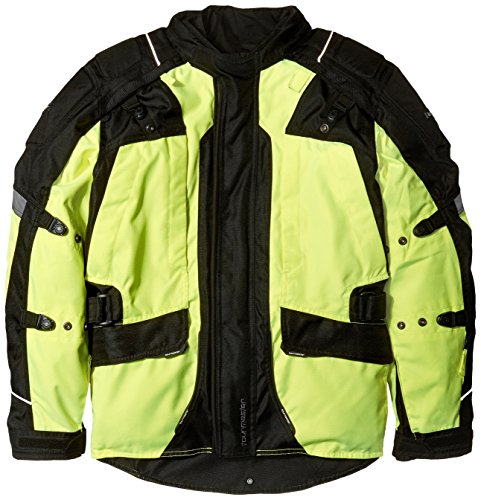
The Transition Series 4 is the traditional road-touring formula done thoroughly. A 600D Carbolex shell with 1680D ballistic overlays at the shoulders and elbows handles abrasion, while a removable Rainguard waterproof-breathable liner keeps rain out and a zip-out quilted thermal liner handles cold mornings. Because both liners come out, the same jacket commutes through spring showers, crosses a hot plateau in summer with its Pipeline vents open, and keeps working into autumn.
Pipeline venting runs across the chest, shoulders and arms with exhausts at the back, and it moves a useful amount of air for a solid-shell jacket. CE protectors are fitted at the shoulders and elbows; the back gets a foam pad, so plan to add a certified insert if you want spine coverage. Reflective piping is worked across the shell for night visibility, and the fit is a relaxed American touring cut that layers comfortably in a broad size range. You can check sizes and colors on the Tourmaster Transition Series 4 listing.
Specs
- Shell: 600D Carbolex with 1680D ballistic overlays at shoulders and elbows
- Waterproofing: removable Rainguard waterproof-breathable liner
- Thermal liner: zip-out quilted liner included
- Armor: CE protectors at shoulders and elbows; foam back pad
- Venting: Pipeline chest, arm and back vents
- Visibility: reflective piping across the shell
Alpinestars Andes Drystar
The Andes Drystar is the low-fuss option in this group. Its Drystar waterproof-breathable membrane is built into the jacket’s construction rather than carried as a liner, so there is nothing to zip in when rain arrives and nothing to leave at home by mistake: you simply ride through it. The poly-fabric shell uses reinforced panels in the impact zones, and a removable long-sleeve thermal liner extends the jacket into cold weather.
Shoulder and elbow protectors are CE Level 1, and the back and chest compartments accept optional Alpinestars inserts — both pockets ship empty, so factor in an insert if you want spine coverage. Zippered chest intakes and back exhaust ports help on warm days, pre-curved sleeves keep the fit natural in the riding position, and reflective detailing aids night visibility. The cut is a straightforward touring fit that works over a fleece without bulk — an easy daily jacket for riders whose weather is more often damp than extreme. You can check sizes and colors on the Alpinestars Andes Drystar listing.
Specs
- Shell: poly-fabric textile with reinforced panels in impact zones
- Waterproofing: fixed Drystar waterproof-breathable membrane
- Armor: CE Level 1 protectors at the shoulders and elbows
- Back protection: pocket for an optional back insert, sold separately
- Thermal liner: removable long-sleeve liner included
- Venting: zippered chest intakes and back exhaust ports
FAQ
Are textile motorcycle jackets actually waterproof?
It depends on the construction. A laminated jacket keeps rain out at the shell, so it stays light and dries quickly. A liner-based jacket also keeps you dry, but the outer shell soaks through and holds water, which adds weight and pulls heat away on cold, windy days. The surface finish is only the first line of defense; the membrane underneath does the real work, and keeping that finish re-proofed helps any design shed rain longer.
How hot do textile touring jackets get in summer?
Hotter than most riders expect. A waterproof membrane slows airflow even with every vent open, and vents do little at walking pace or in traffic. Large chest intakes paired with back exhausts help most at highway speed, and jackets with mesh panels — or shells you can strip down to mesh — are the better answer for genuinely hot climates. If your summer riding is mostly slow and humid, treat a touring textile as a three-season jacket and keep a mesh jacket for the peak weeks.
Do these jackets include back protectors?
Some do, and some very much do not. The Klim Carlsbad and the Firstgear Kathmandu 2.0 both include CE Level 2 back protectors in the box. The Tourmaster Transition Series 4 ships with a foam back pad, while the REV’IT! Tornado 4 H2O and the Alpinestars Andes Drystar have empty pockets sized for inserts sold separately. Always check what is actually fitted, and if the pocket is empty, adding a certified insert is one of the most worthwhile upgrades you can make.
How do I wash a textile jacket and renew its water repellency?
Remove the armor first, close the zippers, and wash gently with a technical cleaner made for waterproof gear — household detergents leave residues that clog the membrane. Air-dry away from radiators and direct heat. When water stops beading on the shell and begins soaking in, re-proof the outer finish with a spray-on or wash-in treatment. That renews the surface beading so the membrane underneath is not overwhelmed — normal maintenance every season or two.
Conclusion
Match the jacket to the weather you actually ride in. For wet-climate adventure touring, the Klim Carlsbad is the pick: a laminated shell that never soaks, complete CE Level 2 armor including the back, and storage for long days. For hot, changeable climates, the REV’IT! Tornado 4 H2O wins on flexibility, stripping down to a mesh shell and building back up layer by layer. Riders who want the strongest armor package and serious luggage-grade pockets should take the Firstgear Kathmandu 2.0. For daily commuting and road touring, the Tourmaster Transition Series 4 covers the year with its two removable liners and relaxed fit. And if you want waterproofing that asks nothing of you at all, the Alpinestars Andes Drystar, with its fixed membrane, is the simplest jacket here to live with.
More from Amazon
Programs that pair well with the guide above. Offers and eligibility are set by Amazon and may change.
Free shipping on eligible items, Prime Video and more. Eligible new members can start with a free trial.
Start a Prime free trialA Prime membership for ages 18-24 with a trial period. Eligibility is set by Amazon.
See Prime for Young AdultsAudiobooks and podcasts to listen to on the go. Eligible new members can start with a free trial.
Try Audible freeAd-free music streaming. Eligible new subscribers can start with a free trial.
Try Music Unlimited freeAs an Amazon Associate we earn from qualifying purchases.

Write Your Review
No reviews yet. Be the first to share your experience!