

Our Short List of 3

- Best for: shared clinical benches spinning mixed 2-15 ml tube sizes all day
- Brand: LAB FISH
- Item model number: LC-8S-1
- Speed range: 500-5000 RPM
- Maximum RCF: 3074 xg

- Best for: PRP and routine separation work built around two repeated protocols
- Brand: ONiLAB
- Model: DM0506
- Speed range: 300-5000 rpm, in 10 rpm increments
- Rotor: built-in fixed-angle A6-15P with adaptors

- Best for: lower-speed biochemistry and cosmetic preparation needing a stated lid lock
- Brand: QIUSUO
- Speed range: 500 to 4000 RPM
- Maximum RCF: 2146 xg
- Rotor semi-diameter: 12 cm
All 3 Picks at a Glance
| Product | Specs | Action |
|---|---|---|
| LAB FISH LC-8S Centrifuge |
| Check price on Amazon |
| ONiLAB Lab PRP Benchtop Centrifuge DM0506 |
| Check price on Amazon |
| QIUSUO Benchtop Centrifuge |
| Check price on Amazon |
Key takeaways
- Compare benchtop centrifuges whose listings state a lid or rotor locking feature, with specs on speed, capacity, timers and lock release behaviour.
Choosing a benchtop centrifuge is mostly a safety decision disguised as a speed decision. A rotor turning several thousand times per minute stores serious energy, so the lock holding the lid shut until that rotor stops matters as much as the headline rpm figure. Buyers also have to separate genuine locking mechanisms from vague wording, because some listings mention a latch or cover without ever stating that it locks during a run.
This guide is for clinical technicians, PRP practitioners, teaching-lab staff and small research teams who need that locking behaviour stated plainly before they order. Every model below was selected because its Amazon listing names a lid lock, lid interlock or safety lock feature in its own wording, and each specification quoted here comes from that listing rather than from a brochure or a review site.
Quick Picks
As an Amazon Associate we earn from qualifying purchases
| Product | Best for | Key spec |
|---|---|---|
| LAB FISH LC-8S Centrifuge | Mixed tube sizes on one shared bench | Automatic lid lock, 500-5000 RPM |
| ONiLAB Lab PRP Benchtop Centrifuge DM0506 | Repeated PRP protocols with saved settings | Door lid-interlock, 300-5000 rpm |
| QIUSUO Benchtop Centrifuge | Lower-speed biochemistry and cosmetic work | Automatic lid-lock system, 500-4000 RPM |
How to Choose
Read the Lock Wording Literally
Manufacturers describe containment in several distinct ways, and only some of them describe an actual lock. Phrases such as automatic lid lock, door lid-interlock and smart electronic safety lock state that the lid is held shut and cannot be opened while the rotor turns. A listing that merely mentions a lid, a cover or a latch tells you nothing about behaviour during a run. Check also what happens at the end of the cycle: some models release the lock automatically once the rotor stops, while others need a manual release, and that difference shapes how a busy bench flows between back-to-back samples.
Match Rotor Capacity to Your Tube Mix
Capacity figures hide two separate questions: how many tubes fit, and which sizes the rotor accepts without extra parts. A fixed-angle rotor drilled for eight positions that accepts 2, 5, 10 and 15 ml tubes covers most clinical draws in one load. A six-place rotor relying on adaptors for smaller tubes can be equally flexible, but only if those adaptors are included in the box. Count your typical batch before ordering, because an undersized rotor forces a second run, and remember that every position opposite another must carry a balanced load of equal weight for the spin to stay smooth.
Compare Speed Range and RCF, Not Just Top Speed
Protocols are written in relative centrifugal force, yet many listings lead with revolutions per minute. Two machines sharing a 5000 rpm ceiling can deliver quite different maximum RCF figures because rotor radius differs, so check the stated xg value against the force your protocol actually requires. The bottom of the range matters too: gentle separations suffer when a centrifuge cannot run slowly in a controlled way. Increment size is worth a glance as well, since fine steps let you reproduce a setting exactly instead of approximating it between coarse detents on a dial.
Check the Timer, Display and End-of-Run Behaviour
Timed runs free staff from watching a bench, but timer ranges vary widely between models. Short spin-down work needs a range that starts in seconds, while longer separations need settings approaching an hour or more without babysitting. A digital display that shows speed and remaining time at a glance reduces setting errors compared with an unmarked knob. Finally, look for supporting safety behaviour around the lock itself, such as imbalance alarms or an overspeed detector, because those systems protect the rotor long before a lock is ever asked to do its job.
The 3 Best Options
LAB FISH LC-8S Centrifuge
- Best for: shared clinical benches spinning mixed 2-15 ml tube sizes all day
- Brand: LAB FISH
- Item model number: LC-8S-1
- Speed range: 500-5000 RPM
- Maximum RCF: 3074 xg
shared clinical benches spinning mixed 2-15 ml tube sizes all day
confirm your tubes match the four listed sizes, since the fixed rotor accepts no other formats
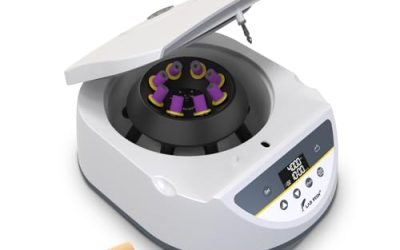
The LC-8S suits benches that spin several tube sizes through the day and want the locking behaviour spelled out rather than implied. Its listing describes a smart electronic safety lock alongside an automatic lid lock and malfunction alarms, so the lid stays secured while the brushless motor runs anywhere between 500 and 5000 RPM. Eight rotor positions accept 2, 5, 10 and 15 ml tubes, which covers routine clinical and PRP loads without swapping hardware. An LCD display handles timing from ten seconds up to just under one hundred minutes, and an instantaneous centrifugation function covers quick spin-downs between timed runs.
ONiLAB Lab PRP Benchtop Centrifuge DM0506
- Best for: PRP and routine separation work built around two repeated protocols
- Brand: ONiLAB
- Model: DM0506
- Speed range: 300-5000 rpm, in 10 rpm increments
- Rotor: built-in fixed-angle A6-15P with adaptors
PRP and routine separation work built around two repeated protocols
the six-place rotor is the capacity ceiling, so larger batches need a second run
ONiLAB words its protection as a door lid-interlock, and the listing is specific about the sequence: the interlock prevents the lid opening until the rotor has stopped spinning, then an automatic lid-lock release frees it when the operation ends. That behaviour fits PRP work, where the same separation runs repeatedly and staff open the machine the moment each cycle finishes. Speed can be set and displayed in RPM or RCF, two stored programs recall routine settings with one key, and an overspeed detector watches the run. A cast iron base with vacuum suction feet keeps the unit planted on the bench.
QIUSUO Benchtop Centrifuge
- Best for: lower-speed biochemistry and cosmetic preparation needing a stated lid lock
- Brand: QIUSUO
- Speed range: 500 to 4000 RPM
- Maximum RCF: 2146 xg
- Rotor semi-diameter: 12 cm
lower-speed biochemistry and cosmetic preparation needing a stated lid lock
the 4000 RPM ceiling and 2146 xg maximum rule it out for high-force protocols
The QIUSUO model targets gentler work, topping out at 4000 RPM, and its title and listing both put the safety wording up front: a safety lid-lock, described in the listing as an automatic lid-lock system that prevents accidental opening during operation. The lid also opens automatically once a run ends, which suits cosmetic and PRP preparation where the operator’s hands are often gloved or occupied. A maximum RCF of 2146 xg covers biochemistry separations that never call for high-force pelleting, and the rotor semi-diameter is stated at 12 cm for buyers calculating force for their own tube lengths.
Which One Fits Your Situation
A Small Clinic Running Mixed Tube Sizes Daily
Pick the LAB FISH LC-8S. Its eight positions accept 2, 5, 10 and 15 ml tubes in a single load, so one machine handles paediatric draws and standard adult samples without a rotor change. The automatic lid lock and malfunction alarms suit a bench where several staff members share the same unit, and the wide timer range covers both quick spin-downs and longer separations across a full clinic day.
A PRP Practice Repeating the Same Two Protocols
Choose the ONiLAB DM0506. Its two stored programs let staff start a familiar separation with one key instead of re-entering settings, and the display can show RCF directly when a protocol is written in force rather than rpm. The door lid-interlock holds until the rotor stops, then releases automatically, which keeps turnaround brisk between patients without anyone forcing a lid.
A Cosmetic Studio Doing Gentle Separations
The QIUSUO benchtop centrifuge fits work that never approaches high force. Its 500-4000 RPM range and 2146 xg maximum cover PRP and cosmetic preparation comfortably, the automatic lid-lock system guards the run, and the lid opening automatically at the end suits an operator whose hands are busy with syringes and vials. It is the simplest match when protocols stay gentle.
A Teaching Lab Where Students Load the Machine
Either locked model works, but the LAB FISH LC-8S has an edge because its listing pairs the automatic lid lock with malfunction alarms, giving supervisors an audible cue when something is wrong. Whichever unit a teaching lab picks, the stated interlock behaviour matters more than top speed, since inexperienced users are the ones most likely to try opening a lid early.
Common Mistakes
- Assuming every centrifuge lid locks during a run, when many listings only describe a cover or latch and never state locking behaviour at all
- Comparing top rpm figures while ignoring maximum RCF, even though rotor radius makes two machines with equal rpm deliver different force
- Loading tubes without balancing equal weights in opposite positions, which stresses the rotor and can trigger imbalance alarms mid-run
- Buying a rotor capacity that fits today’s batch but leaves no room when sample volume grows, forcing double runs every day
- Trying to open the lid the moment a cycle ends instead of waiting for the lock to release after the rotor has fully stopped
Frequently Asked Questions
What does rotor locking actually mean on a benchtop centrifuge?
In practice, the term covers the lid and interlock systems that keep the rotor chamber sealed while the rotor turns. Listings phrase it differently: automatic lid lock, door lid-interlock or safety lock. The shared behaviour is that the lid cannot be opened until rotation stops, and some models then release the lock automatically so the next load can start sooner.
Can a centrifuge run if the lid lock fails to engage?
On the ONiLAB DM0506, the listing describes a door lid-interlock designed to prevent opening until the rotor stops, backed by an overspeed detector and automatic internal self-testing at switch-on. Any machine that reports a lock fault should be taken out of service rather than run with the fault ignored, because the lock is the barrier between the operator and a spinning rotor.
Is RCF or RPM the better figure to compare?
RCF transfers between machines, while RPM does not. A protocol written as 2000 xg produces the same separation on any centrifuge, whereas 4000 rpm yields different force depending on rotor radius. That is why the listings above quote both figures where the manufacturer states them, and why a stated maximum such as 3074 xg or 2146 xg deserves more weight than the speed ceiling alone.
How many tubes should a small lab plan for?
Count the largest batch you spin at once, then add headroom for a busy day. An eight-place rotor like the one on the LAB FISH LC-8S handles most routine clinical loads in a single run, while a six-place rotor suits practices processing smaller, repeated batches. Remember that positions must be balanced in opposing pairs, so usable capacity on a partly filled rotor is always even.
More from Amazon
Programs that pair well with the guide above. Offers and eligibility are set by Amazon and may change.
Free shipping on eligible items, Prime Video and more. Eligible new members can start with a free trial.
Start a Prime free trialA Prime membership for ages 18-24 with a trial period. Eligibility is set by Amazon.
See Prime for Young AdultsAudiobooks and podcasts to listen to on the go. Eligible new members can start with a free trial.
Try Audible freeAd-free music streaming. Eligible new subscribers can start with a free trial.
Try Music Unlimited freeAs an Amazon Associate we earn from qualifying purchases.
Write Your Review
No reviews yet. Be the first to share your experience!