

Our Short List of 3

- Best for: A home shop on a standard 120-volt circuit that wants blade-brake safety and a wide fence.
- Motor: TEFC induction, 120V, 14A; the listing shows 1.75 HP in the title and technical specs but 1.3 HP in the Power Source field
- Blade: 10-inch, 40-tooth blade included
- Fence: 52-inch Professional T-Glide fence system
- Included: miter gauge, Micro Blade Guard, riving knife, blade wrenches, push stick, standard brake cartridge
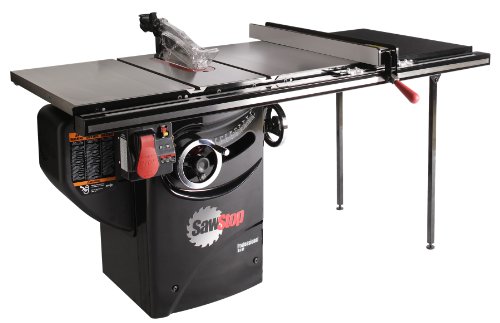
- Best for: A permanent professional shop with a 230-volt circuit that rips hardwood and sheet goods daily.
- Motor: 3 HP TEFC induction, 1-phase, 230V, 13A
- Blade: 10-inch, 40-tooth blade included
- Fence: 36-inch Professional T-Glide fence, rail, and table assembly
- Cast iron table: 20 x 27 inches; cabinet footprint 19-3/8 x 19-3/8 inches

- Best for: A small shop that wants cabinet-saw build quality and a wide fence on household 115-volt power.
- Motor: 1-3/4 HP TEFC induction, 115/230V, 1-phase; prewired for 115V
- Blade: 10-inch; arbor speed 4,200 RPM
- Rip capacity: 52 inches
- Current: 20 amps at 115V
All 4 Picks at a Glance
| Product | Specs | Action |
|---|---|---|
| SawStop Contractor Saw CNS175-TGP252 (1.75 HP, 52-Inch T-Glide Fence) |
| Check price on Amazon |
| SawStop Professional Cabinet Saw PCS31230-TGP236 (3 HP, 36-Inch T-Glide Fence) |
| Check price on Amazon |
| Powermatic PM1000 1791001K (1-3/4 HP, 52-Inch Rip) |
| Check price on Amazon |
 SawStop Professional Cabinet Saw PCS175-TGP236 (1.75 HP, 36-Inch T-Glide Fence) |
| Check price on Amazon |
Key takeaways
- Compare four table saws with induction motors for quiet, steady ripping, from contractor saws to cabinet saws, with fence, voltage and dust notes.
A table saw with an induction motor changes the decision from how loud the cut feels to how the saw fits the shop. Induction motors run quieter and smoother than the universal motors in portable saws, and they hold speed better when the blade meets thick hardwood. The real choice is not between brands but between a contractor saw that plugs into a standard outlet, a hybrid that borrows cabinet-saw construction, and a full cabinet saw that needs a 230-volt circuit and a permanent spot on the floor.
This guide is for home woodworkers setting up a first stationary saw, owners upgrading from a portable saw, and professionals who rip hardwood and sheet goods every week. Each saw below is a stationary table saw with a belt-driven induction motor, chosen from its Amazon listing details: motor size, blade size, fence, rip capacity, and included parts. Read the voltage and circuit notes before ordering, because the wrong circuit is the most common reason a new saw cannot run on delivery day.
Quick Picks
As an Amazon Associate we earn from qualifying purchases.
| Product | Best for | Key spec from title |
|---|---|---|
| SawStop Contractor Saw CNS175-TGP252 | A 120V home shop that wants blade-brake safety and wide rips | 1.75-HP, 52-inch T-Glide fence |
| SawStop Professional Cabinet Saw PCS31230-TGP236 | A permanent shop with a 230V circuit | 3-HP, 36-inch T-Glide fence |
| Powermatic PM1000 (1791001K) | A small shop that wants cabinet build on household power | 1-3/4 HP, 52-inch rip |
| SawStop Professional Cabinet Saw PCS175-TGP236 | A small shop that wants a cabinet saw plus blade-brake safety | 1.75-HP, 36-inch T-Glide fence |
How to Choose
Motor type and circuit
Induction motors spin the blade through a belt, so the motor sits away from sawdust and vibration, runs quieter, and keeps torque steady through thick stock. Universal motors drive the blade directly, spin faster, and wear brushes, which is why they suit portable saws and not a stationary shop saw. Check the circuit before anything else. A 1.75 HP saw on 120 volts usually needs a dedicated 20-amp circuit, while a 3 HP cabinet saw needs a 230-volt circuit that many garages do not have. Confirm the outlet, the breaker, and the cord length in the manual before the saw arrives, because adding a circuit after delivery delays the first cut by days.
Rip capacity and fence
Rip capacity decides whether a saw handles full sheets and wide panels or only narrow boards. A 30-inch fence covers most furniture parts, a 36-inch fence adds room for wider panels, and a 52-inch fence lets one person break down sheet goods without a second pair of hands. The fence matters as much as the number. A T-square fence that locks square at the front and rear stays true across its travel, while a fence that flexes forces constant rechecking. Look at the rail material, the locking mechanism, and whether the fence slides smoothly across the full rail. Extension wings add support for long boards, so check whether they ship in the box or arrive as a separate part.
Table, trunnions, and weight
A cast iron table stays flat through temperature changes and damps vibration better than an aluminum top, which shows up as cleaner edges and less sanding. Cabinet-mounted trunnions hold alignment longer than table-mounted trunnions, because the blade assembly hangs from the cabinet instead of the table surface. Weight is part of the same decision. A saw near 400 pounds stays planted during heavy rips and resists tipping, but it needs two people and a planned path to move into place. Measure the doorway, the floor space, and the route from the driveway before ordering, and decide whether a mobile base belongs on the same order so the saw can shift for cleaning.
Safety hardware and dust control
The guard, riving knife, and anti-kickback pawls are not optional extras. The guard covers the blade above the cut, the riving knife keeps the kerf open behind the blade so the board cannot pinch and kick back, and the pawls add a second layer of protection on through cuts. Some saws add a brake that stops the blade on skin contact, which changes the risk of a serious cut but does not replace careful technique. Dust control matters too. A 4-inch dust port connected to a collector keeps the cabinet clear and the air cleaner, while a blade guard with its own dust pickup catches what escapes above the table. Confirm which guards ship in the box.
The 4 Best Options
SawStop Contractor Saw CNS175-TGP252 (1.75 HP, 52-Inch T-Glide Fence)
- Best for: A home shop on a standard 120-volt circuit that wants blade-brake safety and a wide fence.
- Motor: TEFC induction, 120V, 14A; the listing shows 1.75 HP in the title and technical specs but 1.3 HP in the Power Source field
- Blade: 10-inch, 40-tooth blade included
- Fence: 52-inch Professional T-Glide fence system
- Included: miter gauge, Micro Blade Guard, riving knife, blade wrenches, push stick, standard brake cartridge
A home shop on a standard 120-volt circuit that wants blade-brake safety and a wide fence.
The listing shows conflicting horsepower figures (1.75 HP in the title and technical specs, 1.3 HP in the Power Source field), so confirm the motor figures on the listing before ordering. The saw is heavy, so plan assembly help and a mobile base.
The SawStop contractor saw suits a home shop that wants serious safety hardware without rewiring the garage. Its 1.75 HP induction motor runs on a standard 120-volt circuit, and the 52-inch T-Glide fence gives enough room to rip sheet goods in one pass. The blade brake stops the blade on skin contact, which is the feature that sets this saw apart from other contractor saws. Cast iron extension wings and a heavy frame keep the saw steady, while the included miter gauge, guard, and riving knife cover the basic cutting setup from the first day.
Watch out for: The listing shows conflicting horsepower figures (1.75 HP in the title and technical specs, 1.3 HP in the Power Source field), so confirm the motor figures on the listing before ordering. The saw is heavy, so plan assembly help and a mobile base.
SawStop Professional Cabinet Saw PCS31230-TGP236 (3 HP, 36-Inch T-Glide Fence)
- Best for: A permanent professional shop with a 230-volt circuit that rips hardwood and sheet goods daily.
- Motor: 3 HP TEFC induction, 1-phase, 230V, 13A
- Blade: 10-inch, 40-tooth blade included
- Fence: 36-inch Professional T-Glide fence, rail, and table assembly
- Cast iron table: 20 x 27 inches; cabinet footprint 19-3/8 x 19-3/8 inches
A permanent professional shop with a 230-volt circuit that rips hardwood and sheet goods daily.
It needs a 230-volt circuit and a permanent spot; at 426 lbs it takes two people to move and position.
The 3 HP SawStop cabinet saw is the pick for a permanent shop where the saw runs for hours and the work is mostly hardwood and sheet goods. Its 230-volt induction motor holds speed through deep cuts that would slow a smaller saw, and the enclosed cabinet with cast iron wings keeps vibration low. The 36-inch T-Glide fence locks square and stays true across its travel, which matters when every cabinet part must match. The blade brake, dust collection guard, and riving knife arrive in the box, so the safety setup is complete without extra parts.
Watch out for: It needs a 230-volt circuit and a permanent spot; at 426 lbs it takes two people to move and position.
Powermatic PM1000 1791001K (1-3/4 HP, 52-Inch Rip)
- Best for: A small shop that wants cabinet-saw build quality and a wide fence on household 115-volt power.
- Motor: 1-3/4 HP TEFC induction, 115/230V, 1-phase; prewired for 115V
- Blade: 10-inch; arbor speed 4,200 RPM
- Rip capacity: 52 inches
- Current: 20 amps at 115V
A small shop that wants cabinet-saw build quality and a wide fence on household 115-volt power.
The listing states the dado insert and saw blade are sold separately, so check what arrives in the box. At 115 volts it needs a dedicated 20-amp circuit.
The Powermatic PM1000 fits a small shop that wants cabinet-saw construction without a 230-volt circuit. Its 1-3/4 HP induction motor runs on 115 volts, and the poly-V belt drive keeps vibration low enough for clean edges on furniture parts. The 52-inch Accu-Fence handles full sheets, and the cast iron table with a beveled edge supports long boards without catching. The arbor lock makes one-handed blade changes simple, and the hands-free power switch sits where a knee can reach it. It is the quietest kind of upgrade from a portable saw: same outlet, far steadier cuts.
Watch out for: The listing states the dado insert and saw blade are sold separately, so check what arrives in the box. At 115 volts it needs a dedicated 20-amp circuit.
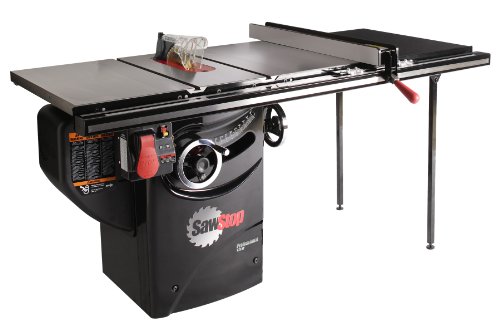
SawStop Professional Cabinet Saw PCS175-TGP236 (1.75 HP, 36-Inch T-Glide Fence)
- Best for: A small permanent shop that wants a cabinet saw and blade-brake safety on a standard circuit.
- Motor: 1.75 HP TEFC induction, 110V single-phase, 14A; configurable to 220V
- Blade: 10-inch; arbor speed 4,000 RPM
- Fence: 36-inch Professional T-Glide fence system
- Dust collection: above and below the table through the guard and cabinet
A small permanent shop that wants a cabinet saw and blade-brake safety on a standard circuit.
Published weights differ across sources (408 to 471 lbs), so confirm the weight on the listing and plan help for delivery. A brake activation needs a replacement cartridge and usually a new blade.
The 1.75 HP SawStop cabinet saw brings cabinet construction and the blade brake to a shop that only has a standard circuit. It runs on 110 volts and can be rewired for 220 volts later, so the saw grows with the shop instead of forcing electrical work on day one. The 36-inch T-Glide fence and cast iron cabinet give the same steady, square cutting as the larger cabinet saw, and the gas piston elevation makes blade height changes smooth. For a small shop that plans to keep one saw for years, this is the most complete single purchase in the group.
Watch out for: Published weights differ across sources (408 to 471 lbs), so confirm the weight on the listing and plan help for delivery. A brake activation needs a replacement cartridge and usually a new blade.
Which One Fits Your Situation
A standard 120-volt garage, first stationary saw
Pick the SawStop Contractor Saw CNS175-TGP252. It runs on a standard circuit, so there is no electrical work before the first cut, and the 52-inch fence handles sheet goods that a portable saw struggles with. The blade brake adds protection while a new owner is still building habits. Add a mobile base if the garage shares space with a car, and check the listing’s motor figures before ordering.
A permanent shop with a 230-volt circuit
Pick the SawStop Professional Cabinet Saw PCS31230-TGP236. The 3 HP motor holds speed through thick hardwood, and the enclosed cabinet keeps the saw steady during long ripping sessions. The 36-inch fence covers cabinet parts and panels without taking the floor space of a 52-inch setup. Plan a permanent position near the dust collector, because this saw is not meant to move once it is set.
A small shop that wants cabinet build on household power
Pick the Powermatic PM1000. It brings a cast iron table, an Accu-Fence, and a poly-V belt drive to a shop that only has 115-volt outlets, and the 52-inch rip capacity handles full sheets. The hands-free switch and arbor lock make daily use smoother than a contractor saw. Confirm the blade situation before ordering, since the listing states the blade is sold separately, and put the saw on a dedicated 20-amp circuit.
A small shop that wants the brake and a cabinet saw
Pick the SawStop Professional Cabinet Saw PCS175-TGP236. It pairs the blade brake with a cast iron cabinet on a standard 110-volt circuit, and it can move to 220 volts later if the shop is rewired. The 36-inch fence suits furniture and cabinet work without the footprint of a 52-inch fence. Expect a heavy delivery and a longer assembly session, and keep a spare brake cartridge on hand once the saw is running.
Safety Notes
Table saws demand respect on every cut, so read the manual for the saw you buy and follow its setup and operating instructions. Keep the blade guard and riving knife in place for through cuts, use a push stick for narrow rips, and keep hands clear of the blade path. Wear eye and hearing protection, and connect dust collection before switching the saw on. Disconnect power before changing the blade or clearing a jam. A brake system reduces the harm from accidental contact, but it does not replace guards, a sharp blade, and a steady feed.
Common Mistakes
- Ordering a 230-volt saw for a garage that only has 120-volt outlets, then discovering the circuit work after delivery.
- Choosing by horsepower alone and ignoring the fence, the table, and whether the blade guard ships in the box.
- Skipping the dedicated 20-amp circuit for a 1.75 HP saw and tripping the breaker on the first deep cut.
- Removing the riving knife or guard for convenience and losing the protection that prevents kickback.
- Measuring the saw but not the doorway and the delivery path, then finding the cabinet cannot reach its spot.
Frequently Asked Questions
What makes an induction motor better in a table saw?
An induction motor drives the blade through a belt, so it runs quieter, vibrates less, and holds speed better under load than the direct-drive universal motor in a portable saw. It also has no brushes to wear out, which suits a stationary saw that runs for hours. The trade-off is size and weight, and most induction saws need a dedicated circuit.
Can I run an induction-motor table saw on a standard outlet?
Many 1.75 HP induction saws run on a standard 120-volt outlet, but they usually need a dedicated 20-amp circuit with nothing else on it. A 3 HP cabinet saw needs a 230-volt circuit, which most garages do not have without electrical work. Check the motor plate and the manual for the exact circuit, and confirm the outlet before the saw arrives.
Do I still need a blade brake if the saw has a guard and riving knife?
Yes, because the guard, riving knife, and brake protect against different failures. The guard covers the blade, the riving knife stops the board from pinching the blade, and the brake stops the blade itself on skin contact. No single device covers every mistake, so keep all of them in place and keep your technique careful on every cut.
How much rip capacity do I need?
A 30-inch fence covers most furniture parts and cabinet components. A 36-inch fence adds room for wider panels and reduces the need to cut sheets down before ripping. A 52-inch fence lets one person break down full sheets, but it takes more floor space and needs extension support. Match the fence to the widest material you cut regularly, not to the widest board you might cut once.
More from Amazon
Programs that pair well with the guide above. Offers and eligibility are set by Amazon and may change.
Free shipping on eligible items, Prime Video and more. Eligible new members can start with a free trial.
Start a Prime free trialA Prime membership for ages 18-24 with a trial period. Eligibility is set by Amazon.
See Prime for Young AdultsAudiobooks and podcasts to listen to on the go. Eligible new members can start with a free trial.
Try Audible freeAd-free music streaming. Eligible new subscribers can start with a free trial.
Try Music Unlimited freeAs an Amazon Associate we earn from qualifying purchases.





Write Your Review
No reviews yet. Be the first to share your experience!