

Key takeaways
- Learn how to choose motorcycle handlebar risers by rise, pullback, clamp size and cable slack, with five options for adventure, touring and street bikes.
- Top Pick: Rox Speed FX Barback Risers for 1-1/8 inch handlebars
- Runner-up: Rox Speed FX Pro-Offset Block Riser
- Also consider: Tusk Handlebar Risers for 7/8 inch bars, 30mm height
Handlebar risers look like one of the simplest parts on a motorcycle, yet they change the riding position more than almost any other bolt-on part. Raising the bars or moving them closer to the rider can ease wrist pressure on long touring days, make standing on an adventure bike feel natural instead of cramped, and give shorter riders a calmer reach on street bikes. The wrong riser, by contrast, can strain cables, clash with a windshield or tank, and leave the front end feeling vague.
This guide explains how to choose motorcycle handlebar risers by the measurements that actually matter: clamp diameter, rise, pullback, bolt pattern, and cable slack. It then walks through five real riser options sold on Amazon, covering simple block risers for small corrections, barback risers for touring reach, offset blocks for fine-tuning, and pivoting risers that offer the widest range of adjustment. Each type suits a different problem.
As an Amazon Associate, we earn from qualifying purchases.
Quick answer
Start with clamp diameter: match 7/8 inch or 1-1/8 inch bars and the stock clamp pattern first. Then pick rise for standing comfort and pullback for seated reach. Simple block risers suit small changes, barback models help touring reach, and pivoting risers give the widest adjustment range for adventure riding and mixed terrain days.
Rox Speed FX Barback Risers for 1-1/8 inch handlebars
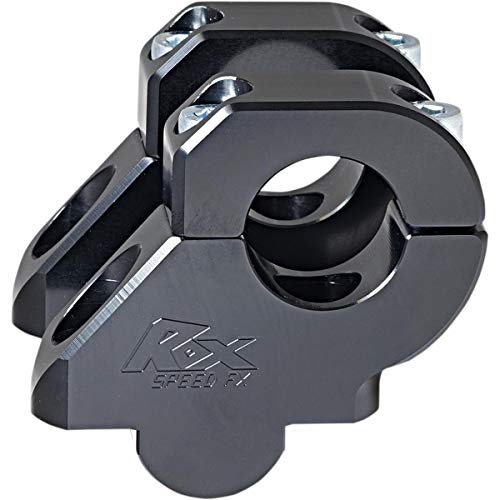
The Rox Speed FX 3R-B17R-15K Barback Risers move 1-1/8 inch handlebars up by 1-1/2 inches and back by 1 inch, and they can also be installed facing the other direction to move the bars forward instead. That reversible design makes them a strong pick for touring and adventure riders who sit for long stretches and feel the strain across the shoulders rather than in the wrists. Pulling the bars closer shortens the reach without forcing a new handlebar bend.
The risers are machined from aluminum with a black anodized finish and bolt into the stock clamp position on many large adventure and touring machines. One important limit is printed clearly by the maker: these risers cannot be installed on bikes with angled or V-shaped original bar clamps, so the shape of the stock lower clamp needs checking before ordering. Cable slack also needs confirming at full steering lock, since the combined rise and pullback uses more free length than a plain vertical spacer of the same height.
Rox Speed FX Pro-Offset Block Riser

The Rox Speed FX Pro-Offset Block Riser, part number 3R-B12POEK, takes a different approach to fit problems. Instead of a fixed bolt pattern, it uses an oblong mounting hole that accepts a wide range of fore-and-aft bolt center distances, which makes it useful on bikes whose clamp spacing does not match common aftermarket patterns. It raises the bars by 1 inch to 1-1/4 inches and accepts both 7/8 inch and 1-1/8 inch handlebars with the appropriate clamp setup.
That flexibility suits riders who want a modest, tidy lift on a street or dual-sport bike without committing to a tall pivoting assembly. The offset hole also allows a small amount of forward or rearward positioning. Because the rise is modest, most stock cables and hoses usually keep enough slack, although the maker still advises checking routing at full lock. Riders wanting a dramatic change in standing position should look at taller options instead, since this block is about precision rather than height.
Tusk Handlebar Risers for 7/8 inch bars, 30mm height

The Tusk Handlebar Riser Kit is the straightforward end of the riser market: two billet blocks that lift 7/8 inch handlebars by 30mm, with a 15mm version also offered in the same family. The blocks are machined from 6061 T-6 billet aluminum and ship with high-grade 12.9 chromoly steel bolts, which matters because riser bolts carry steering loads.
This style suits dirt, dual-sport, and smaller street bikes where the rider mainly wants a little more room when standing on the pegs, or a small correction to a cramped cockpit. Installation is simple because the kit reuses the stock top clamps and needs no pivot hardware to align. The trade-off is zero adjustability after fitting: the bars end up exactly 30mm higher and in the same fore-and-aft position as before. Riders who are unsure about the position they want should choose a pivoting or barback design instead, while riders who already know they only need height will appreciate the low weight, clean look, and short fitting time of a fixed block.
Tusk 2 inch Pivoting Bar Risers for 1-1/8 inch bars

The Tusk 2 inch Pivoting Bar Risers answer a different question: what if the ideal bar position sits somewhere between the fixed choices? These risers clamp into 1-1/8 inch bar mounts and hold 1-1/8 inch handlebars, adding 2 inches of rise with a pivot that lets the bars roll forward or backward before the clamp bolts are torqued down. Adventure riders who alternate between seated highway miles and standing trail sections benefit most, because one setting can balance both postures instead of favoring one.
A silver version for 7/8 inch clamp bases also exists in the same product family, so checking the clamp size on both ends of the riser is essential before ordering. Pivoting designs place more importance on correct bolt torque and periodic checks, since the pivot joint must never slip under load. Cable and hose slack also deserves extra attention at this height: 2 inches of rise is the point at which many adventure and dual-sport bikes need cables rerouted, and some need longer lines.
Raceast Pivoting Handlebar Clamp Risers for 7/8 inch stem

The Raceast Pivoting Handlebar Clamp Risers bring the pivoting concept to bikes with a 7/8 inch stem clamp, offering 2 inches of raise with CNC-machined aluminum construction. The listing is aimed at a wide spread of machines, including BMW, Can-Am, and Yamaha models, and the risers can position bars fitted with either 7/8 inch or 1-1/8 inch diameter at the clamp area, depending on the configuration chosen at purchase.
For street and light adventure riders on smaller-displacement bikes, this is a practical way to gain adjustment without replacing the handlebar itself. The pivot allows the rider to trade a little rise for a little pullback, which is often the difference between numb fingers on a commute and a neutral wrist angle. As with every pivoting riser, the clamp faces must be clean, the bolts tightened evenly, and the final position checked for clearance against the tank, screen, and instruments through the full steering sweep. Riders with 1-1/8 inch stem clamps should not order this version, because the stem size, not the bar size, decides whether the riser body fits the bike.
How to choose
Start by measuring the handlebar diameter at the clamp. Most dirt and smaller street bikes use 7/8 inch bars, while many adventure, touring, and performance naked bikes use tapered 1-1/8 inch bars that are thicker at the center. Next, measure the stock clamp bolt pattern and note whether the lower clamps are separate posts, a one-piece bridge, or angled in a V shape, because some risers cannot mount on angled clamps at all.
Then decide what problem needs solving. Riders who feel cramped only when standing usually need pure rise, and a fixed block in the 15mm to 30mm range often solves it. Riders with shoulder or neck ache when seated usually need pullback, which barback risers supply by moving the bars up and toward the rider. Riders who cannot describe the problem in one direction should pick a pivoting riser, since its adjustment covers both axes and can be fine-tuned after a few rides.
Cable slack is the step most often skipped. Before ordering anything taller than about 1 inch, turn the bars to full lock on both sides and look for tight throttle cables, brake hoses, and wiring. Rerouting sometimes frees enough length, but a riser that needs longer lines adds real cost and time to the job. Finally, check clearance at full lock between the bars, levers, windshield, tank, and any mounted accessories, and confirm that local rules on handlebar height are respected before riding.
Who should skip
Riders whose discomfort comes from the handlebar bend itself should skip risers and shop for a different bar, because raising a bar with the wrong sweep only moves the problem higher. Owners of bikes with clip-on handlebars should also skip this entire category, since risers of this type need a conventional top clamp and cannot mount to clip-on fork clamps. Anyone unwilling to check cable slack, or whose bike already has taut cables at full lock, should skip tall risers until longer lines are budgeted and fitted. Finally, riders who are fully comfortable with the stock position gain nothing here: a riser changes leverage and steering feel slightly, so fitting one without a clear reason is an experiment without a purpose.
FAQ
How much rise can stock cables usually handle?
Many bikes tolerate around 1 inch of added rise with careful rerouting, and some adventure models accept more because their cables are routed with slack for standing riding. The only reliable test is physical: fit nothing until the bars have been turned to full lock on both sides with the stock setup and every cable, hose, and wire checked for tension or sharp bends.
Do handlebar risers affect handling?
A modest riser changes leverage slightly and shifts rider weight a little rearward, which most riders notice as a calmer, more upright feel rather than a handling problem. Very tall risers can make the front end feel less direct, especially on dirt, because the longer clamp stack flexes more than a short one. Staying with the smallest riser that solves the comfort problem keeps steering feel closest to stock.
What is the difference between barback and pivoting risers?
Barback risers move the bars up and toward the rider by a fixed amount, which suits seated touring comfort and a shorter reach. Pivoting risers rotate around the stock clamp position, so the rider chooses how much of the movement becomes rise and how much becomes pullback. Barbacks are simpler and very secure, while pivoting models offer adjustment at the cost of more careful bolt torquing.
Can risers be stacked or combined for more height?
Stacking riser blocks or combining a block with a pivoting riser is not recommended, because each added joint reduces rigidity and increases the load on the clamp bolts. If more height is needed, the safer routes are a single taller riser designed for the bike or a handlebar with more built-in rise. Both keep one solid clamping interface between the triple clamp and the bars.
Final verdict
Choosing handlebar risers well comes down to three checks: clamp diameter and bolt pattern first, the direction of movement second, and cable slack third. Riders who only need height should pick a fixed Tusk block and enjoy the simplest fitting job. Riders chasing seated comfort should pick the Rox Speed FX barback design, riders with unusual clamp spacing should look at the Pro-Offset block, and riders who want to experiment should pick a pivoting model from Tusk or Raceast in the correct stem size. Measured carefully, any of the five will feel like a tailored cockpit change rather than a guess.
More from Amazon
Programs that pair well with the guide above. Offers and eligibility are set by Amazon and may change.
Free shipping on eligible items, Prime Video and more. Eligible new members can start with a free trial.
Start a Prime free trialA Prime membership for ages 18-24 with a trial period. Eligibility is set by Amazon.
See Prime for Young AdultsAudiobooks and podcasts to listen to on the go. Eligible new members can start with a free trial.
Try Audible freeAd-free music streaming. Eligible new subscribers can start with a free trial.
Try Music Unlimited freeAs an Amazon Associate we earn from qualifying purchases.




Write Your Review
No reviews yet. Be the first to share your experience!