

Key takeaways
- Learn how to choose a motorcycle wheel balancer and truing stand for home wheel work, with five stands compared on fit, cones, bearings and leveling.
- Top Pick: VEVOR Motorcycle Wheel Balancer and Truing Stand
- Runner-up: Orion Motor Tech Motorcycle Bike Wheel Balancer
- Also consider: Tanfix Motorcycle Wheel Balance Stand
A wheel that is slightly out of balance or slightly out of true rarely announces itself in the driveway. It shows up later, as a buzz through the bars at highway speed, a front end that feels vague in long corners, or a tire that wears unevenly long before its tread is gone. Shops solve these problems with a balancer and a truing stand, and both tools translate well to a home garage. A static balancer lets a wheel settle so the heavy spot can be found and corrected with small weights. A truing stand holds the wheel steady against a pointer so lateral and radial runout can be seen and, on spoked wheels, adjusted at the nipples.
Choosing between stands comes down to fit, friction and stability. The stand has to accept the wheel diameter, axle size and hub width of the bikes in the garage. Its bearings have to spin freely enough that the wheel stops because of imbalance, not because of drag. Its base has to sit level on a real garage floor, not a showroom slab. The five stands below cover the main shapes of the category, from a full balancer and truing stand with a pointer and leveling feet to compact portable balancers that store in a drawer. As an Amazon Associate, we earn from qualifying purchases.
Quick answer
Choose a combined balancer and truing stand if spoked wheels need runout checks as well as balance, and match the stand to the largest wheel and axle in the garage. Low-friction bearings, centering cones that cover the axle range, a leveling base and a truing pointer matter more than size alone. Compact balancers suit solid wheels and occasional tire changes.
VEVOR Motorcycle Wheel Balancer and Truing Stand

The VEVOR stand, model TD-004-05, is the full-featured pattern for this category. It combines static balancing with a truing pointer, so one frame handles both jobs described in this guide. The listing covers wheels up to 35 inches in diameter, axle diameters from 0.65 to 1.5 inches, and a load capacity of 88.2 pounds, which spans everything from small dirt bike wheels to heavy touring assemblies with rotors and a sprocket carrier fitted.
The frame is carbon steel, and the base uses four adjustable leveling feet with a bubble level, a practical pairing for garage floors that slope toward a drain. Two adjustable centering cones support both hollow and solid axles, and the package includes sets of 5 gram and 10 gram weights, so a first balance job can be finished without a separate weights order. At 25.6 pounds the stand is a bench fixture rather than a portable tool, and assembly with the included wrench is required before first use. Riders who true spoked wheels regularly and want the pointer, the leveling base and the wide diameter range in one unit will find this the most complete specification here.
VIVOHOME Motorcycle Bike Wheel Balancer
The VIVOHOME balancer, part VH772 in black, takes the simpler route. It is a spin balancer built around a heavy-duty iron frame with a black protective coating, a center shaft and adjustable centering cones. Four bearings support the shaft so the wheel can rotate with little drag and settle at its heavy point, which is the core requirement for accurate static balancing.
The unit weighs 13.11 pounds, roughly half the VEVOR, and its compact footprint suits a crowded bench or a shelf between tire changes. The listing describes it for most motorcycles and sport dirt bikes, and the cone setup handles a range of hub sizes without tools beyond the cones themselves. What it does not add is a dedicated truing frame with a pointer, so runout checks on spoked wheels are better served by one of the combined stands. It is a dedicated balancer for solid wheels and routine tire swaps.
Orion Motor Tech Motorcycle Bike Wheel Balancer

Orion Motor Tech, often shortened to OMT, builds its balancer around the same low-friction idea with a portable frame. Adjustable centering cones position the wheel on the shaft, and four low-friction radial bearings let it spin freely enough for the heavy spot to repeat in the same place, which is how a static balancer earns trust. The heavy-duty steel construction keeps the frame rigid while the wheel is turning.
Published specifications for this stand cover tires up to 12 inches wide and 28 inches in diameter, a range that fits the great majority of street and dirt wheels a home garage sees. The design is a balancer first, aimed at tire changes and balance checks rather than spoke work, and its size makes it one of the easier stands here to store or carry to a track day paddock. Buyers with unusually wide rear wheels should confirm the width figure against their own tire before ordering, since that is the tightest limit in this lineup.
Tanfix Motorcycle Wheel Balance Stand

The Tanfix stand, model Tanfix-101, is the lightest option in this group at about 8.2 pounds, and it folds its appeal into portability. It is described for both static and dynamic balancing, with adjustable centering cones to secure different wheel sizes and a truing pointer to help identify imbalance and runout. The steel frame is built for sport bikes, cruisers, touring bikes and off-road machines, and published material describes it for wheels of 12 inches and larger.
That combination of low weight and a pointer makes the Tanfix interesting for riders who balance wheels at home but store tools in limited space, or who want a stand that travels in a van or trailer. The trade-off is mass: a lighter stand depends more on a flat, solid surface to stay planted while a heavy wheel is spinning. Set on a level bench or a stable floor section, the specification covers the standard home routine of finding the heavy spot, adding weight and re-checking until the wheel rests at random positions.
BikeMaster Wheel Balancer and Truing Stand
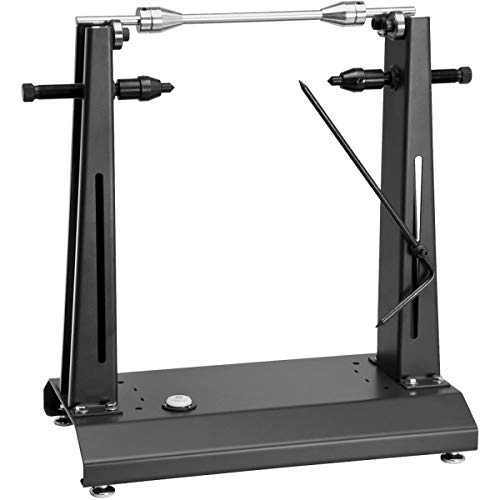
BikeMaster is a long-running name in workshop tools, and its balancer and truing stand follows the traditional steel plate pattern. The stand ships with a shaft, cones and spacers intended to fit just about any wheel, and a bubble level is built in to help set the stand correctly before balancing begins. The maker describes it for motorcycle and ATV wheels, which broadens it beyond street bikes to the quads many home garages also maintain.
The design emphasis is simplicity. Steel plate construction keeps the frame stable, the included hardware covers the fitting work, and the pointer supports truing checks on spoked wheels. Period catalog material for this stand lists a generous wheel size range. Riders who prefer an established tool brand and a no-frills layout will find this the familiar option.
How to choose
Start with the wheels, not the stand. Measure the largest wheel diameter in the garage, note each axle diameter, and check hub widths, then compare those figures with the stand limits. A stand rated for wheels up to 21 inches is fine for most dirt and many street wheels, while the 35 inch class covers large cruiser and adventure assemblies with room to spare. Cone range matters just as much, because a wheel that is not centered cannot be balanced accurately no matter how good the bearings are.
Next, decide whether truing is part of the job. Solid cast wheels only need balancing, so a dedicated spin balancer is enough. Spoked wheels can drift out of true, and correcting that needs a stand with a pointer and clear access to the nipples, which points to a combined balancer and truing stand. Bearing quality is the third filter. Four-bearing shafts and low-friction designs let the wheel settle under gravity alone, and repeatability is the test: a good stand shows the heavy spot in the same place on successive spins.
Stability and leveling come fourth. Adjustable feet and a bubble level compensate for garage floors that are rarely flat, and a heavier frame resists walking while a big wheel turns. Finally, consider storage and routine. A portable stand that gets used after every tire change beats a superior stand that stays boxed, and included weights, wrenches and cones save a second order before the first job can start.
Who should skip
Riders who change tires once a year and ride gently may find a shop balance charge simpler than owning, storing and learning a stand. Owners of single-sided swingarm wheels or centerless hubs should also pause, because many stands in this category cannot support those wheels without brand-specific adapters, and some exclude them outright. Anyone expecting a powered, computerized balancing machine should skip this entire group, since every stand here is a manual static tool that relies on gravity and patience. Finally, riders who are not comfortable removing wheels, handling axle hardware and re-checking torque on reassembly should leave wheel work to a technician rather than buy the stand first.
FAQ
Does a static balancer work as well as a shop machine?
For motorcycle wheels, a static balancer in good condition gives results that suit street riding well, because the wheel and tire are narrow and the heavy spot is easy to isolate. The process is slower than a powered machine and depends on careful setup, a level stand and clean bearings, but the underlying method is sound and widely used in home garages and paddocks.
Can the same stand balance and true a spoked wheel?
Yes, if the stand is a combined design with a truing pointer. Balancing uses the free-spinning shaft and cones, while truing uses the pointer as a fixed reference while spoke tension is adjusted in small steps. A balancer-only stand can still show obvious wobble, but it lacks the reference point that makes measured truing practical.
What wheel sizes should be checked before buying?
Check three figures: overall wheel diameter with the tire fitted, axle or hub bore diameter against the cone range, and hub width against the space between the stand uprights. Wide rear wheels and large adventure bike assemblies are the usual problem cases, so the largest wheel in the garage should set the requirement.
Are wheel weights included with these stands?
Some packages include starter weights and some do not. The VEVOR package lists sets of 5 gram and 10 gram weights, while other stands expect the buyer to supply weights separately. Checking the contents list before ordering avoids a stalled first job, and adhesive weights in small increments are the usual choice for alloy wheels.
Final verdict
For a home garage that handles both spoked and solid wheels, a combined balancer and truing stand is the versatile buy, and the VEVOR TD-004-05 carries the broadest published specification here, with its 35 inch wheel range, leveling feet and included weights. The BikeMaster is the traditional alternative for riders who value an established tool brand and a simple steel layout. Where balancing alone is the job, the VIVOHOME and Orion Motor Tech stands cover it with bearing-supported shafts and adjustable cones, and the Tanfix adds a pointer in the lightest frame of the group. Match the stand to the largest wheel, confirm the cone range, and any of the five will turn balance and truing into routine home maintenance.
More from Amazon
Programs that pair well with the guide above. Offers and eligibility are set by Amazon and may change.
Free shipping on eligible items, Prime Video and more. Eligible new members can start with a free trial.
Start a Prime free trialA Prime membership for ages 18-24 with a trial period. Eligibility is set by Amazon.
See Prime for Young AdultsAudiobooks and podcasts to listen to on the go. Eligible new members can start with a free trial.
Try Audible freeAd-free music streaming. Eligible new subscribers can start with a free trial.
Try Music Unlimited freeAs an Amazon Associate we earn from qualifying purchases.








Write Your Review
No reviews yet. Be the first to share your experience!