

Key takeaways
- Compare five snowmobile helmets with heated and dual-pane shields, breath boxes and DOT-rated shells from Castle X, ScorpionEXO, ILM and Typhoon.
If you want one answer up front: the Castle X CX950 V2 Modular Electric is the best snowmobile helmet for most trail riders, because its electrically heated dual-pane shield solves the fogging problem at the source instead of managing it with vents and breath deflectors. Riders who also want an ECE 22.06 rating for crossover use should look at the ScorpionEXO AT960 Cold Weather, while the Typhoon TH158 and the two ILM models cover the mid-range and budget tiers with heated shields, Pinlock inserts, and breath boxes.
A snowmobile helmet is not just a motorcycle helmet in colder colors. Sub-zero air turns every exhale into shield fog, so sled helmets add hardware that street helmets rarely need: dual-pane or electrically heated shields, breath boxes that route exhaled air away from the lens, chin curtains that seal the gap above your jacket, and drop-down sun visors for glare off open snowfields. The five helmets below were chosen because each one addresses fogging with a published, verifiable system rather than a marketing claim, and each is sold in a dedicated snow configuration.
As an Amazon Associate, we earn from qualifying purchases.
Table of Contents
- How to Choose a Snowmobile Helmet
- 1. Castle X CX950 V2 Modular Electric Snow Helmet
- 2. ScorpionEXO AT960 Cold Weather Helmet
- 3. Typhoon TH158 Modular Snowmobile Helmet
- 4. ILM Model 129 Full Face Helmet
- 5. ILM 909F Modular Helmet
- Frequently Asked Questions
- Conclusion
- Product and ASIN Reference
How to Choose a Snowmobile Helmet
Start with the shield system, because fog is the whole problem. There are three levels of defense. A dual-pane shield traps an insulating layer of air between two lenses, which slows condensation and needs no power. An electrically heated shield goes further: a heating element warms the lens itself, so fog and frost never form, but it needs a power cord running to the sled. A Pinlock insert creates a dual-pane effect inside a standard shield and is the lightest solution, though it can still frost over on the coldest, dampest days. Match the system to your riding: heated shields suit long trail days in deep cold, dual-pane shields suit riders who do not want a cord, and Pinlock inserts suit mixed street-and-snow use.
Look for a breath box and a chin curtain. A breath box is a fitted guard inside the chin bar that routes your exhale down and out instead of up across the lens. A chin curtain seals the opening under the chin bar so wind and powder snow cannot blow up into the helmet. Together they matter almost as much as the shield itself, and every helmet in this roundup includes at least one of the two.
Check the certification. Most snow helmets sold in the United States carry a DOT FMVSS 218 rating, which also makes them legal on a street motorcycle in the off-season. A smaller number, including the ScorpionEXO AT960 below, add an ECE 22.06 rating. Confirm the rating printed for the exact variant you are buying, because certification can differ between the snow and street versions of the same model.
Decide between modular and full face. A modular (flip-up) chin bar makes fuel stops, trail-map checks, and conversations easier and helps riders who wear glasses. A fixed full face is simpler and usually quieter. Both styles appear below, and the right choice depends on how often you stop on a typical ride.
Size for a balaclava. Most riders wear a thin balaclava under a snow helmet, so measure your head with one on and follow the brand’s size chart rather than assuming your street-helmet size carries over. Several models here run to 3XL or beyond, which matters because snow helmets are often bought for the whole family.
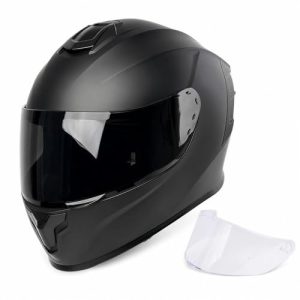
1. Castle X CX950 V2 Modular Electric Snow Helmet
Tier: Premium — listed variant: Matte Black, size Medium
Castle X builds gear specifically for snowmobiling, and the CX950 V2 is its flagship modular. The headline feature is the electrically heated dual-pane shield: plug the included cord into the sled and the lens stays warm enough that breath fog and frost simply do not form, which is the single biggest quality-of-life upgrade a trail rider can buy. When the sun comes out over an open lake, an internal drop-down sun visor handles glare without a shield swap.
The cold-weather kit around the shield is complete. A breath box directs exhaled air away from the lens, a chin curtain seals the bottom of the helmet, and the liner is removable and washable for mid-season cleaning. The chin bar lifts with one button, which makes gas stops and trail talk painless even with thick gloves on, and Castle X backs the helmet with a five-year warranty, the longest coverage in this group. For riders who log serious winter miles and want the fog problem solved rather than managed, this is the benchmark the rest of the list is measured against.
Specs:
- Shell: Polycarbonate
- Shield: Electrically heated dual-pane, power cord included
- Sun visor: Internal drop-down
- Breath management: Breath box and chin curtain included
- Liner: Removable and washable
- Certification: DOT
- Sizes: S to 3XL
- Warranty: Five years
- Listed variant dimensions: 15 x 11.25 x 11.5 inches
- Manufacturer part number: 4522084
2. ScorpionEXO AT960 Cold Weather Helmet
Tier: Premium — listed variant: Topographic Hi-Vis, size X-Large
The AT960 Cold Weather is the snow version of ScorpionEXO’s popular adventure modular, and it is the only helmet here that carries both a DOT rating and the newer ECE 22.06 certification, which makes it a genuine crossover pick for riders who tour on two wheels in summer and on a sled in winter. Its electric shield pairs with a cold-weather breath box and bib to keep the lens clear in extreme conditions, and the shield can be removed entirely if you prefer to ride with goggles in a snowcross setup.
The adventure format is the other draw. The external peak visor cuts glare and roost on bright trails and can be removed for a sleeker profile, the chin bar flips up for stops, and the shell has Bluetooth-ready speaker pockets for a communicator. If your winter riding mixes groomed trails, off-trail exploring, and the occasional street mile, the AT960 covers all three without asking you to own two helmets.
Specs:
- Shell: Polycarbonate adventure modular
- Shield: Electric shield; removable for goggle use
- Peak: Removable external peak visor
- Breath management: Cold-weather breath box and bib included
- Communications: Bluetooth-ready speaker pockets
- Certification: DOT and ECE 22.06
- Listed variant dimensions: 17 x 12 x 13 inches
- Manufacturer part number: 96-1056-EC
3. Typhoon TH158 Modular Snowmobile Helmet
Tier: Mid-range — listed variant: Blue
The TH158 is the value benchmark for a properly equipped snow helmet. Typhoon includes both shields in the box: a dual-lens heated shield with its power cord for winter, and a single-pane shield for summer street use, so one purchase covers two seasons. An adjustable breath box and a removable chin skirt handle breath management, and a retractable tinted sun visor deals with midday glare.
Day-to-day details are sensible rather than fancy. The aerodynamic ABS shell keeps the design simple, the flip-up chin bar opens and closes with an easy-to-actuate button that works with gloves, ventilation channels can be opened or closed as temperatures change, and the liner comes out for washing. The quick-release chin strap and included drawstring carry bag round out a package that gives new and occasional sledders the complete cold-weather feature set without stepping into premium territory.
Specs:
- Shell: ABS
- Shield: Dual-lens heated shield with cord, plus single-pane summer shield included
- Sun visor: Retractable tinted internal visor
- Breath management: Adjustable breath box and removable chin skirt
- Liner: Removable and washable
- Closure: Quick-release chin strap
- Certification: DOT FMVSS 218
- Sizes: S to 2XL
4. ILM Model 129 Full Face Helmet
Tier: Budget
The ILM-129 takes the no-cord route to a clear view. Instead of a heated element, it uses a Pinlock 30 insert inside the main shield to create the insulating air gap that keeps the lens fog-resistant, and the helmet is also compatible with a heated shield if you want to add one later. A second internal sun visor drops down for bright conditions, so the single helmet handles both overcast mornings and sunny afternoons.
Fit range is the quiet headline here. The 129 is one of the few snow-suitable helmets listed in sizes running up to 3XL and 4XL, which makes it a realistic option for riders who struggle to find larger shells. The ABS shell uses a high-density EPS liner, the certification is DOT through Intertek testing, and the roomy eye port is designed to work with eyewear and helmet speakers. For riders who want a fixed full face with a real anti-fog system at the budget tier, this is the straightforward pick.
Specs:
- Shell: ABS with high-density EPS liner
- Shield: Clear shield with Pinlock 30 anti-fog insert; heated shield compatible
- Sun visor: Internal drop-down
- Certification: DOT (Intertek, certificate TE-00326846)
- Sizes: S to 4XL
- Fit notes: Eyewear and speaker friendly eye port
5. ILM 909F Modular Helmet
Tier: Budget — listed variant: Matte Black, size Medium
The 909F is ILM’s three-in-one modular: with its peak fitted it reads as an adventure helmet, and with the peak removed it converts between full-face and open configurations for street, ATV, and snow use. For winter riding, the relevant hardware is the Pinlock anti-fog visor, which works without any wiring to the sled, and a drop-down sun shade for glare. A lock holds the chin bar in the raised position at stops, which is a small detail that matters when you are flipping the bar up at every fuel stop.
As with the Model 129, the appeal is getting the complete modular feature set — flip-up chin bar, anti-fog insert, sun visor, DOT rating — at the budget tier, from a listing sold in a dedicated snowmobile configuration. Riders in the coldest, dampest conditions may still frost the visor where a heated shield would not, so treat the 909F as the right answer for trail riders who want modular convenience without a power cord.
Specs:
- Shell: ABS
- Shield: Pinlock anti-fog visor
- Sun visor: Drop-down sun shade
- Chin bar: Flip-up with raised-position lock
- Certification: DOT (certificate TE-00326846)
- Manufacturer part number: FBA-909F-MB-M (listed variant)
Frequently Asked Questions
Does a snowmobile helmet need to be DOT certified?
For trail use on private or club trails, certification rules vary, but a DOT FMVSS 218 rating is the baseline to look for because it confirms the helmet passed a recognized impact standard, and it also makes the helmet legal if you ride it on a street motorcycle. All five helmets in this roundup carry a DOT rating, and the ScorpionEXO AT960 adds ECE 22.06. Always confirm the rating on the exact variant you buy, since snow and street versions of a model can differ.
Which is better for fog: a heated shield, a dual-pane shield, or a Pinlock insert?
A heated shield is the most effective because it actively warms the lens, so fog and frost never form; it is the right choice for long rides in deep cold, at the cost of a power cord to the sled. A dual-pane shield is the best cordless option, using an insulating air gap to slow condensation. A Pinlock insert creates a similar air gap inside a normal shield and is the lightest solution, but it can still frost on the coldest, dampest days. Breath boxes and chin curtains improve all three systems.
Can I use a regular motorcycle helmet for snowmobiling?
You can, but you will probably fight fog. Street helmets usually ship with a single-pane shield, no breath box, and no chin curtain, so exhaled air condenses on the lens within minutes in sub-zero air. A dual-pane or heated snow shield, plus a breath box, is what separates a dedicated snow helmet from a street helmet. If you only ride a sled once or twice a season, a Pinlock-equipped full face like the ILM-129 is a reasonable crossover; frequent riders should buy a helmet sold in a snow configuration.
How should a snowmobile helmet fit compared with a street helmet?
Measure your head while wearing the balaclava you plan to ride in, and follow the brand’s size chart for that measurement rather than your street size. The fit should be snug all around without pressure points, and the chin bar of a modular should clear your chin when it swings closed. Because sizes and shell shapes vary, the extended ranges offered by models like the Castle X CX950 V2 (to 3XL) and the ILM-129 (to 4XL) are worth checking if standard sizes run small for you.
Conclusion
The right snowmobile helmet is the one whose fog defense matches your riding. The Castle X CX950 V2 Modular Electric is the top pick for most trail riders, with a heated dual-pane shield, a full breath-management kit, and a five-year warranty. The ScorpionEXO AT960 Cold Weather is the crossover choice, adding ECE 22.06 certification, a removable peak, and speaker pockets. The Typhoon TH158 delivers the heated-shield experience at the mid-range tier with both winter and summer shields in the box, while the ILM-129 and ILM 909F cover the budget tier with Pinlock anti-fog systems, the 129 in a fixed full-face shell with sizes to 4XL and the 909F in a convertible modular. Choose the shield system first, then the fit, and any of these five will keep your view clear all winter.
More from Amazon
Programs that pair well with the guide above. Offers and eligibility are set by Amazon and may change.
Free shipping on eligible items, Prime Video and more. Eligible new members can start with a free trial.
Start a Prime free trialA Prime membership for ages 18-24 with a trial period. Eligibility is set by Amazon.
See Prime for Young AdultsAudiobooks and podcasts to listen to on the go. Eligible new members can start with a free trial.
Try Audible freeAd-free music streaming. Eligible new subscribers can start with a free trial.
Try Music Unlimited freeAs an Amazon Associate we earn from qualifying purchases.
Write Your Review
No reviews yet. Be the first to share your experience!