

Key takeaways
- Compare five motorcycle LED turn signals, from plug-in Harley 1157 kits to universal stalks and fork strips, with fit, wiring and mounting notes.
Stock turn signals are easy to ignore until one cracks, fills with water, or simply proves too dim for modern traffic. LED replacements light up faster, draw less power, and open up cleaner shapes, from tiny stalks to fork-mounted strips. The catch is fitment: sockets, stalk threads, and flash rates vary by bike. These five kits cover the main mounting styles, so you can match the signal to your motorcycle instead of forcing one universal part to fit everything.


There is also a safety argument for the swap. An LED reaches full brightness almost instantly, while a filament bulb needs a fraction of a second to warm up, and at road speed that fraction is real distance for the driver behind you. LEDs also shrug off vibration that shortens bulb life, which matters on singles, twins, and dual-sports that shake their rear ends over every mile.
As an Amazon Associate, we earn from qualifying purchases.
Quick answer
For most riders, a matched four-piece stalk set like the QUASCO kit is the simplest full upgrade. Harley owners with 2-inch bullet housings should pick the plug-in Benlari 1157 kit, while the Kuryakyn Torpedo suits riders who want a metal rear run-turn-brake bullet. The KEMIMOTO pair adds a bright amber running light, and the CoCsmart strips clean up a front end without brackets.
Kuryakyn 2509 Torpedo LED Lights
Kuryakyn’s Torpedo pair is the premium pick here, built around a matte black metal bullet housing with a clear lens. This 2509 version is a rear-only, multi-function light: separate red and amber circuits let one unit handle running light, brake light, and turn signal duties, which suits bobbers and minimalist rear ends where a separate tail light cluster is going away.
The lights are ECE approved according to Kuryakyn, run on 12 volts, and mount on a threaded stud, so they fit many aftermarket brackets and fender struts. The kit includes T-tap and spade connectors plus a dielectric grease pack, a thoughtful touch for connections that live in road spray. Kuryakyn notes the Torpedos are not compatible with separate run-turn-brake controllers, and some bikes may need a load equalizer to keep the flash rate correct, so budget a little wiring time rather than expecting a two-minute swap.
Kuryakyn sells turn-only indicator versions in the same Torpedo family for the front of the bike, so a full build can keep one housing design at both ends. The clear lens over red and amber elements also keeps the rear cluster looking like a single designed part rather than a stack of add-ons, which is exactly the point of paying for a branded bullet instead of a generic one.
KEMIMOTO Motorcycle Turn Signals Light, 2PCS
KEMIMOTO’s two-piece set uses 12 lamp beads per housing and an 8mm mounting bolt, the most common stalk thread on Japanese and European bikes. The listing carries an E24 safety certification mark and describes the housings as waterproof, shockproof, and lightweight, with an amber lens that can serve at the front or the rear of the bike.
The headline feature is brightness with a second job: the amber array also works as a daytime running light, keeping a lit signature on the bike between flashes. That makes this pair a sensible choice for commuters who ride in traffic all year and want to be seen from the front quarter. Fit is listed as universal across 12-volt motorcycles, but measure your stock stalk holes before ordering, because a few models use 10mm threads and will need adapters.
Wiring the running-light function means giving the signals a keyed power feed in addition to the flash wire, so allow time to trace one extra circuit per side. Riders who only want a plain flash can still use the pair as indicators; the running function is an option in the wiring, not a requirement for the lamps to work.
QUASCO 4PCS Universal Motorcycle Turn Signals
Most signal upgrades fail on quantity: a rider buys a pair, then discovers the other two corners still look tired. QUASCO sells its universal signals as a matched set of four, so the front and rear of the bike get the same lens shape, brightness, and flash behavior in one box.
Each amber signal mounts through an 8mm hole, and QUASCO lists compatibility across sport bikes, street bikes, cruisers, choppers, quads, and dirt bikes running 12-volt electrics. The mini housings keep a low profile on naked bikes and cafe builds where the stock signals look oversized. Because all four corners change at once, this is also the set to choose when converting a full bike from bulbs to LED: one flasher relay or equalizer decision covers the whole system, and the flash rate stays consistent front to rear.
A matched set also ages evenly. Mixing one new LED pair with two faded stock housings leaves the bike looking half finished, and the older lenses keep yellowing while the new ones stay clear. With four identical units, spares are simple too: any corner can donate its lamp to another in a pinch on a long trip.
Benlari 2-Inch Front 1157 LED Turn Signals
Harley riders with the classic 2-inch bullet housings do not need new brackets at all. Benlari’s kit drops an LED board into the stock-style housing position using the 1157 dual-contact base, so installation is closer to changing a bulb than rewiring a lamp. The maker fits 81 LED chips per light and includes two smoked lens covers that darken the housing when parked while still flashing amber.
Fitment covers a long run of Harley models from 1986 to 2024, including Touring, Street Glide, Road Glide, Road King, Electra Glide, Sportster, Dyna, and Softail families. Two cautions from the listing matter: the kit does not fit 3-1/4 inch housings or 1156 single-contact sockets, so confirm your housing size and base type first. Some models may also flash faster than normal after the swap, which a load resistor or LED relay corrects.
Benlari sells matching rear boards in the same line for riders who want the front and rear clusters to match, and the front kit’s included smoked covers mean you are not paying extra for the dark-lens look. For a bagger that still runs its original bulbs, this is the lowest-effort brightening step in the whole list: no brackets, no drilling, and the stock housings stay on the bike.
CoCsmart 2PC Flexible Switchback Fork Strips
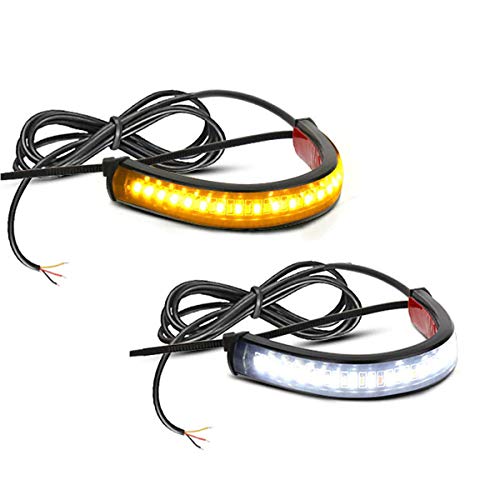
The CoCsmart kit takes a different route entirely: instead of a stalk, each signal is a flexible strip carrying 36 LEDs that wraps around the fork tube. The strips fit fork diameters from 39mm to 70mm and attach with self-adhesive backing plus cable ties, so there are no brackets to fabricate and nothing sticks out to snap off in a tip-over.
In running mode the strip glows white as a daytime running light, then switches to amber when you signal, a switchback pattern with a 120-degree viewing angle per the maker. That wide spread helps at intersections, where a stalk signal can hide behind a fairing edge. The trade-off is wiring length and placement: the strips need a clean, degreased fork surface and a tidy wire run down to the signal circuit, and they are a front-end solution only, so pair them with a separate rear set.
Adhesive mounting rewards patience. Fit the strips on a warm day, press them home evenly, and let the tape cure before the first wash or wet ride; rushed installs are the ones that peel at the ends. The cable ties in the kit are not decoration either, since they carry the load if the adhesive ever lets go at speed.
How to choose
Start with the mount, not the marketing. Check whether your bike uses a threaded stalk (usually 8mm or 10mm), a socket base such as 1157 or 1156, a fork wrap, or a model-specific housing, and buy the kit built for that interface. Adapters exist, but every adapter is another joint to loosen or leak.
Next, count wires and functions. A basic two-wire signal only flashes. Three- and four-wire units add a running light or brake function, which means tapping extra circuits; the Kuryakyn and QUASCO rear lights and the Benlari front kit all assume you are comfortable identifying the running, brake, and signal wires with a test light.
Plan for hyperflash. LEDs draw far less current than bulbs, so many flasher relays read them as a failed bulb and blink fast. The clean fixes are an LED-specific flasher relay or a load equalizer, and several makers, Kuryakyn included, state this plainly in their instructions. CAN-bus bikes may need a model-specific module instead.
Check markings before you ride. Front signals must flash amber; rear signals can be amber, and red is reserved for combined rear run and brake functions. Look for DOT or ECE markings where your state or country requires them, since not every universal kit carries an approval stamp. Finally, remember that factory signals are not immune from defects: some original-equipment signals have been recalled for fracturing stems and flickering output, so a quick recall check on your own bike is worthwhile before blaming the aftermarket parts.
Think about connectors while you are at it. Many Japanese bikes use small bullet connectors that universal kits can join with simple adapters, while some European and Harley models use proprietary plugs that reward a plug-and-play kit or a model-specific adapter harness. Knowing your connector type before ordering saves the cut-and-crimp work for the bikes that genuinely need it, and keeps the stock harness intact on the bikes that do not.
Who should skip
Skip this upgrade if your bike already runs factory LED signals that work; the gain is mostly cosmetic. Skip universal stalk kits if you are not willing to splice or tap wires, and choose a socket-style kit instead. Riders in jurisdictions that require DOT-marked lamps should pass on any kit without the right stamp, however bright it looks. And if your charging system or flasher setup is already marginal, sort the electrics first rather than adding four new loads and an equalizer to a weak system.
FAQ
Will LED turn signals make my motorcycle hyperflash?
Often, yes. The low current draw of LEDs makes many stock relays flash quickly, as if a bulb were out. An LED-rated flasher relay is the tidiest fix; load equalizers and resistors also work and are mentioned in several makers’ instructions.
Are aftermarket LED turn signals street legal?
It depends on the kit and your location. Rules generally require amber front signals, amber or red rear signals, and lamps with DOT or ECE markings in many regions. Check the markings on the specific kit and your local equipment rules before ordering.
Can I mix LED signals at the front with stock bulbs at the rear?
You can, and the signals will work, but brightness and flash behavior may differ between ends, and the relay may still hyperflash on the LED circuit. Most riders convert all four corners together so one relay or equalizer choice settles the whole bike.
Do these kits need wire cutting?
Socket kits such as the Benlari 1157 set plug into the existing base with no cutting. Stalk and strip kits usually need the signal wires joined, using included taps, crimp connectors, or solder. Nothing here requires cutting the main harness if you tap carefully.
Final verdict
Match the kit to the mount and the job gets easy. The QUASCO four-piece set is the default full-bike upgrade, the Benlari kit is the painless Harley answer, and the Kuryakyn Torpedo is the polished rear bullet for custom builds. Add the KEMIMOTO pair where an amber running light helps in traffic, or the CoCsmart strips when brackets will not fit. Whichever you choose, settle the flasher question at the same time and the conversion is done in one session.
Product and ASIN Reference
| Product | ASIN |
|---|---|
| Kuryakyn 2509 Torpedo LED Lights | B00T6JAIM6 |
| KEMIMOTO Motorcycle Turn Signals Light, 2PCS | B0CQLWHBP4 |
| QUASCO 4PCS Universal Motorcycle Turn Signals | B09ZTVBGM9 |
| Benlari 2-Inch Front 1157 LED Turn Signals | B0F47QZMQT |
| CoCsmart 2PC Flexible Switchback Fork Strips | B07YYBRH3G |
More from Amazon
Programs that pair well with the guide above. Offers and eligibility are set by Amazon and may change.
Free shipping on eligible items, Prime Video and more. Eligible new members can start with a free trial.
Start a Prime free trialA Prime membership for ages 18-24 with a trial period. Eligibility is set by Amazon.
See Prime for Young AdultsAudiobooks and podcasts to listen to on the go. Eligible new members can start with a free trial.
Try Audible freeAd-free music streaming. Eligible new subscribers can start with a free trial.
Try Music Unlimited freeAs an Amazon Associate we earn from qualifying purchases.


Write Your Review
No reviews yet. Be the first to share your experience!