

Key takeaways
- Floating vs fixed motorcycle brake rotors compared, with heat, feel, weight and upkeep explained, plus floating and fixed replacement discs to consider.
Every disc brake rotor does the same basic job: it gives the pads a surface to clamp and turns motion into heat. How the rotor is built, though, changes how it handles that heat, how the lever feels, and how it wears. The two constructions a rider will meet most often are floating rotors and fixed rotors, and the difference is structural, not cosmetic.
A fixed rotor is a single piece of steel bolted rigidly to the wheel. A floating rotor splits the job in two: an outer friction ring rides on buttons or bobbins attached to an inner carrier, so the ring can move slightly and expand as it gets hot. Neither design is automatically better. The right choice depends on how hard the brakes work and how the rider uses the bike.
This comparison explains both designs in plain terms, then looks at five real replacement rotors that sit on either side of the divide: three floating examples and two fixed examples. Fitment is model specific for every rotor, so listings should always be matched to the exact bike before ordering.
As an Amazon Associate, we earn from qualifying purchases.
Quick answer
Floating rotors suit heavier, faster, and harder-braked motorcycles because the separate friction ring expands freely, resists warping, and keeps pad contact even under heat. Fixed rotors suit lighter bikes, rear wheels, and everyday riding, where their one-piece build is simpler, quieter, and easier to maintain. Many motorcycles sensibly run floating discs at the front and a fixed disc at the rear.
Floating: Arashi Front and Rear Brake Disc Rotors for Kawasaki Ninja ZX-10R

The Arashi set for the Kawasaki Ninja ZX-10R from 2008 to 2015 shows the classic performance layout in one box. The two front rotors are floating, built with a 420 stainless steel braking surface on a CNC aluminum alloy center, while the single rear rotor in the same set is a fixed design. That split mirrors how the bike itself divides braking work, with the front doing most of it.
Arashi gives the front rotors a wave profile with slots. The wave edge and cutouts help clear the pad surface and shed heat, and the floating mount lets the hot ring grow without pulling against the carrier. On a liter-class sport bike that brakes hard from high speed repeatedly, that freedom keeps lever feel consistent instead of developing a pulse as temperatures climb.
The set is listed with a front rotor diameter of 310 millimeters and a rear diameter of 220 millimeters. Mounting bolts are typically not included, so original hardware and Kawasaki torque values are part of the job.
As a floating example, this set is the clearest illustration in the guide: both constructions sit side by side, showing why the hard-working end of the bike gets the more complex design.
Floating: EBC Brakes MD2092 Brake Rotor
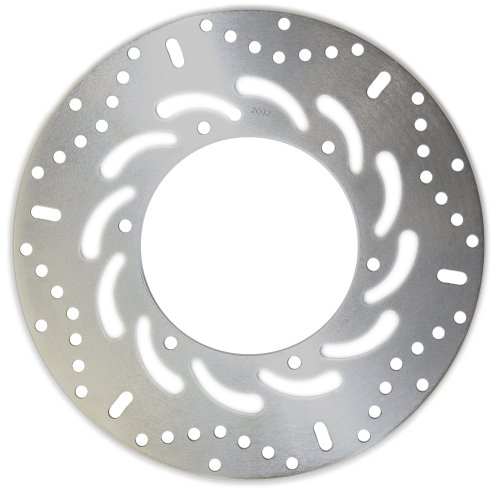
EBC Brakes is one of the most established names in motorcycle braking, and the MD2092 listing is a useful floating-side example because the MD range is offered in solid and floating variants depending on fitment. The listing describes a British-made rotor cut from German mill-rolled stainless steel, laser cut, heat treated, and tempered, and sold as a direct replacement for the original disc with no changes needed at the caliper or wheel.
The MD2092 listing gives a diameter of 282 millimeters and positions the rotor for street sport motorcycles. Riders ordering from this range should confirm, for their exact fitment, whether the variant supplied is the floating or the solid version, since the range covers both constructions across different bikes. The floating variant is the one that belongs in this side of the comparison.
EBC also advises fitting new pads with a new rotor, which is sound practice for either design: a fresh, flat friction surface beds in evenly against fresh pad material. For a floating upgrade from a mainstream brake brand, this range is the natural starting point.
Floating: Arashi Front Brake Disc Rotors and Pads Kit for Yamaha FZ1
The second Arashi entry is a front kit for the Yamaha FZ1 1000, covering FZ1 and FZ1 Fazer models across the 2006 to 2014 period depending on variant. It pairs front brake disc rotors with pads in one package, suiting a rider refreshing a front brake as a system rather than one part at a time.
The front rotors follow the Arashi pattern of a stainless braking ring on an alloy center in a wave style, the two-piece arrangement that defines a floating rotor. On a heavy, powerful naked bike like the FZ1, the front brakes absorb repeated high-energy stops, and the floating mount gives the ring room to expand while the carrier stays true to the wheel.
Including pads in the kit removes a common mismatch. Rotor and pad materials need to be compatible, and a kit put together for the same bike avoids pairing a new rotor with pads of an unknown compound. Riders should still confirm the exact model years covered, since the FZ1 range includes standard and ABS versions.
This kit represents the floating side as a complete front-end refresh: two-piece rotors plus matched pads for a bike whose weight and speed place real thermal demands on its front discs.
Fixed: Taskboim 220mm Rear Brake Rotor for Kawasaki Ninja 300

The Taskboim rear rotor for the Kawasaki Ninja 300 and Versys-X 300 is a textbook fixed rotor. It is a single piece of 420 stainless steel, 220 millimeters across, that bolts directly to the rear wheel with no carrier and no buttons. The listing covers Ninja 300 models from 2013 to 2018, including ABS versions.
Rear brakes work far less hard than fronts. Weight transfers forward under braking, the rear tire unloads, and the rear disc mostly provides balance and low-speed control rather than raw stopping power. Heat loads are modest, so the expansion management of a floating design buys little at the rear on a light bike. A simple solid disc does the job with fewer parts.
The one-piece build also suits the rear environment. Rear wheels collect chain lubricant, road grit, and water, and a solid rotor shrugs that off with basic cleaning. There are no button pockets to pack with debris and no carrier finish to corrode.
For Ninja 300 and Versys-X 300 owners replacing a worn or scored rear disc, this is the fixed design in its natural habitat: light bike, light duty, and a straightforward like-for-like swap. Choosing fixed is not choosing worse; it is choosing the level of engineering the position actually needs.
Fixed: Cylemoto Front Brake Disc Rotor for Sur-Ron Light Bee

The Cylemoto front rotor for the Sur-Ron Light Bee and Segway X160 and X260 electric dirt bikes shows that fixed rotors are not only a rear-wheel story. Light off-road machines run solid front discs as standard, and this replacement follows that pattern: a one-piece steel disc matched to the Light Bee front wheel and caliper position.
Electric dirt bikes of this class are light, and their braking energy is far below that of a full-size road bike. Regenerative braking on electric models also shares some of the slowing work. In that context, a floating front rotor would add cost and maintenance points without a matching thermal problem to solve. The fixed disc keeps the front end simple, which suits a bike that gets dropped and ridden through mud.
Durability thinking also differs off road. A solid disc tolerates knocks and can be checked at a glance for cracks, scoring, and thickness, while floating buttons can loosen or collect grit in off-road use. This rotor is listed for the Sur-Ron S, X, X160, and X260 family and the related Segway models, and the maker notes it is a compatible spare part rather than an original equipment item. Buyers should compare diameter, bolt pattern, and thickness against the disc coming off the bike before fitting.
How to choose
Begin with the position and the workload. Front brakes on medium and large road bikes generate serious heat, and repeated hard stops are where a floating rotor earns its keep by letting the friction ring expand without distortion. Rear positions and light bikes rarely reach those temperatures, so a fixed rotor usually serves just as well there.
Then consider riding style honestly. Track sessions, mountain descents, heavy touring loads, and powerful bikes all push rotor temperatures up and favor floating fronts. Gentle commuting, small-displacement bikes, and off-road play riding place far less thermal stress on discs, and the simplicity of fixed rotors becomes the stronger argument.
Whatever the design, the non-negotiables are the same: exact model fitment, correct diameter and thickness, new pads with a new rotor, correct bolt torque, and a careful bedding-in period. A well-matched fixed rotor will always outperform a poorly matched floating one.
Who should skip
Riders should skip a floating upgrade if the bike is light, the riding is gentle, and the original fixed discs show no heat-related problems. Spending more to solve a problem the bike does not have adds maintenance points without changing how the brakes feel in normal use.
Skip mixing constructions casually, too. Changing one front disc on a twin-disc bike while leaving a worn disc on the other side invites uneven braking. Rotors on the same axle should be replaced as a matched pair with matching pads.
Finally, skip any rotor, floating or fixed, whose listing does not name the exact model and year of the bike. Brake discs are safety parts with precise dimensions, and a vague universal listing is not a sound basis for a purchase.
FAQ
What is the real difference between floating and fixed rotors?
A fixed rotor is one solid piece bolted to the wheel. A floating rotor has a separate outer friction ring mounted to an inner carrier on buttons, so the ring can move slightly and expand with heat. That movement helps the rotor stay flat and keep even pad contact under hard braking.
Do floating rotors stop the bike faster?
Not directly. Stopping power comes mainly from pad compound, caliper, and tire grip. Floating rotors help braking stay consistent as temperatures rise, so the tenth hard stop feels like the first. On a single cool stop, both designs perform very similarly.
Can a fixed rotor be replaced with a floating rotor?
Often yes, when a floating rotor is made for the exact bike and matches the original diameter, thickness, and offset. The replacement must be a listed fitment for the model, fitted as an axle pair, and paired with new pads.
How can rotor wear be checked at home?
Measure thickness with a micrometer at several points around the disc and compare it with the minimum thickness marked on the rotor or listed for the model. Look for deep scoring, cracks, and discoloration, and feel for a pulsing lever, which can signal a warped disc. Any doubt about a brake part justifies a professional inspection.
Final verdict
Floating rotors win where heat is the enemy: front wheels of heavier, faster bikes and any riding built on repeated hard stops, as the Arashi and EBC examples show. Fixed rotors win on simplicity everywhere else, from the Ninja 300 rear wheel to the Sur-Ron front. Most riders do best by copying the logic manufacturers already use: floating where the work is, fixed where it is not.
More from Amazon
Programs that pair well with the guide above. Offers and eligibility are set by Amazon and may change.
Free shipping on eligible items, Prime Video and more. Eligible new members can start with a free trial.
Start a Prime free trialA Prime membership for ages 18-24 with a trial period. Eligibility is set by Amazon.
See Prime for Young AdultsAudiobooks and podcasts to listen to on the go. Eligible new members can start with a free trial.
Try Audible freeAd-free music streaming. Eligible new subscribers can start with a free trial.
Try Music Unlimited freeAs an Amazon Associate we earn from qualifying purchases.





Write Your Review
No reviews yet. Be the first to share your experience!