

Key takeaways
- Compare five hybrid integrated amplifiers with phono inputs by power, sound and build, so vinyl and digital both play clearly without extra boxes.
A hybrid integrated amplifier with a phono input solves a specific problem: a turntable and a phone should share one box, one set of speakers, and one volume knob, without a separate phono stage taking up shelf space. The choice that matters is not the name on the front panel. It is whether the phono stage matches the cartridge on the turntable, whether the power output suits the speakers in the room, and whether the digital inputs cover the sources already in the house.

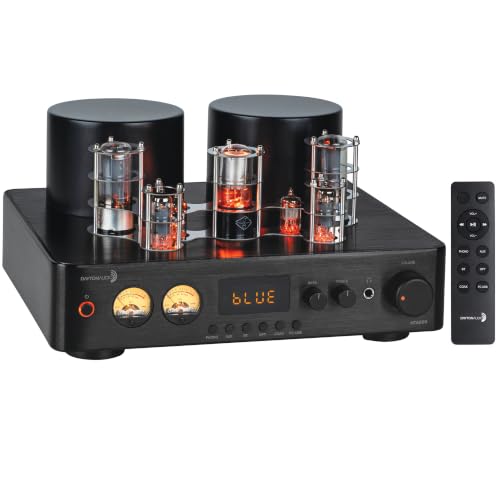
This guide is for vinyl listeners who also stream music, for buyers setting up a first serious stereo, and for anyone replacing a receiver with a simpler single box. Every amplifier below pairs a vacuum tube preamp stage with a solid-state power stage, includes a dedicated phono input, and appears on Amazon US with a verifiable listing. The details come from the Amazon product listings, so the comparison rests on what each maker actually publishes.
Quick Picks
As an Amazon Associate we earn from qualifying purchases.
| Product | Best for | Key spec from title |
|---|---|---|
| Dayton Audio HTA100 | Smaller rooms where vinyl and streaming share one shelf | 65 watts RMS per channel at 4 ohms |
| Dayton Audio HTA200 | Larger rooms that need more headroom for demanding speakers | 100 watts RMS per channel at 4 ohms |
| Douk Audio X1 | Desktop systems where a small chassis matters most | 160 watts per channel maximum at 4 ohms |
| Juson Audio JTA100 | Headphone listeners who also play vinyl | Headphone output for 16 to 600 ohm models |
| Juson Audio JTA200 | Big rooms with floor-standing speakers | 150 watts RMS per channel |
How to Choose
Match Power Output to Your Speakers and Room
Power output only means something next to speaker sensitivity and room size. A pair of efficient bookshelf speakers in a small room sounds full with modest power, while large floor-standing speakers in an open living room need far more headroom to stay clean at higher volumes. Read the wattage figure with the load it was measured at, because a number quoted at 4 ohms is higher than the same amplifier delivers into 8 ohm speakers. Check the speaker impedance before ordering, and leave some reserve so loud passages never push the amplifier into distortion. A bigger number is not automatically better, but too little power is a real limit.
Check the Phono Stage Against Your Cartridge
Most built-in phono stages in this class are made for moving magnet cartridges, which cover the large majority of turntables sold today. A moving coil cartridge needs far more gain, so it usually calls for a separate stage or a different amplifier altogether. Look for a ground terminal on the rear panel, because a turntable ground wire connected there keeps hum out of quiet passages. If the turntable already has a built-in preamp, it can connect to a line-level input instead, and the phono input stays free. Confirm the cartridge type first, since it decides whether the built-in stage is enough.
Count the Inputs You Will Actually Use
A phono input is the starting point, not the whole story. A television connects through optical or coaxial digital inputs, a computer through USB, and a phone through Bluetooth, so the amplifier should cover the sources already in the house rather than the ones in a catalogue photo. A subwoofer output matters for anyone planning a 2.1 setup later, and a headphone jack matters for late-night listening. Tone controls help when a room sounds bright or a recording sounds thin. Write down every source before choosing, then pick the amplifier whose rear panel already has a socket for each one.
Weigh Size, Weight, and Tube Upkeep
Hybrid amplifiers range from a compact desktop box to a chassis that weighs as much as a small child, so measure the shelf before ordering. Heavy units need a sturdy surface, and every tube amplifier needs air around it, because the tubes run warm and a closed cabinet shortens their life. Tubes are wear parts, and a model with common tube types is easier to keep running years from now than one with an obscure complement. A remote control sounds trivial until the amplifier sits across the room. Treat size, ventilation, and tube availability as part of the purchase, not as an afterthought.
The 5 Best Options
Dayton Audio HTA100
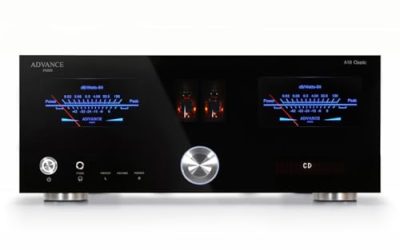
The HTA100 is the compact Dayton in this pair, and it suits a listener who wants tube character without a large chassis dominating the room. Its tube preamp stage warms the sound while the Class A/B power stage handles the heavy lifting, and the front panel VU meters give the unit a classic look that fits a vinyl setup. Bluetooth, a USB DAC, and digital inputs cover a phone, a computer, and a television, so the turntable is not the only source that gets attention. It is a sensible centrepiece for a first stereo built around records and streaming in equal measure.
Specs
- Hybrid design with a vacuum tube preamp stage and a Class A/B power stage
- Power output: 65 watts RMS per channel at 4 ohms
- Inputs: phono, USB DAC, optical, coaxial, Bluetooth 5.0, stereo RCA
- Subwoofer output and headphone output
- Front panel VU meters with bass and treble controls
- Dimensions: 14.02 x 13.39 x 9.45 inches
Best for: Smaller rooms where vinyl and streaming share one shelf.
Watch out for: Published power figures for this model disagree across sources, so confirm the 65 watt RMS figure against the listing before ordering.
Dayton Audio HTA200
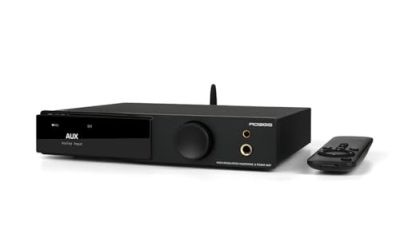
The HTA200 is the stronger Dayton, built for rooms and speakers that need more headroom than its smaller sibling gives. It keeps the same hybrid recipe of tubes in the preamp and a Class A/B output stage, but it adds a motorized volume knob, a remote, and a fuller set of inputs, including a dedicated AUX socket alongside the digital connections. The phono input, USB DAC, and optical input mean a turntable, a computer, and a television can all stay connected at once. It suits a living room system where vinyl is one source among several and the speakers are harder to drive.
Specs
- Hybrid design with a vacuum tube preamp stage and a Class A/B power stage
- Power output: 100 watts RMS per channel at 4 ohms
- Inputs: phono, USB DAC, optical, coaxial, AUX, Bluetooth 5.0
- Subwoofer output and headphone jack
- Motorized volume knob with remote control included
- Front panel VU meters with bass and treble controls
Best for: Larger rooms that need more headroom for demanding speakers.
Watch out for: The 200 watt figure in the listing title is the total across both channels, not 200 watts per channel.
Douk Audio X1

The Douk Audio X1 is the smallest amplifier here by a wide margin, and it is made for a desk or a small shelf where a full-size chassis simply does not fit. Its tube preamp stage feeds a Class D power stage, and the built-in phono stage is designed for moving magnet cartridges, so a turntable connects directly with no extra box. Bluetooth with aptX support, a stereo RCA input, and a subwoofer output cover the rest of a compact system. It is a practical choice for a bedroom or office setup where vinyl plays beside a computer and space is the scarcest resource.
Specs
- Hybrid design with a vacuum tube preamp stage and a TDA7498E Class D power stage
- Power output: 160 watts per channel maximum at 4 ohms
- Inputs: MM phono, Bluetooth 5.0 with aptX and aptX-HD, stereo RCA
- Subwoofer output for a 2.1 channel setup
- Frequency response: 20 Hz to 20 kHz
- Speaker impedance: 4 to 8 ohms
- Dimensions: 4.53 x 6.54 x 2.36 inches
- 32V/5A power supply included
Best for: Desktop systems where a small chassis matters most.
Watch out for: The phono stage is for moving magnet cartridges only, and no headphone output is listed for this model.
Juson Audio JTA100

The JTA100 stands out in this group for headphone listening, because its headphone output carries a high-low gain switch that covers models from 16 to 600 ohms. The hybrid layout pairs a tube preamp with a Class AB transistor power stage, and the input list is the widest here, with phono, optical, coaxial, PC-USB, AUX, and Bluetooth all on the rear panel. A subwoofer output and a remote round out a unit that works as the single hub for records, digital files, and late-night headphone sessions. It suits a listener whose system has to do everything rather than one thing well.
Specs
- Hybrid design with a vacuum tube preamp stage and a Class AB transistor power stage
- Power output: 200 watts RMS total
- Inputs: phono, optical, coaxial, AUX, Bluetooth 5.0, PC-USB
- Headphone output for 16 to 600 ohm models with high-low gain switch
- Subwoofer output and remote control included
- LED display with VU meter
- Dimensions: 12.99 x 12.44 x 6.65 inches
- Weight: 16.28 pounds
Best for: Headphone listeners who also play vinyl.
Watch out for: More than one ASIN has been linked to the 2025 version of this model, so confirm the listing matches the 2025 version before ordering.
Juson Audio JTA200
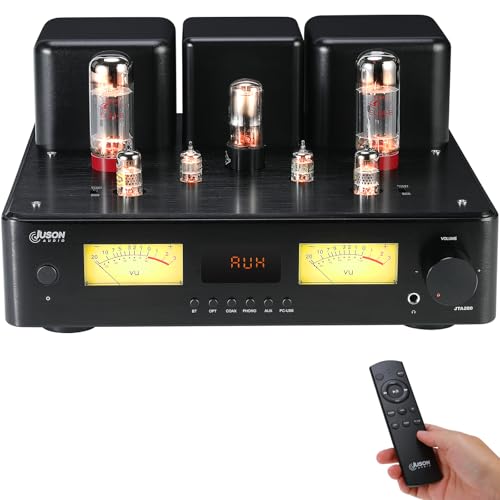
The JTA200 is the most powerful amplifier in this guide, and it is built for large rooms and demanding speakers that smaller hybrids cannot drive cleanly. Its hybrid Class AB design uses EL34 tubes with Toshiba output transistors, and Bluetooth 5.4 with aptX Adaptive and LDAC support keeps wireless sources sounding their best. The phono input sits alongside optical, coaxial, PC-USB, and AUX, so a turntable shares the chassis with every digital source in the house. A VU meter, LED display, remote, and headphone and subwoofer outputs complete a unit that behaves like a full hi-fi hub rather than a simple amp.
Specs
- Hybrid Class AB design with EL34 tubes and Toshiba output transistors
- Power output: 150 watts RMS per channel
- Inputs: phono, optical, coaxial, AUX, PC-USB, Bluetooth 5.4
- Headphone output and subwoofer output
- Remote control, VU meter, and LED display included
- Dimensions: 14.9 x 14.9 x 8.15 inches
- Weight: 32 pounds
Best for: Big rooms with floor-standing speakers.
Watch out for: At 32 pounds it needs a sturdy shelf, and the listing should be checked live before ordering because this model is the least widely documented of the five.
Which One Fits Your Situation
You Have a Small Room and a Modest Turntable
Pick the Douk Audio X1 when space is tight and the system lives on a desk or a small shelf. Its compact chassis, moving magnet phono input, and subwoofer output cover a bedroom or office setup without crowding it. If the speakers are larger or the room is bigger, the Dayton Audio HTA100 is the next step up, with more power and a fuller input set in a still manageable box.
You Listen Through Headphones as Much as Speakers
Pick the Juson Audio JTA100 for a system where headphones get as much use as speakers. Its gain switch covers a wide range of headphone models, and the phono input keeps vinyl in the same setup. The Dayton Audio HTA200 is the alternative when headphone use is occasional and speaker power matters more, since it trades the gain switch for stronger output.
You Run Large Speakers in a Large Room
Pick the Juson Audio JTA200 when floor-standing speakers and an open room demand real headroom. Its 150 watts RMS per channel and EL34 tube stage drive demanding loads without strain. The Dayton Audio HTA200 is the fallback for a large room on a tighter footprint, with 100 watts RMS per channel and a remote for everyday control from the sofa.
You Want One Box for Vinyl, TV, and Phone
Pick the Dayton Audio HTA200 for a living room where a turntable, a television, and a phone all feed the same speakers. Its phono input, optical input, and Bluetooth cover all three without swapping cables. The Juson Audio JTA100 is the alternative when a computer joins the mix, since its PC-USB input adds a direct digital path for a desktop.
Common Mistakes
- Plugging a turntable into a line-level RCA input instead of the phono input, which leaves the sound quiet and thin because the phono stage is bypassed.
- Assuming a built-in phono stage supports a moving coil cartridge, when most models in this class are made for moving magnet cartridges only.
- Reading a headline wattage figure as per-channel power, when it is often the total across both channels or a maximum at 4 ohms.
- Forgetting the turntable ground wire, which lets a steady hum into quiet passages even when everything else is connected correctly.
- Placing a heavy tube amplifier on a flimsy shelf or inside a closed cabinet, where heat builds up and ventilation suffers.
Frequently Asked Questions
Do all five amplifiers have a built-in phono stage?
Yes. Every amplifier in this guide has a dedicated phono input, so a turntable with a moving magnet cartridge connects directly with no separate phono stage. Check the cartridge type first, because a moving coil cartridge usually needs a separate stage with higher gain. If the turntable has its own built-in preamp, it can use a line-level input instead.
Can I connect a turntable with a built-in preamp to one of these amplifiers?
Yes. A turntable with a built-in preamp sends a line-level signal, so it connects to the AUX or stereo RCA input rather than the phono input. Set the turntable preamp to line mode first, then use a standard RCA cable. The phono input stays free for a future turntable without a built-in preamp.
What makes an amplifier a hybrid?
A hybrid amplifier splits the work between vacuum tubes and transistors. The tubes sit in the preamp stage, where they shape the tone, while transistors or a Class D chip in the power stage drive the speakers. That combination aims for tube character with the power, efficiency, and reliability of solid-state output, without the size and heat of an all-tube design.
Do I still need a separate DAC or streamer with one of these?
Usually not. Every model here includes Bluetooth for a phone, and most add optical, coaxial, or USB inputs for a television or computer. A separate DAC only helps when the built-in conversion or the available inputs fall short of a specific source. Check the input list against the devices already in the house before adding another box.
More from Amazon
Programs that pair well with the guide above. Offers and eligibility are set by Amazon and may change.
Free shipping on eligible items, Prime Video and more. Eligible new members can start with a free trial.
Start a Prime free trialA Prime membership for ages 18-24 with a trial period. Eligibility is set by Amazon.
See Prime for Young AdultsAudiobooks and podcasts to listen to on the go. Eligible new members can start with a free trial.
Try Audible freeAd-free music streaming. Eligible new subscribers can start with a free trial.
Try Music Unlimited freeAs an Amazon Associate we earn from qualifying purchases.





Write Your Review
No reviews yet. Be the first to share your experience!