

Key takeaways
- Compare the best motorcycle first aid kits for road trips and touring, with size, organization, contents, and mounting tips for saddlebags and tank bags.
- Top Pick: MyMedic MyFAK
- Runner-up: EVERLIT 250 Pieces Survival First Aid Kit
- Also consider: Be Smart Get Prepared 110 pc First Aid Kit
A first aid kit earns its space on a motorcycle only if it is small enough to carry on every ride, organized enough to use with gloves on or in poor light, and stocked for the minor problems riders actually face far from home. Scrapes from a parking lot tip over, a cut from roadside luggage repairs, and blisters on a long walking detour are the everyday cases. A well chosen kit also carries basic supplies for stabilizing a more serious roadside situation until professional help arrives, without replacing training or emergency services.
Motorcycle luggage space is limited, so kit design matters as much as the supply list. Hard cases protect contents but can be bulky in a soft saddlebag, while soft pouches with labeled compartments flex into odd spaces and open flat for quick access. Groups can carry a fuller kit than a solo commuter. This guide compares five established kits across size, organization, and contents, so the right one can be matched to a tank bag, tail bag, or saddlebag.
As an Amazon Associate, we earn from qualifying purchases.
Quick answer
For most touring riders, the EVERLIT 250 Pieces Survival First Aid Kit offers the fullest mix of everyday supplies and emergency extras in a MOLLE pouch that suits a saddlebag. Riders wanting a premium organized system should choose the MyMedic MyFAK, the RHINO RESCUE kit suits trained riders, and minimalists can carry the compact Protect Life First Aid Kit.
MyMedic MyFAK

The MyMedic MyFAK is a premium, modular kit built around labeled categories and a folding bag that opens to show supplies in organized sections. The standard configuration is listed with 132 pieces covering bandages, gauze, antiseptic items, burn and blister care, and trauma oriented supplies such as a tourniquet and pressure dressing in many configurations, though exact contents vary by version and buyers should confirm the current list before ordering. That layout is the main advantage on the road, because a rider or riding partner can find the right category quickly without emptying the whole bag onto the shoulder of a highway.
Many versions use a MOLLE compatible back panel, which helps the kit mount to luggage or the inside of a top case lid, and the construction is noticeably sturdier than basic zip pouches. Size is the trade off, since the standard MyFAK takes meaningful room in a small tank bag and suits a saddlebag, tail bag, or top case better. For riders who tour two up or in groups, the MyFAK is the most capable and best organized option here. Riders should still add personal essentials, check expiration dates each season, and take basic first aid training.
EVERLIT 250 Pieces Survival First Aid Kit

The EVERLIT 250 Pieces Survival First Aid Kit combines a large count of first aid supplies with survival tools in a MOLLE compatible EMT pouch. Listings describe bandages, dressings, wipes, tape, and shears alongside extras such as an emergency blanket and a whistle, aimed at camping, hiking, and vehicle use. For touring, that blend is practical at fuel stops and during unexpected roadside waits alike.
The pouch format suits soft luggage well. It compresses into a saddlebag or tail bag, the MOLLE webbing gives options for securing it so it does not migrate under other gear, and internal compartments keep small items from becoming a loose tangle. With 250 pieces it is not the smallest kit here, so riders with very limited space should check its packed dimensions against the intended bag before relying on it for a small tank bag setup. Value and breadth are the reasons to choose it. Buyers should still look past the headline number, confirm that the categories match their needs, replace used items promptly, and store the pouch where it can be reached without unpacking the entire motorcycle.
Be Smart Get Prepared 110 pc First Aid Kit
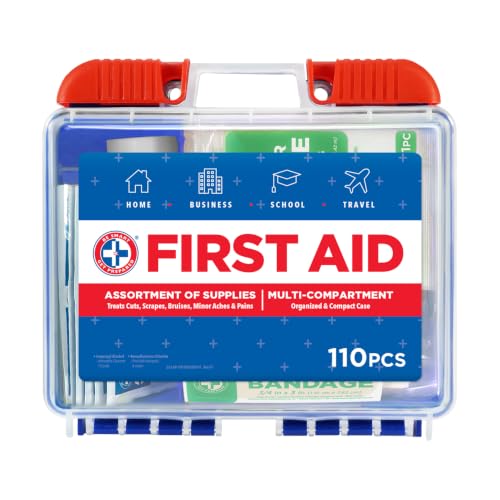
The Be Smart Get Prepared 110 pc First Aid Kit is a straightforward general purpose kit organized around a simple clean, treat, and protect approach for minor cuts and scrapes. The soft case holds bandages in assorted sizes, gauze, antiseptic and cleansing items, tape, and other basics for travel and outdoor use, in a format that is easy for any rider or passenger to understand without studying a complicated trauma layout. For many touring days, those basics are exactly what gets used, from a nicked finger during a roadside adjustment to a scraped knee at a campsite.
Its compact soft case fits a tank bag or the top of a saddlebag, where it can be reached first without digging past tools and rain gear. The trade off is scope, since this is a minor injury kit rather than a trauma focused system, so riders traveling far from help may want to supplement it with additional supplies recommended by a first aid course, and with a separate emergency blanket if one is not already carried elsewhere on the bike. For commuters and new riders, it is an easy, restock friendly starting point small enough to carry on every ride.
RHINO RESCUE IFAK Trauma Kit

The RHINO RESCUE IFAK Trauma Kit is the trauma focused option in this group, supplied in a rugged MOLLE pouch and built around bleeding control categories. Listings for this configuration describe items such as a tourniquet, emergency bandages, compressed gauze, chest seals, an emergency blanket, gloves, and shears, with exact contents varying by version, so the current packing list should be confirmed before purchase. Those categories go beyond a basic bandage kit and are intended for serious roadside emergencies until professional responders take over.
That focus comes with a responsibility buyers should take seriously. Trauma supplies are only appropriate for someone who has learned to use them, and a short bleeding control or first aid course is strongly advisable before carrying this style of kit. The pouch itself is compact and durable for motorcycle use, packs securely in a tail bag or saddlebag, and is designed for fast access rather than for browsing through dozens of small everyday items. Riders who tour in remote areas, ride in groups that have agreed to carry a shared trauma kit, or already hold relevant training will get the most from this choice. It pairs well with a smaller everyday kit for minor problems.
Protect Life First Aid Kit

The Protect Life First Aid Kit, in its 160 piece configuration, is a compact soft case kit aimed at travel, car, home, camping, and hiking use. Contents typically include assorted bandages, gauze, antiseptic items, tape, scissors, tweezers, an emergency blanket, and other small essentials arranged in clear internal compartments, which makes it easy to see what is available and what needs replacing after a trip. The case is light and flexible, so it slips into a tank bag or a corner of a top case without forcing a luggage rethink.
For solo riders and minimal packers, that size is the whole appeal. A kit that is always on the bike beats a larger kit left in the garage, and this one covers the minor cuts, scrapes, and irritations that make up the great majority of roadside first aid needs. It is not a trauma system, so riders heading into remote regions should treat it as the everyday layer and consider adding a separately chosen emergency layer. For day trips, commuting, and light touring, it is the most carry friendly balance of coverage and size in this lineup.
How to choose
Start with space and access. Measure the tank bag, tail bag, or saddlebag pocket where the kit will live, then choose a kit that fits without displacing rain gear or tools and can be reached without fully unpacking. A kit buried under luggage will not help in a hurry, so many riders keep it in an outside pocket or on top of a saddlebag load, secured so it does not shift while riding.
Next, match contents to training and trip type. Everyday kits built around bandages, gauze, antiseptic items, and blister care serve most riders best, while trauma focused pouches make sense only alongside relevant training and group planning. Check organization as carefully as piece count, because labeled compartments and a bag that opens flat save time and stress, and headline piece counts often include many small bandages rather than broader capability. Finally, plan for maintenance. Choose a kit with refills that are easy to buy, check expiration dates at least once a season, replace anything used as soon as the trip ends, and consider weather protection, since a water resistant case helps supplies survive a wet tour.
Who should skip
Skip carrying a large trauma kit if no one in the riding group has training to use its contents, because unused complexity adds bulk without adding safety, and a well understood basic kit is the better choice in that case. Skip the biggest kits entirely if luggage space is limited to a small tank bag, since forcing an oversized pouch in usually means leaving it behind on short rides. Skip bargain kits with unclear contents lists or no refill path, because a kit that cannot be checked and restocked reliably should not be trusted on a long tour. Also skip relying on any kit as a substitute for a phone, emergency contacts, and a plan for getting help in areas without signal.
FAQ
Where is the best place to carry a first aid kit on a motorcycle?
The best place is a spot that stays dry, does not crush the contents, and can be reached without unpacking the whole bike, such as the top of a saddlebag, an outside luggage pocket, a tail bag, or a top case.
How often should a motorcycle first aid kit be checked?
A sensible routine is a full check at the start of each riding season, a quick check before any long tour, and an immediate restock after anything is used. During those checks, look at expiration dates, replace damp or damaged packaging, confirm scissors, tape, and closures still work, and make sure personal additions are present and in date before the kit goes back on the bike.
Should a touring kit include trauma supplies?
That depends on training, group size, and how remote the route is. Trauma category supplies are designed for serious emergencies until professional help arrives, and they are most appropriate when the carrier has completed relevant first aid or bleeding control training. Riders without that training are usually better served by a clear, well stocked everyday kit, a charged phone, and a plan for reaching emergency services quickly.
Can one kit be shared between two motorcycles?
Yes, provided it is moved deliberately as part of a pre ride routine and never assumed to be on the other bike. A compact soft case kit transfers most easily between tank bags and top cases, though two regular riders often find a basic kit on each motorcycle simpler and safer.
Final verdict
For most riders, the EVERLIT kit offers the broadest everyday and emergency coverage in a pouch that suits touring luggage, while the MyMedic MyFAK is the premium pick for organization and group touring. The RHINO RESCUE kit serves trained riders who want a trauma focused layer, and the Be Smart Get Prepared and Protect Life kits keep things compact, simple, and easy to carry on every ride, which is where a first aid kit does its real work.
More from Amazon
Programs that pair well with the guide above. Offers and eligibility are set by Amazon and may change.
Free shipping on eligible items, Prime Video and more. Eligible new members can start with a free trial.
Start a Prime free trialA Prime membership for ages 18-24 with a trial period. Eligibility is set by Amazon.
See Prime for Young AdultsAudiobooks and podcasts to listen to on the go. Eligible new members can start with a free trial.
Try Audible freeAd-free music streaming. Eligible new subscribers can start with a free trial.
Try Music Unlimited freeAs an Amazon Associate we earn from qualifying purchases.



Write Your Review
No reviews yet. Be the first to share your experience!